


New Delhi:
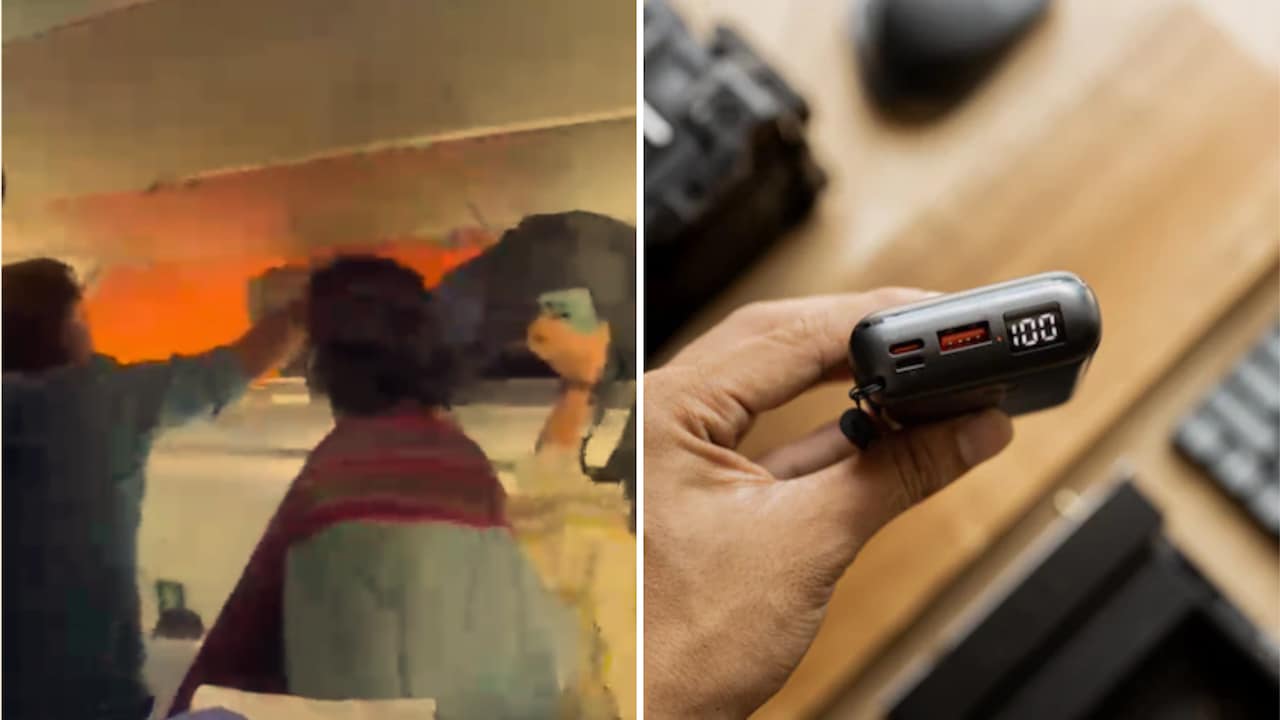
An IndiGo flight from Delhi to Chennai was diverted to Hyderabad as an urgent measure after a power bank kept in the overhead luggage compartment caught fire, triggering panic. The cabin crew of flight 6E 6115 used a fire extinguisher to douse the fire, and the aircraft landed safely in Hyderabad, but this has again brought into focus the risks associated with carrying such gadgets.
A 36-second clip from inside the cabin showed passengers trying to put the fire out using their bags at first, but the angle is not clear about who eventually put it out.
The airline issued a statement that read: “IndiGo flight 6E 6115, operating from Delhi to Chennai on October 11, 2026, was diverted to Hyderabad after smoke was detected from a customer’s personal electronic device. The cabin crew responded promptly and the situation was brought under control… An alternate aircraft has been arranged to continue the journey to Chennai.”
On the IndiGo website, its baggage policy states that power banks and spare/loose lithium batteries are permitted only in hand baggage. The policy states that they “must remain within the passenger’s personal reach at all times”, such as under the seat, in the seat pocket, or carried on one’s person.
It adds that they “must not be stowed in overhead compartments or checked baggage”.
In this case, the video clip showed the fire was in the overhead compartment.
Under the policy, IndiGo may allow a passenger to carry a maximum of two spare lithium-ion batteries, including power banks, rated up to 100 watt-hours (Wh), subject to security clearance at the airport. A standard 100 Wh battery works out to roughly 27,000 milliampere-hours (mAh). It was not clear what the capacity of the power bank in this case was, though consumer-grade ones are usually 10,000 to 20,000. Batteries rated above 100 Wh and up to 160 Wh are also allowed, again to a maximum of two, “only if such are used for portable medical devices”. Carrying them requires approval from IndiGo at the check-in counter.
The airline’s policy states that power banks must be packed in their original retail packaging or in separate plastic bags, with terminals “taped and insulated to prevent short circuit”, and they must not be recharged or be used to charge another device while on board the aircraft. Also
The rules apply to both domestic and international flights.
The Directorate General of Civil Aviation (DGCA) also issued a Dangerous Goods Advisory Circular in November 2025 prohibiting the use of power banks to charge devices during flights, including through aircraft seat power outlets. The circular also mandates that power banks and spare batteries must not be stored in overhead compartments, as fires there are harder to detect and contain. The IndiGo policy toes this line.
The biggest concern is a situation called thermal runaway, where a battery overheats rapidly and can catch fire.
The Sunday incident comes months after another IndiGo flight was evacuated on landing in Chandigarh on March 5, 2026, after a passenger’s power bank caught fire. DGCA said the power bank had been kept in a seat pocket at the time. Two fire extinguishers were used to control the fire, and all passengers were evacuated safely and escorted to the terminal.
After the Chandigarh incident, Vandana Singh, Chairperson (Aviation Cargo), Federation of Aviation Industry in India (FAII), told NDTV that a ban was not a feasible answer. “Instead of an outright ban, the aviation industry should focus on strengthening existing safety protocols. This includes strict adherence to cabin-only carriage, clear limits on battery capacity, and enhanced passenger awareness regarding proper handling and storage,” she said at the time.
“Airlines must also ensure that crew members are well-trained to respond swiftly to any battery-related incidents onboard,” she added.


