


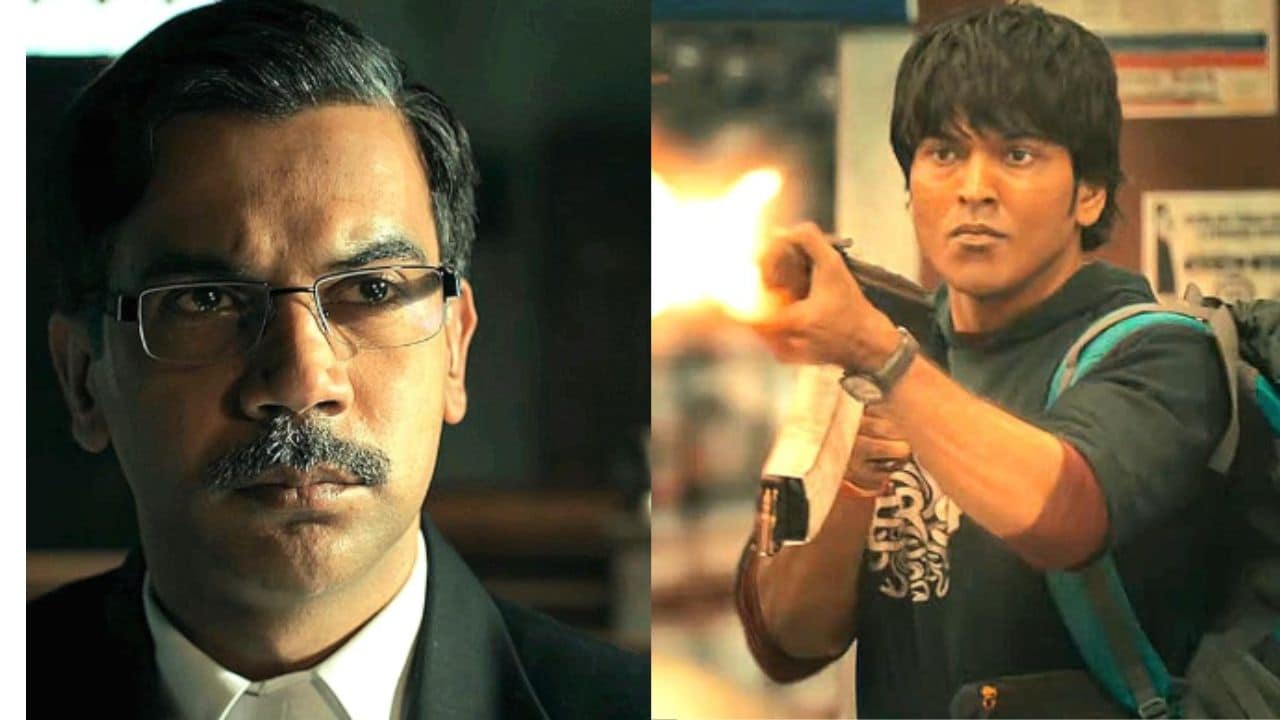
The tagline suffixed to the title – it reads “The Untold Story of Ujjwal Nikam” – reveals would have us believe that Prahaar, produced by Dinesh Vijan of Maddock Films, written by Sumit Roy and helmed by director-cinematographer Avinash Arun, is out to narrate a tale that simply had to be told.
That supposition might be open to debate but consider this: while dramatised depictions of the 26/11 Mumbai terror attacks and its immediate aftermath have often found their way to the screen, the legal process that led to the conviction and execution of the sole surviving terrorist, Ajmal Kasab, has not.
The director and the screenwriter of Prahaar, moving in lockstep, do their best to whip up urgency around the trial and the resolve of one lawyer to bring Kasab to justice without trampling upon the latter’s right to a hearing.
A certain degree of grandstanding is inevitable in a narrative such as this. To the credit of the makers of Prahaar, they do not get carried away.
The film does not stray too much from the real-life tale of a public prosecutor who shot to national fame with his single-minded pursuit of the power granted to him by the law of the land to avenge the dastardly acts of terrorists from across the border.
Rajkummar Rao makes more than a fair fist of fleshing out Ujjwal Nikam who, when the film opens is seen celebrating his win in the 1993 Mumbai blasts case.
The lead actor probably does not disappear as completely into the character as he did when he played another real-life lawyer in Shahid, but he comes pretty close. He stays remarkably true to the real-life inspiration.
On the other hand, the multiple lawyers who defended Ajmal Kasab at different points of the 26/11 trial are condensed into one fictionalized figure, a Muslim lawyer (Sikandar Kher) aware that he is fighting a battle that has already been lost because all the recorded and widely publicized evidence point towards his client’s culpability.
The defence lawyer faces the ire of the people. Prahaar does not lose sight of the fact this advocate, too, is only doing a job that is well within the provisions of the legal system.
That he belongs to India’s principal minority community only makes his position that much trickier – a fact that the film acknowledges without shying away from the complexities inherent in the situation.
Nikam, played with the requisite restraint by Rajkummar Rao, is inevitably projected as a patriotic and untiring advocate committed to his mission, but the overall tone of Prahaar is marked by equanimity.
The protagonist is far more committed to upholding the law than pandering to the understandable wave of public anger against the sole surviving perpetrator of the 26/11 Mumbai terror attacks. “Justice delayed is justice denied but justice hurried is justice buried,” says Nikam.
Indeed, more than lionizing an individual for simply doing his duty as Hindi films often do, Prahaar showcases the efficacy of India’s judicial system that ensures that even an accused with no real escape route isn’t sent to the gallows without due process.
It helps that Rao is now a past master at playing real-life personages with complex undertones. He never attempts to get ahead of the script and scream “I’m larger than life”.
This despite the fact Nikam is a man on a short fuse. When the going gets tough, he plays tough. That aspect of the character fuels almost everything that is written for him in the script by way of actions and words.
Nikam has to deliver lines that border on the declamatory, but the script makes it a point not to let the ’emotions’ of the trial of a terrorist overwhelm the logic of a lawyer’s considered submissions and arguments in court.
Rao’s steady performance is the backbone of Prahaar, but there is little in the film that is more dazzling than the transformation of Lalit Prabhakar (who audiences saw earlier this year in the stormy relationship drama Toh Ti Ani Fuji) into Ajmal Kasab. He does a first-rate, stunningly convincing impersonation.
What the screenplay does is humanize Kasab to a considerable extent without in any way trying to condone the diabolic quality of the act he and his accomplices committed on one Mumbai’s darkest ever nights. The film recognizes that the man in the dock has been fed on a staple of venom – he is an indoctrinated, misguided lad ready to go on a killing spree.
Avinash Arun’s approach to the story of Ujjwal Nikam benefits from the eye for framing and blocking precision that he possesses as a cinematographer. He does not use the camera to influence how we view the courtroom drama and the individuals involved in it.
He uses it to achieve a combination of objective distance and studied intimacy. That, more than anything else, sets Prahaar apart from any 26/11 film that Bollywood has made.
The latter attribute is brought in via the portrayal of Nikam’s domestic life, which might seem to some like avoidable digression. But it isn’t. It only helps the audience understand Nikam the man.
Wamiqa Gabbi plays his wife, Jyoti, a woman he spends little time with, and Ritvik Sahore is cast as his son, Aniket, who, too, is deprived of his father’s presence during his growing up years.
The 26/11 terror attack takes place when Nikam is preparing for his daughter’s marriage. His life as a lawyer instantly takes precedence over everything else, which explains why he has drifted apart from his family.
The family dynamics manifest themselves at times in the protagonist’s professional moves, necessitated by circumstances that serve to emphasise that no great deed is ever attained without navigating little slippery stepping stones.
Prahaar – a celebration of the power of the proverbial long arm of the law – retains its balance almost all through. It isn’t reduced to a series of flashy hammer blows. The blows do find their mark but that isn’t all there is to the film.
Jaideep Ahlawat makes an impact in a brief role of a Pakistani lawyer who crosses swords with Nikam. The character is compelled to yield ground but is also permitted occasionally to have his say.
Prahaar does not harp on the horrors of 26/11 but funnels its anger and outrage into one courtroom sequence involving a 10-year-old victim of terrorism. It drives home the toll it took on innocents.
Prahaar stays focused on its avowed purpose, which ensures that it stays on course for the most part – not a mean feat at all.


