


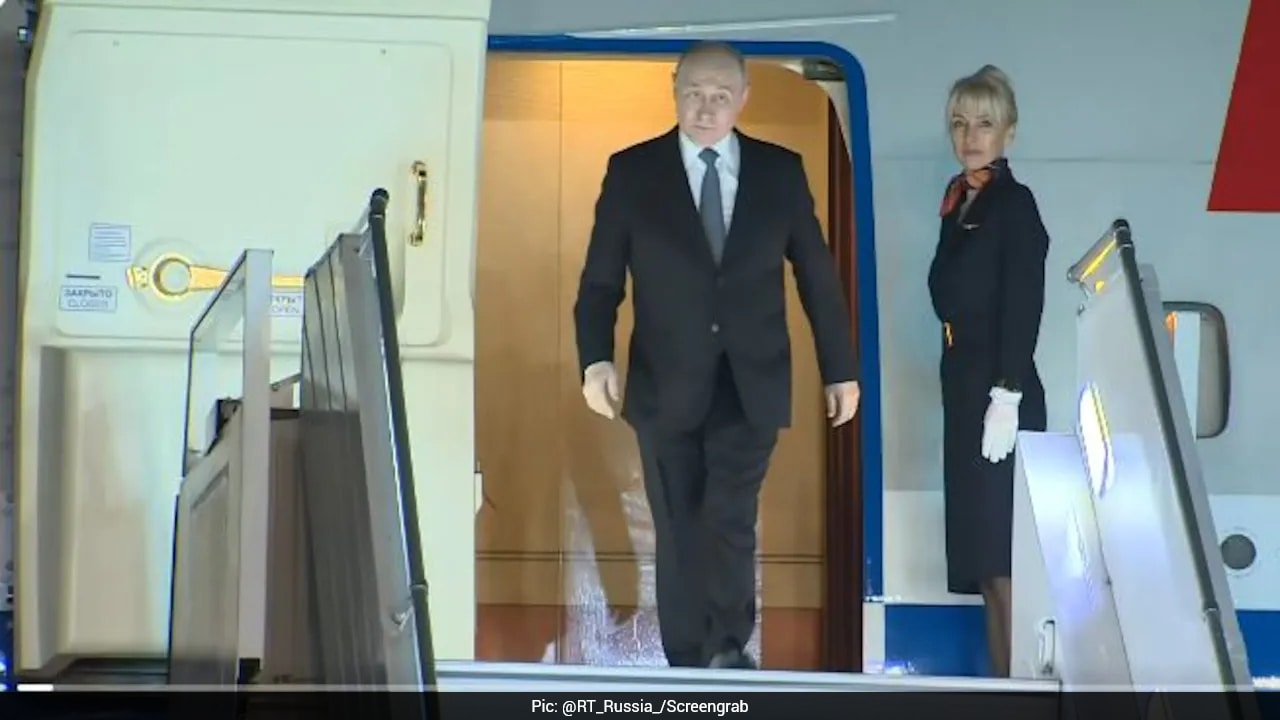
Russian President Vladimir Putin has arrived in New Delhi to participate in the BRICS summit and hold bilateral talks with Prime Minister Narendra Modi on boosting cooperation in the defence, energy and technology sectors.
PM Modi and Putin last met on the sidelines of the Shanghai Cooperation Organisation summit in Bishkek last week. During their meeting, the Prime Minister urged the Russian leader to shift from an “endless war towards the end of war”, referring to the Russia-Ukraine conflict that began five years ago after Moscow’s full-scale invasion.
“We have to move from a situation of ‘endless war’ to ‘end of war’… It is humanity’s wish that the end of this war happens as soon as possible,” PM Modi said.
This meeting, scheduled for Friday, is expected to explore topics of strategic importance to both nations, including defence projects such as BrahMos missile upgrades.
#WATCH | Delhi: Russian President Vladimir Putin arrives in India ahead of BRICS Summit 2026. During his visit, he will also hold talks with PM Narendra Modi and have a series of bilateral meetings. pic.twitter.com/1Ji3cgn5yk
— ANI (@ANI) September 10, 2026
Kremlin spokesperson Dmitry Peskov said earlier this week that New Delhi and Moscow were exploring upgrades to the BrahMos missile. He added that Russia was committed to fulfilling its remaining S-400 system deliveries and discussing the proposed supply of Su-57 fighter jets.
Read: BRICS At 20: How Big It Is, And Why It Matters To India And The World
He also said the two sides would hold negotiations on India’s plan to set up new civil nuclear reactors.
Putin will also attend the two-day BRICS summit that New Delhi is hosting. He will address the Plenary Session of the annual BRICS Business Forum. After that, he will visit the Innoprom exhibition with PM Modi.
The Russian President will also hold meetings with other international leaders, including South African President Cyril Ramaphosa, Malaysian Prime Minister Anwar Ibrahim, and Egyptian President Abdel Fattah el-Sisi, on the sidelines of the summit. However, no separate full-format meeting has been scheduled between him and Chinese President Xi Jinping, who will be visiting India after a long gap of seven years.
The Chinese leader and PM Modi will hold talks on Saturday evening, on topics including trade and investment. They are expected to review the overall situation along the Line of Actual Control (LAC).
PM Modi will also hold talks with Iranian President Masoud Pezeshkian on Friday.
The BRICS Summit
India is hosting the BRICS summit in its capacity as the current chair.
India’s BRICS chairship is guided by the theme: ‘Building for Resilience, Innovation, Cooperation and Sustainability’.
Egyptian President Abdel Fattah el-Sisi, South African President Cyril Ramaphosa, Indonesian President Prabowo Subianto, Malaysian Prime Minister Anwar Ibrahim, Abu Dhabi Crown Prince Mohamed bin Zayed Al Nahyan, and Ethiopian Prime Minister Abiy Ahmed Ali will also attend the summit.
UN Secretary-General Antonio Guterres, WTO Director-General Ngozi Okonjo-Iweala, WHO chief Tedros Adhanom Ghebreyesus, New Development Bank (NDB) President Dilma Rousseff and Asian Infrastructure Investment Bank chief Zou Jiayi will also attend the BRICS summit.
BRICS was originally composed of Brazil, Russia, India, China, and South Africa. In 2024, it expanded to include Egypt, Ethiopia, Iran, the UAE, and Saudi Arabia. Indonesia joined the grouping last year.
Enhancing cooperation in trade, investment, connectivity, and high technology will be on the agenda during the summit.
The grouping will also focus on strengthening cooperation in areas such as health, agriculture, food, energy, disaster risk reduction, and supply chains.
During its chairship, India aims to steer the grouping to champion the Global South’s core developmental priorities.
According to the Ministry of External Affairs (MEA), under New Delhi’s chairship, over 350 meetings and high-level engagements have been held in over 25 cities across the country.
The summit will begin at 2:35 pm on Saturday. It will conclude with the release of the New Delhi Declaration.
(With inputs from PTI)


