


On New Year’s Day in 1814, inside the Tuileries Palace in Paris, Napoleon Bonaparte faced opposition from his own legislature. The armies of the Sixth Coalition were crossing the Rhine and entering French territory. Instead of calming the politicians who criticised his military decisions, the French Emperor attacked them. He reminded them that true authority did not come from government buildings or symbols of power.“What is the throne?” Napoleon asked. “A piece of wood covered with velvet.” He explained that the throne itself had no real power. It was only an object. The power came from people believing in it. “What gives it power is the imagination of men.”Napoleon understood that political power is not something physical. It cannot be created, stored, or touched. It exists because people collectively believe in a ruler, an institution, or an idea. When people stop believing, the symbols of power lose their meaning. A throne becomes just wood and cloth. An empire can collapse when public confidence disappears.
The theater of the first empire
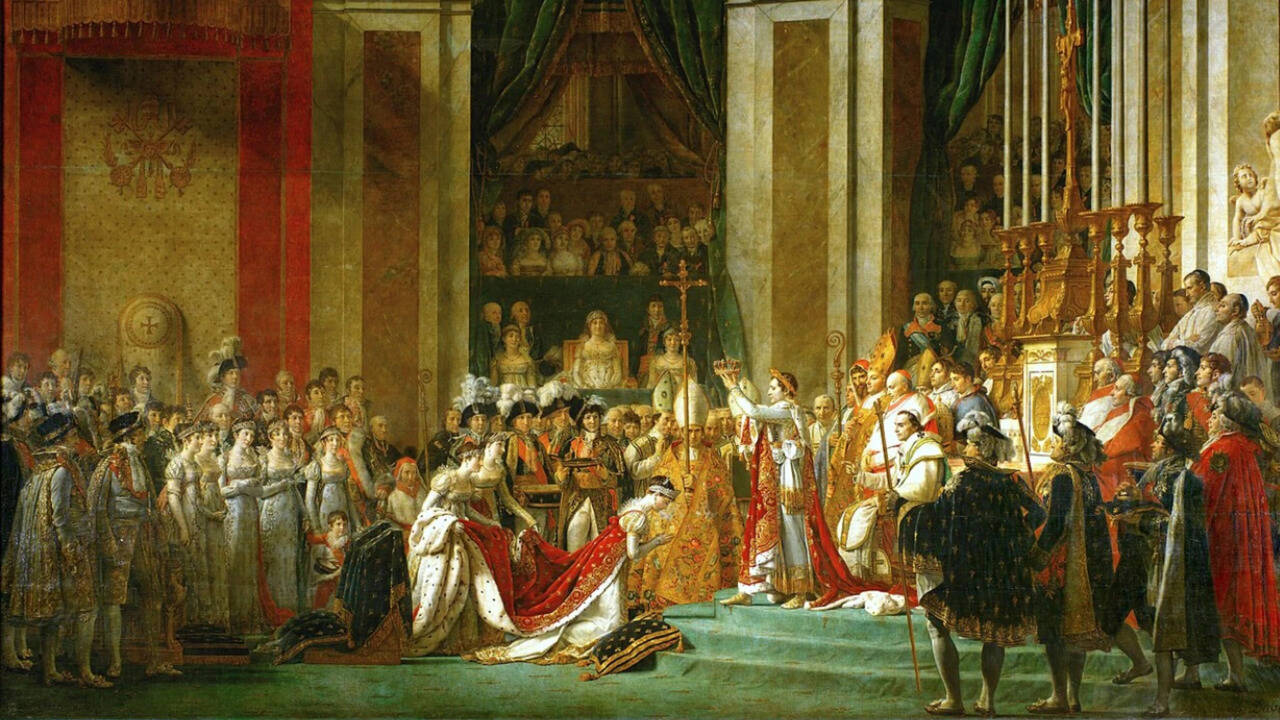
Napoleon’s words showed that he understood how fragile his own power was. Unlike the Bourbon kings before him, Napoleon did not inherit a royal throne. He had no ancient family claim to rule. He had to create his own legitimacy through military victories, legal reforms, and carefully planned public displays.His coronation in 1804 at Notre-Dame Cathedral was a powerful example of political theater. Napoleon ordered the artist Jacques-Louis David to paint the ceremony. The painting showed Napoleon placing the crown on his own head instead of receiving it from Pope Pius VII. This was a clear message: his authority came from himself and his achievements, not from the Church or old royal traditions.By January 1814, that image of strength was beginning to break. The failed invasion of Russia had damaged the reputation of the French army. As enemy forces moved closer to France, the Corps législatif demanded peace talks and greater political freedoms. Napoleon rejected their demands and shut down the assembly.He knew that his rule depended on people seeing him as a strong protector. If that belief disappeared, his throne would become exactly what he described: only wood covered with velvet.
The philosophy of shared belief
Napoleon’s idea connects with older political theories. The English philosopher Thomas Hobbes argued in Leviathan (1651) that governments exist because people agree to accept the authority of a ruler in exchange for order and protection.Later, Scottish philosopher David Hume argued that governments depend mainly on public opinion. Even powerful rulers cannot govern through force alone. They need people to believe that their authority is legitimate.Napoleon understood this idea in practice. He knew that armies, laws, and institutions require a shared belief to function. A ruler needs a story that people accept. When citizens believe in a leader, a nation, or a constitution, that belief creates real power. People follow laws, pay taxes, and fight wars because they accept the system around them.Palaces, crowns, and government buildings are only symbols. Their power comes from the ideas people attach to them.
Modern thrones and shared beliefs
The idea that imagination creates value still shapes the modern world. Money is one example. A banknote is simply paper with printed designs. It has no natural value by itself. It can only buy goods because millions of people believe it has value.When trust in a currency disappears, its value can collapse quickly. The Zimbabwean dollar in the late 2000s and the Venezuelan bolívar in the 2010s showed how money can lose its power when public confidence disappears.Companies also work through shared belief. Large corporations and luxury brands are often valued far beyond their physical buildings, machines, or products. Investors are buying into a story about future success, reputation, and influence.Politics works in the same way. In a stable democracy, people accept election results because they believe in the fairness of the system. Government buildings are only structures made of stone and concrete. Their authority exists because people collectively agree to respect the laws and institutions they represent.
The end of the illusion
Napoleon eventually experienced the collapse of his own belief system. When he was forced to abdicate in 1814, many of his own commanders refused to continue fighting. They realized that the French people no longer supported endless war for the empire.The image of Napoleon’s power had faded. The throne had lost its meaning.However, Napoleon understood that while his empire could disappear, his legend could survive. During his exile on the island of Saint Helena, he spent his final years shaping his story through his memoirs, especially the Mémorial de Sainte-Hélène, written with Emmanuel-Auguste-Dieudonné de Las Cases.This final effort succeeded. The image of Napoleon as a revolutionary hero and military genius remained powerful long after his defeat. Years later, this memory helped his nephew, Louis-Napoléon Bonaparte, gain support in France. In 1848, he became president of the French Second Republic and later declared himself Emperor Napoleon III.The original throne had disappeared, but the idea of the throne survived. Napoleon’s greatest insight was that power does not live in objects. It lives in the minds of the people who believe in it.



