


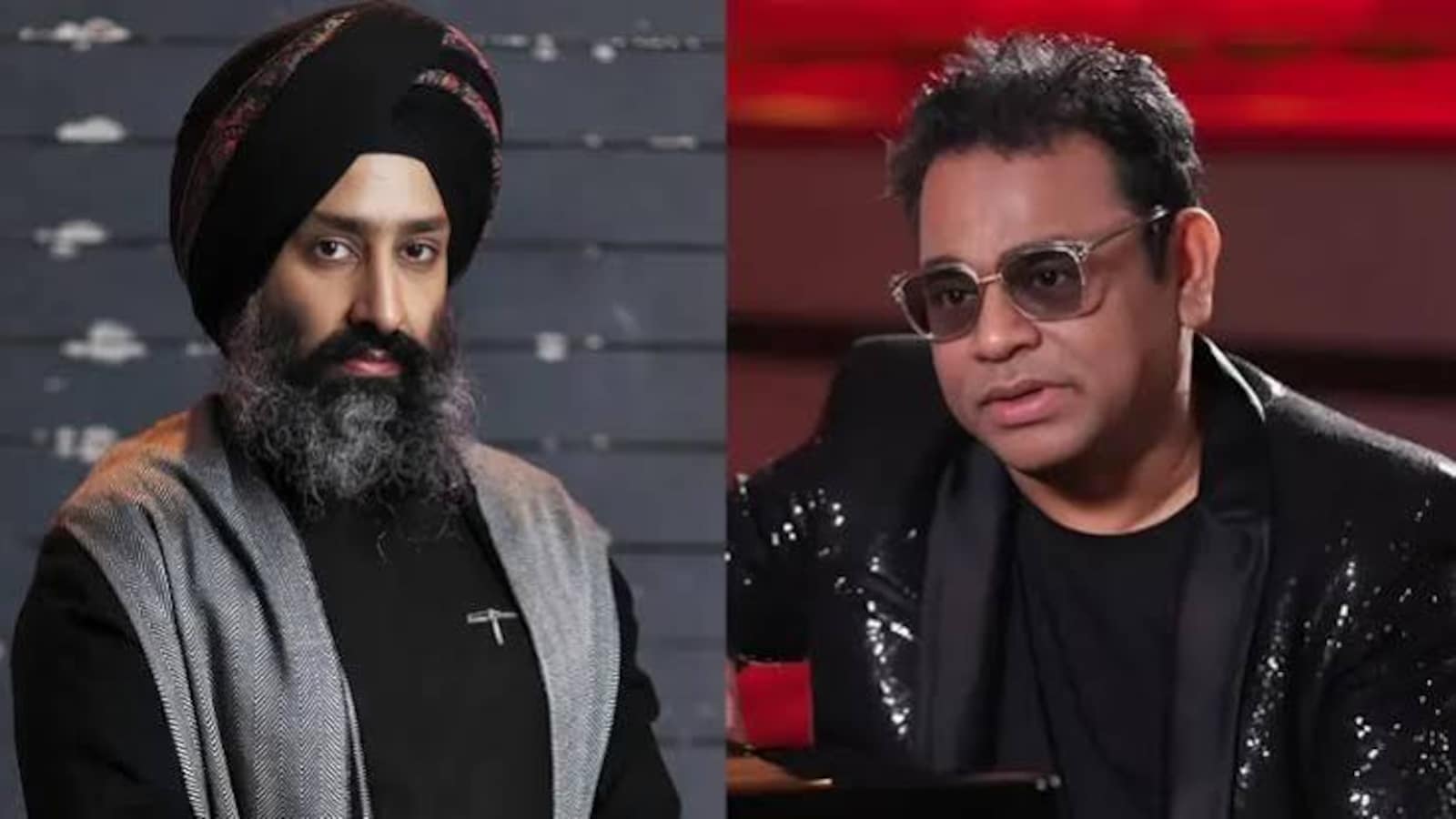
Months after composer-singer A. R. Rahman’s “communal” remark, Tere Bin and Bulla Ki Jana singer Rabbi Shergill said Rahman’s comment could not be dismissed. Citing examples of ‘propaganda’ films like The Kashmir Files and The Kerala Story, Shergill said Rahman’s concerns might hold ground in India’s changing political scenario.
‘How can you deny communal angle?’
Speaking in an interview with The Life Savers Show, Rabbi said he was unaware of the exact context in which Rahman made the statement, but he did not want to dismiss his concerns.
“I don’t know in what context he said it, but how can you deny that right now? How can you deny the communal angle?” Rabbi said.
He clarified that he could not specifically comment on whether such bias exists within the music industry because he is not based in Mumbai.
“I can’t specifically say it’s there in the music industry because I don’t live in Mumbai or interact with those people daily. But a lot of film financing has gone into what many would call propaganda cinema.”
Referring to films such as The Kashmir Files and The Kerala Story, Rabbi added, “These are political films and they don’t necessarily present an unbiased view of things. So if Rahman is saying this, I think you have to take him at his word.”
‘Right-wing ideologies becoming more dominant’
Asked if this shift fits into the larger political scheme happening around the world, Shergill said India’s neighbouring countries have also undergone significant political changes.
“Absolutely. If you look back to the 1960s, left-leaning politics was influential across much of the world. Today, if you look around, you see right-wing governments and ideologies becoming more dominant in many countries. Maybe it’s cyclical and things will change again, but right now nobody is immune to these global currents.”
He added that the phenomenon extends beyond India. “Not at all. Just look around our neighbourhood. Pakistan has changed dramatically over the decades. China is deeply ideological. Sri Lanka too has become increasingly driven by ideology. It’s difficult not to conclude that politics everywhere is moving in this direction,” he said.
‘Centralised republic and one dominant figure’
Commenting on India’s political scene, Shergill said parties have now centred around one dominant figure.
“We’ve become a very centralised republic where every political party revolves around one dominant figure. Whether it’s the Congress with the Gandhi family, the BJP with its central leadership, the Trinamool Congress, the Samajwadi Party, or even regional parties — everywhere there’s a clearly defined centre of power.”
He continued, “You can’t really oppose the central leadership and still remain within the party. The same thing happened in the Aam Aadmi Party.”
Rahman’s communal remark
Rahman said that work from the Hindi film industry had slowed for him in recent years, attributing this change to “shifting power dynamics” over the last eight years and possibly to what he described as “a communal thing” in an interview with the BBC Asian Network.
Elaborating on that shift, the composer added, “People who are not creative have the power now to decide things, and this might have been a communal thing also, but not in my face. It comes to me as Chinese whispers that they booked you, but the music company went ahead and hired their five composers. I said, ‘Oh, that’s great, rest for me, I can chill out with my family.'”
After his comment came under heavy scrutiny, Rahman shared an Instagram post saying he never intended to hurt sentiments.
“Dear friends, music has always been my way of connecting, celebrating and honouring a culture. India is my inspiration, my teacher and my home. I understand that intentions can sometimes be misunderstood, but my purpose has always been to uplift, honour and serve through music. I have never wished to cause pain and I hope my sincerity is felt,” Rahman said.
Recently, Rahman has composed music for Ponniyin Selvan: I and II, Pathu Thala, Maamannan, Ayalaan, Lal Salaam, Raayan, Kadhalikka Neramillai, and Thug Life in Tamil; Shikara, 99 Songs, Dil Bechara, Mimi, Atrangi Re, Heropanti 2, and Tere Ishk Mein in Bollywood; and Malayankunju in Malayalam. His music in Imtiaz Ali’s partition drama Main Vaapas Aaunga received praise across fields.
Also Read | AR Rahman Breaks Silence On “Communal” Remark Controversy: “Never Wished To Cause Pain”



