


Imagine being Rohit Sharma. You’ve been told at the workplace that July 20 might well be your last working day. You have more than 20 years of experience, but you’ve been told you’re not needed any more. But then there’s a lifeline. You have one last day. Can you pull through? Can you give your best when you’ve been told you’re not needed? There are young ones waiting in the wings to take his spot. Looked at from a purely non-emotional angle, maybe it’s time for someone like Yashasvi Jaiswal to get a good run. Rohit is 39. He’ll be nearing 41 when the ODI World Cup gets underway in South Africa next year. What if he goes through a lean patch? What if his body doesn’t work in sync with his mind in 16 months’ time?
The thought of moving on from Rohit isn’t entirely wrong. But what if he wants to put himself through the grind a while longer? What if he’s still scoring the runs? What if he’s willing to stay away from vada pavs for a couple more years?
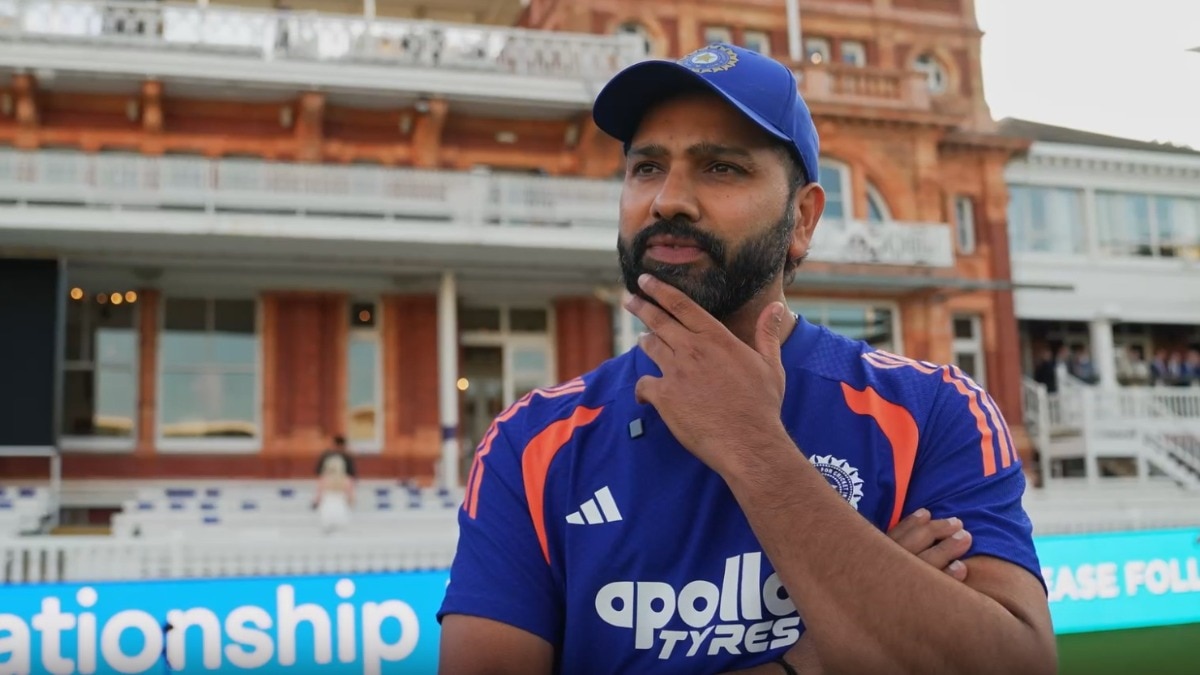
Yet Rohit Sharma did it. He hit 138 from 110 balls in the third and final ODI of a series against England at Lord’s on Saturday. Yes, he was tentative to start, understandable, with the axe hanging over his head. But, as they say, he found the zone. India were set 388 in the series decider, and Rohit scored a daddy hundred, going past Sourav Ganguly’s previous highest score of 90 at Lord’s to become the first Indian to hit an ODI century at the iconic venue.
India lost, but it wasn’t because of Rohit. More on that shortly.
Rohit has more than 40 international hundreds and three ODI double centuries to his name, but ask him if Lord’s ranks among his favourites, and he might just say yes. To play a defining knock with that kind of pressure hanging over him is not easy, especially considering he had endured a lean run coming into the decider, failing to register even a fifty in his previous eight ODI innings.
Speaking to the BCCI afterwards, Rohit said his job was simply to keep contributing and do justice to every opportunity that comes his way.
“If there’s no noise, there’s no fun. My job is inside; their job is outside. That’s how I look at it,” Rohit said, waving away suggestions that talk of the selectors wanting to move on from him was anything more than outside noise.
“The noise since I made my debut was there. And till the time I’m going to stay here, it’s always going to be there. It doesn’t really matter too much. What matters is what I do on the field. I want to try and contribute to the success of the team. That’s all my focus is.”
REALLY OUTSIDE NOISE?
But was it really just outside noise? Perhaps not. Former off-spinner R Ashwin, who retired mid-series during last year’s tour of Australia, said there’s no smoke without fire.
“There is no smoke without fire. There was fire, but now Rohit Sharma scored and shut the fire down,” Ashwin said on his YouTube channel, describing the retirement chatter as more than mere outside noise.
It’s no secret that the selection committee under Ajit Agarkar, and the team management under Gautam Gambhir, moved on from Rohit and Virat Kohli in Test cricket while both were still willing to go on. And the decision to strip Suryakumar Yadav of the T20I captaincy, with Agarkar citing form and the need to plan for the next two-year cycle, a few months after Suryakumar led India to World Cup glory, is a clear signal that this selection process doesn’t bet on emotion. Rohit himself wasn’t spared the cold calculation either: Reports claimed that the selectors told him they would be handing opportunities to younger openers going forward, with an eye on the 2027 World Cup.
So to dismiss the speculation as mere outside noise, as Ashwin put it, isn’t entirely fair.
SELECTORS, LOOK AT THE RIGHT ISSUES
But are the selectors even looking at the right problems, with the World Cup and the team’s wellbeing genuinely in mind? Here’s what needs fixing before more energy goes into phasing out the senior pros.
THE BUMRAH SHAPED HOLE
Bumrah played his first ODI in 968 days at Edgbaston, and the difference he makes was obvious in the two games he played. Then, at Lord’s, he suffered a last-minute knee injury and had to sit out the decider, and England made light work of the rest of the bowling group. With Axar Patel picked as the lone spinner, the pacers were taken to the cleaners: young Gurnoor Brar, who has impressed in his nascent career, went for 97 off his ten overs without a wicket, while Arshdeep Singh and Prince Yadav struggled for control alongside him. Only Prasidh Krishna, with 2 for 69, offered any real resistance. England cruised to 387 for 3.
The Indian bowling attack, without Bumrah, looked toothless. And it has been the case for quite a few years now. Bumrah or bust.
Captain Shubman Gill didn’t dodge the pattern.
“When one player gets injured, you have to play a different combination. If two are injured, you play a different combination. I think if a player is missing after every match, somewhere we are missing a trick,” Gill said, sounding the alarm over the squad’s fitness levels. By his own count, at least five players from the originally announced squad didn’t feature in that Lord’s defeat, Bumrah among them, sidelined by the knee issue.
A bowling attack that looks this thin the moment its spearhead steps out isn’t a succession problem. It’s a depth problem, and no amount of pressure on a 39-year-old opener fixes it.
WHY NOT HAVE SIRAJ?
Since the 2023 World Cup, Siraj has played only nine of India’s 23 ODIs and was left out of the Champions Trophy squad entirely, even as he shouldered the heaviest workload of any Indian fast bowler across formats. He wasn’t picked for this England ODI series either. A bowler who has given his body to Test cricket, and done it well, being treated as surplus in the format where his skills translate just as easily, isn’t a selection quirk. It’s a philosophy that needs interrogating.
A QUEUE WITH NO CLEAR LINE
Trying out fresh faces two years from a World Cup isn’t the problem. Doing it without any visible plan is. When Nitish Kumar Reddy went down with a quad injury, Suryansh Shedge was flown into the UK as cover, but only for the T20Is. By the time the ODI squad was named, it wasn’t Shedge getting a look-in; it was Shivam Dube, recalled to the fifty-over side for the first time since August 2024, having managed four ODIs and one wicket across his entire career before this. A 33-year-old parachuted in as a stopgap isn’t a succession plan, and once Hardik Pandya is fit again, Dube’s history suggests he’ll be forgotten just as quickly as he was summoned.
Then there’s Harsh Dubey, the left-arm spinning all-rounder Gill was happy to publicly champion barely weeks earlier: “It’s important that we show confidence in players like him… he can bowl 10 overs for us and, if required, can also get the job done with the bat.” Fine words, except Dubey didn’t make the original ODI squad at all. He was only called up to Lord’s as injury cover for Washington Sundar, and then didn’t play a single ball. An all-rounder can’t audition for a World Cup from the dugout.
And somewhere in all this, Ravindra Jadeja simply disappeared from the conversation. Left out of the Afghanistan series, left out of England, with no explanation offered either time.
Former opener Aakash Chopra said what most were thinking: “Every time the team is selected, it is said that the player will continue to play the ODI format and that he has a key role to play, but he is not getting selected.”
Nearly 3,000 ODI runs and 232 wickets, and the selectors won’t even say out loud whether they’ve moved on.
Trialling youth is right. Doing it without a defined runway, one series here, an injury slot there, no one told how long they’ve got to prove themselves, isn’t a rebuild.
AND STILL, NO KULDEEP
This is the one that should embarrass the team management most. Kuldeep Yadav has 194 wickets in 121 ODIs, and didn’t play a single match in the England series. He has been one of the better bowlers for India overseas in the recent past.
Since his debut in 2017, Kuldeep has picked 77 wickets away from home at an average of 22. He has seven spells where he has taken more than four wickets in an innings in overseas conditions. No Indian spinner has taken more wickets than Kuldeep outside India in the said period.
Yet, Kuldeep has only played six ODIs away from home since the last World Cup final. Axar Patel has played 12. Washington Sundar has played 9.
Former India batter Mohammad Kaif didn’t hold back.
“Kuldeep Yadav should be thinking of packing his bags and saying goodbye to international cricket. Today there was no Bumrah, no Washington, no Varun, but Kuldeep still hasn’t found a place in the XI. India’s bowling attack at Lord’s is one-dimensional and lacks variety.”
Rohit answered the only question actually worth asking of him: can he still play the innings a crisis demands? Lord’s said yes.
The selectors would do well to ask themselves the harder question, whether the actual gaps in this team have anything to do with him at all.
– Ends



