


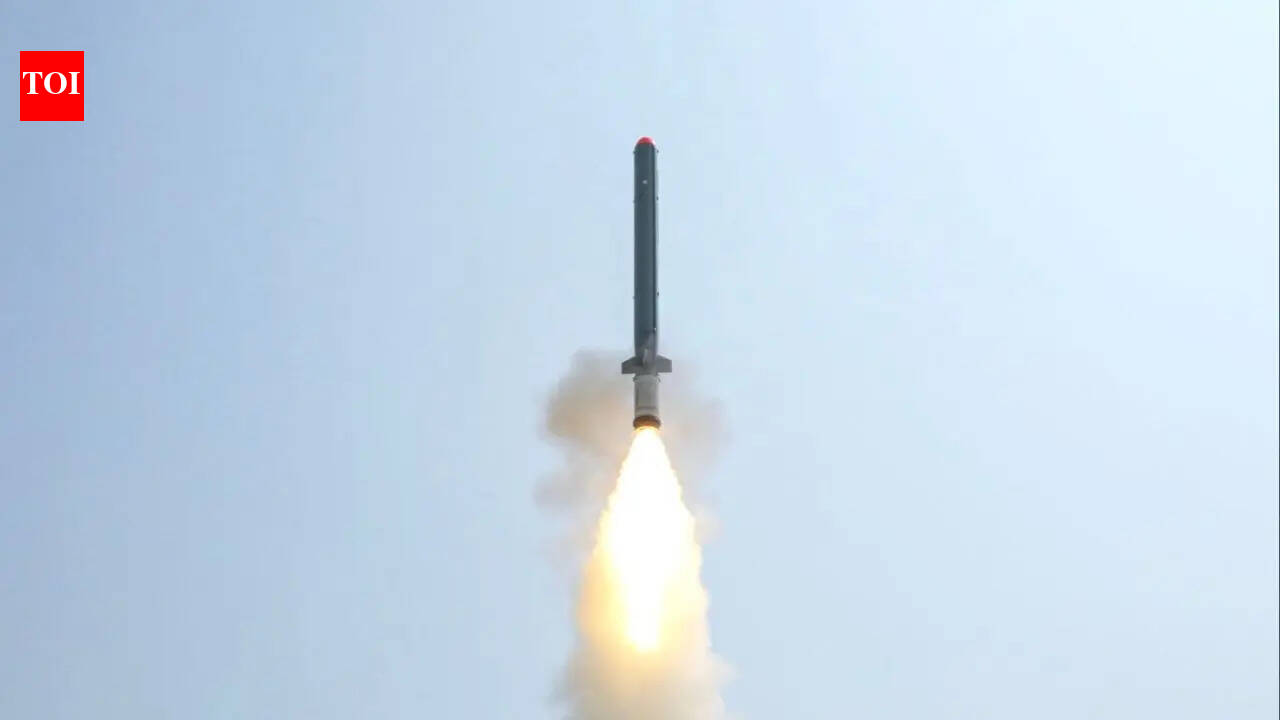
NEW DELHI: India has taken another major step in building its long-range strike capability with the successful test of the Long Range Land Attack Cruise Missile (LRLACM), a weapon designed to fly low, evade enemy radars and strike targets hundreds of kilometres away with precision.Developed by the Defence Research and Development Organisation (DRDO), the missile is increasingly being described as India’s equivalent of the American Tomahawk cruise missile. While India already fields the supersonic BrahMos, the LRLACM is built for a different mission. Its strength lies not in speed but in stealth, range and accuracy.The missile’s latest successful test from Dr APJ Abdul Kalam Island off the Odisha coast brings it closer to induction and provides a glimpse into the technologies shaping India’s next generation of precision-strike weapons.
What makes the LRLACM different?
Unlike ballistic missiles such as the Agni series, which soar into the upper atmosphere before plunging towards their targets, the LRLACM remains within the atmosphere throughout its flight.It flies much like an unmanned aircraft, constantly adjusting its route and altitude to avoid detection. This makes it significantly harder for enemy air-defence networks to track and intercept.Military planners often view cruise missiles as ideal first-strike weapons because they can penetrate defended airspace and neutralise critical targets before larger operations begin.
Terrain-hugging flight profile
One of the missile’s most important features is its terrain-following capability.The LRLACM is designed to fly at very low altitudes, using onboard sensors and navigation systems to follow the contours of the ground below. Hills, valleys and natural terrain features help mask the missile from enemy radar coverage.By hugging the terrain, the missile can remain hidden until the final stages of its approach, reducing the reaction time available to defenders.This low-altitude flight profile is one of the key reasons cruise missiles are considered among the most difficult conventional weapons to stop.
Terrain contour matching navigation
The missile is expected to employ advanced terrain contour matching and digital navigation technologies.Instead of relying solely on satellite navigation, the system compares the terrain below with pre-loaded digital maps. This allows it to determine its position even in environments where GPS signals are degraded, jammed or unavailable.The technology enables the missile to maintain accuracy throughout long-distance missions while navigating complex routes around enemy defences.Such systems have long been associated with advanced Western cruise missiles, including the Tomahawk.
Sea-skimming and radar evasion
Although the current version is land-based, future naval variants are expected to utilise sea-skimming flight profiles.A sea-skimming missile flies just a few metres above the water’s surface, using the curvature of the Earth and sea clutter to reduce detection ranges.Combined with low radar visibility and unpredictable flight paths, such capabilities make cruise missiles particularly dangerous against both land and maritime targets.The LRLACM’s ability to remain close to terrain or sea level is central to its survivability.
Precision-guided strike capability
The missile is designed to attack high-value targets including command centres, air bases, radar stations, logistics hubs and military infrastructure.Unlike weapons designed for area bombardment, the LRLACM is intended to strike specific targets with a high degree of precision.Modern guidance systems continuously update the missile’s flight path, allowing it to approach targets from unexpected directions and hit with minimal collateral damage.This precision makes cruise missiles valuable tools for strategic operations where accuracy matters as much as destructive power.
A 1,000-km punch
While official specifications remain classified, reports indicate the missile has a range of around 1,000 kilometres.That would allow India to engage targets deep inside hostile territory without exposing aircraft and pilots to enemy air-defence systems.The missile’s stand-off strike capability means it can be launched from safe distances while still holding critical enemy assets at risk.This ability has become increasingly important as modern air-defence systems grow more sophisticated.
Successor to Nirbhay
The LRLACM is widely regarded as the operational successor to the Nirbhay cruise missile programme.Many of the technologies tested and refined during more than a decade of Nirbhay development have been incorporated into the new missile.The result is a more mature system that combines long range, precision guidance, survivability and indigenous technology into a single platform.
How it complements BrahMos
India’s missile arsenal already includes the BrahMos, one of the world’s fastest cruise missiles.However, BrahMos and LRLACM are designed for different missions.BrahMos relies on speed, travelling at nearly three times the speed of sound to overwhelm defences. LRLACM focuses on stealthier flight profiles, longer endurance and deep-strike capability.Together, they provide Indian military planners with two distinct options: a high-speed missile for rapid engagement and a low-flying cruise missile designed to slip through enemy defences undetected.



