


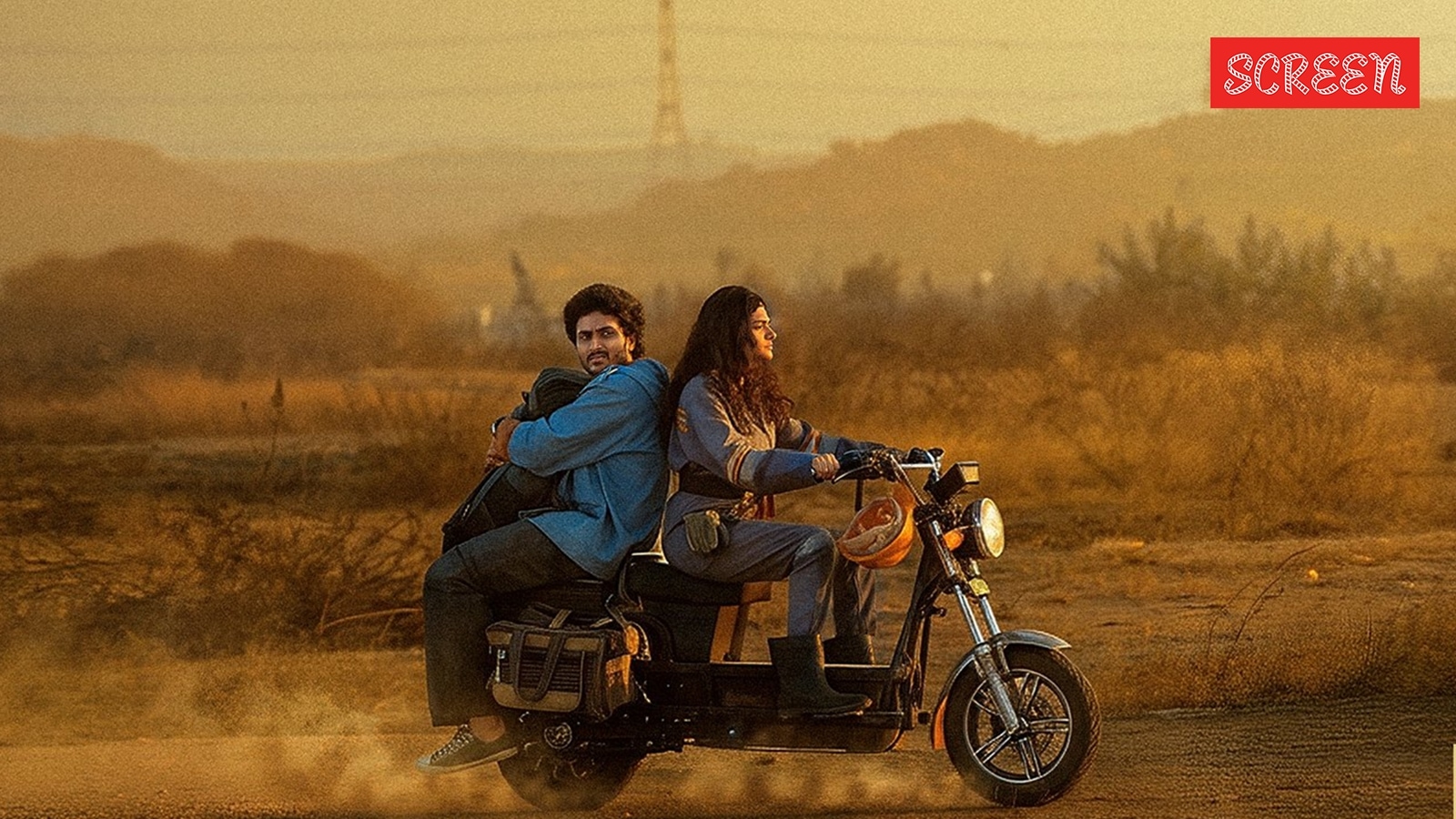
Some films take years to make. Sing Geetham took nearly a lifetime. The idea lived in Singeetham Srinivasa Rao’s head for close to four decades before a producer finally said yes. This explains why the film feels the way it does: deeply personal, unique, stubbornly unconventional, and made with the kind of sincerity that cannot be manufactured. The man who once made a film without dialogues asks you to imagine a world where everyone sings, quite literally.
Kuberapuram is a fictional village in Andhra Pradesh that feels like it exists slightly outside of real time. It sits on gold, and outside interests have noticed. A young man named Pratap (Ayaan) arrives expecting a business opportunity. What he finds instead is a community that is holding itself together with less and less left to hold. At the center of the village’s resistance is Gowri (Ahilya Bamroo), a young woman with an unshakeable attachment to the land and the life it sustains. A gold mining operation managed by Renu (Shalini Kondepudi) is slowly eating into both.

Then, one day, everyone in Kuberapuram loses the ability to speak. Whatever they try to say comes out as a musical note. The village, already on edge, does not know what to make of it. Neither, for the first few minutes, will you. What that strange event means, what caused it, and what the village does about it is the story.
Sing Geetham does not choose a lane. It is a fantasy, a musical, a mystery, a comedy, a drama, and an environmental fable, all rolled into one. Singeetham has spent a career juggling genres, and here he has attempted something more ambitious. He has tried to weave all of them into a single piece of cloth.
What holds all those genres together is not plot or structure, it is compassion. The film’s real subject is what happens to a community when people stop genuinely caring about each other and the world around them, and what it costs them to find empathy again.
That theme runs quietly beneath every tonal shift, whether the film is being funny, unsettling, tender, or mythological. This is a harder thing to pull off than it sounds. Sing Geetam largely manages it.
Nobody speaks in this film. After the first 15 minutes, every word characters say is sung. Not in the way Telugu Cinema pauses for a song and then returns to dialogue. In Sing Geetham, the dialogue is the song. Arguments, confessions, jokes, prayers, confrontations, all of it is delivered in musical form. The entire film is closer in structure to classical opera than to a conventional musical, but rooted in South Indian folk tradition and village sensibility. This will be the most interesting and novel thing you have heard about a Telugu film recently.
Story continues below this ad
Also Read: ‘No reference point’: Nag Ashwin reveals hardships behind Rs 22 cr film Sing Geetham
When the format works, it is genuinely striking. It creates a dreamlike distance from the ordinary world that suits the story’s fable-like quality. It also allows the film to slide between its many genres without jarring the viewer. A scene that is comic can become spiritual because the music is already holding both together. The whole village feels like a place where different rules apply, and the singing is part of why.
When the format does not fully work, which is not often but is noticeable, it creates a slight softness around moments that need harder edges. The film pays that price willingly, and for the most part the tradeoff is worth it.
Ahilya Bamroo is the best thing about this film after the music. As Gowri, she is present and specific in a way that makes the character feel genuinely inhabited rather than performed. She handles the film’s unusual format without ever making it look like work, which in a debut is something close to remarkable.
Story continues below this ad
Ayaan as Pratap is the audience’s point of entry into Kuberapuram, and he plays that role with restraint. He stays grounded while the world around him grows strange, and that grounding gives the film something to measure its stranger elements against.
Also Read: Kamal Haasan on 45-year-old movie idea finally releasing: ‘I am 71 and I get to see it’
Shalini Kondepudi is quietly impressive as Renu. She resists the easier version of her character and plays her instead as someone who has made calculated choices and does not particularly regret them, which is far more interesting than the conventional antagonist read.
Devi Sri Prasad has taken on a structural challenge here that most composers would shy away from. In a normal film the music supports the drama, however, in Sing Geetham the music is the drama. There is no dialogue to fall back on, no spoken scene to give the score a rest. Every emotional beat, every tonal shift, every moment of weight or lightness has to be carried entirely by what DSP writes.
Story continues below this ad
He handles that responsibility with real skill. The compositions span folk-inflected pieces that establish the village’s texture, romantic passages, more urgent driven sequences, and everything in between. The background score threads through the film without calling attention to itself. It is the kind of work that you absorb without fully registering how much it is doing, which is exactly what a score in this position needs to do. Technically and creatively, it is among the more demanding things DSP has delivered.
Ankur C’s cinematography gives Kuberapuram a warm, textured look that holds the tension between the real and the mythological without tipping too far in either direction. The village looks lived in and slightly enchanted at the same time.
Production designer Arvind Mule has built a world with a coherent visual grammar. The colour palette, the architecture, and the costumes all read as part of the same thought. The visual effects largely hold up, with a few sequences that needed more time in post before they reached the screen.
However, it takes its time. The premise is established early and clearly, but the film circles back to it repeatedly before committing to development. A tighter first hour would have served the story better and kept more of the audience with it through to the end.
Story continues below this ad
Telugu cinema in 2026 knows how to be big. It knows how to build action, scale mythology, and produce spectacle that justifies a large screen. What it does less often is make films that are small in the best sense: intimate, thematically specific, rooted in feeling, and genuinely experimental.
Sing Geetham is that kind of film. It is asking, through every genre it passes through and every song its characters sing, whether people still have it in them to care about each other. That is the compassion at its center, and it earns it by the end.
The film is not perfect but the sincerity behind it is not something you can fake, and the craft that Singeetham himself has brought to this material is real and evident. A man spent 45 years waiting to make this film and that makes this surely a worthy watch.



