


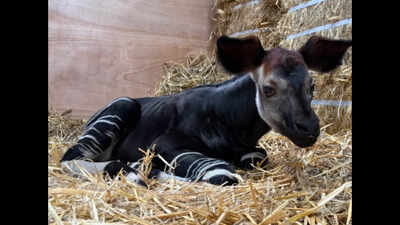
A rare okapi calf has been born at Rainforest Wild Adventure in Singapore, marking the first recorded birth of an okapi in Southeast Asia. The male calf was born on July 27 to first-time parents Kisala, 7, and Xandor, 4, at Mandai Wildlife Group’s wildlife park.The calf weighed about 20kg when it was first weighed a day after birth. Nearly two months later, it has more than doubled its weight to 48kg. The young okapi is being cared for with its mother in the Hidden Forest at Rainforest Wild Adventure East.Okapis are an endangered species and are rarely seen even in zoos. Native only to the dense rainforests of the Democratic Republic of Congo, the animals are listed as Endangered on the International Union for Conservation of Nature (IUCN) Red List. Habitat loss and poaching have contributed to a sharp decline in their wild population.
What is an okapi?
Despite its zebra-like striped legs and brown body, the okapi is actually the closest living relative of the giraffe. It shares several characteristics with giraffes, including a long, flexible tongue and bony, horn-like structures called ossicones on the head of males.The animal is sometimes described as a “forest giraffe” because it lives in dense tropical forests rather than the open grasslands associated with giraffes. Its striped hindquarters and legs are thought to provide camouflage in the forest undergrowth.Okapis are elusive, largely solitary animals that live in the forests of northeastern and central Democratic Republic of Congo. Their habitat provides dense vegetation in which they can browse for leaves, shoots and other plant material.
Why okapi calves are unusual
The Singapore calf has also been displaying a behaviour that may seem surprising to visitors. Instead of constantly following its mother, the young okapi spends much of its time hidden in its den, reports said.This is normal for the species. Okapi calves naturally remain concealed for much of their first few months, while their mothers leave them periodically to forage and return to nurse them. This behaviour is believed to help protect the young from predators.Okapis also have an unusually long pregnancy. Gestation lasts around 14 to 15 months — roughly 440 days — and females generally give birth to a single calf.Mandai said it prepared a quiet, secluded calving box for Kisala and her calf to allow them to follow this natural behaviour. The calf has recently been given access to its outdoor habitat, although keepers said it is still taking time to become comfortable in the new surroundings.
A first for Southeast Asia
Kisala and Xandor arrived in Singapore under the EAZA Ex situ Programme, a coordinated breeding programme for threatened species. The programme works to maintain healthy populations of endangered animals under human care, including through managed breeding and the movement of animals between participating institutions.Visitors to Rainforest Wild Adventure East can see Kisala and the calf in the Hidden Forest, although the youngster may retreat to its den. A live “baby monitor” also allows visitors to catch glimpses of the calf when it is inside.Mandai has invited the public to help choose the calf’s name. The three options are Imara, meaning “strong” in Swahili; Mayaka, meaning “pearl” in Lingala; and Kiah, meaning “dawn”, “new beginnings” or “start of the season” in Swahili.


