


Take yourself back to 2016. Leicester City had just shocked the footballing world. Pep Guardiola was preparing for his first season at Manchester City. Kylian Mbappe was still an exciting teenager waiting for his big breakthrough. Cristiano Ronaldo would go on to win the Euros the same year with Portugal.
But one thing that did not pan out was Argentina and Lionel Messi. He had just announced his retirement from international football after suffering yet another heartbreak with Argentina in the Copa America, falling victim to Chile for the second year straight after skying his penalty off target.
Things looked bleak for the Argentine who was still at the peak of his powers. Just one season earlier, he was the key cog in the South American attacking troika with Neymar and Luis Suarez for FC Barcelona, where they won the treble under Luis Enrique. Messi was also on his Ballon d’Or winning spree, having claimed five already by 2016.
Yet there was something missing when he played for Argentina. Whether an individual problem or a team problem remained unclear. But still, he had managed to get Argentina to the World Cup final in 2014. That major international trophy he desperately wanted always eluded him.
On June 27, 2016, at the MetLife Stadium in New Jersey, he dropped the bombshell. “For me, the national team is over,” he said after defeat against Chile in the Copa America final, as reported by the BBC. “I’ve done all I can. It hurts not to be a champion.”
It looked like not winning a trophy for the national team would always haunt him throughout his career. With the shadow of Diego Maradona looming over him, he did not have the luxury to bring back anything less. With that retirement announcement, it felt like he would never be loved by his own country. The one he had played for even when he had the likes of Spain desperate for his talents.
Not to mention, the Messi versus Ronaldo rivalry was at its peak. Social media and critics were having a field day over Argentina’s performance in that final and with respect to Messi’s announcement. It did not look like there was anyone who had an ounce of empathy. Everyone was embroiled in the madness that ensued with this rivalry.
A TEENAGER’S PLEA
When Messi announced his retirement, a 15-year-old Enzo Fernandez was watching. The midfielder, then unknown to the wider world, sat down and wrote an open letter to his hero on Facebook.
“How are we going to convince you if in our lives we have never had one percent of the pressure that you have on your shoulders?” he pleaded. “Do what you want Lionel, but please think about staying. Stay to have fun.”
Messi did not read it at the time. He was too consumed by his own despair. But a decade later, that teenager would become one of Argentina’s most pivotal midfielders. The two are now teammates chasing history together. In 2026, the same player who once begged Messi not to leave will stand beside him, fighting for the trophy that once seemed impossible.
It is the kind of symmetry that feels too perfect to be real. Yet here it is.
THE RETURN NOBODY EXPECTED
But retirement proved premature. In less than five years, the narrative flipped entirely. The Copa America triumph of 2021 changed everything. Messi was back, and this time Argentina delivered. That tournament in Brazil showed something had shifted. The team around him was finally functioning, finally complementing rather than constraining. When Messi lifted the trophy, the weight of a decade lifted with it.
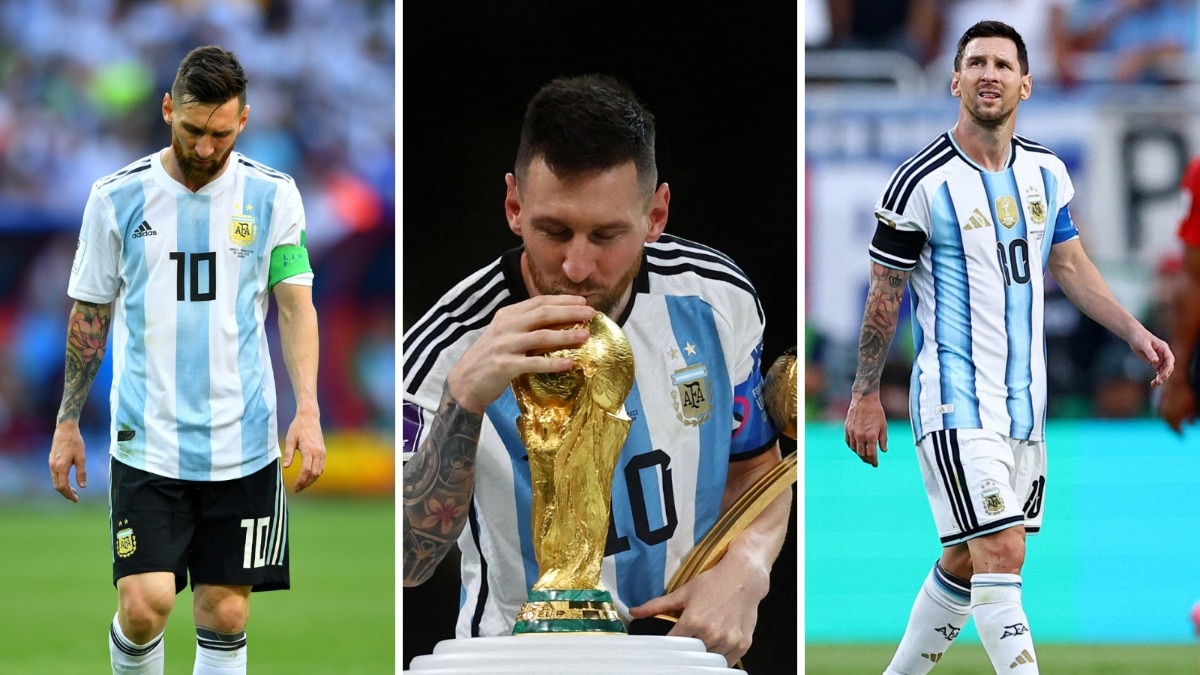
Then came Qatar. The 2022 World Cup was supposed to be Messi’s last genuine chance. Instead, it became his redemption. Not just for him, but for an entire nation that had lost faith. Argentina’s journey through that tournament was resurrection disguised as sport. When he held that trophy aloft, he was not just winning for himself. He was answering all the doubters, all the comparisons to Maradona, all the critics who said he could not deliver on the biggest stage.
The penalty kick he had skied in 2016 was suddenly irrelevant. History rewrites itself for champions.
REDEMPTION IN FULL CIRCLE
Now, as 2026 beckons, Messi stands on the precipice of something extraordinary. Winning back-to-back World Cups would place Argentina alongside Brazil’s 1958 and 1962 legacy. More than that, it would cement Messi’s story as one of sport’s greatest redemption arcs. The player who walked away in shame could now finish on his own terms, with a trophy cabinet that silences every critic.
The MetLife Stadium saw his lowest moment. But football does not deal in symbolism alone. What matters is that Argentina has evolved. The supporting cast around Messi has matured. The team understands its own identity now. That was missing in 2016.
The narrative has come full circle. A teenager’s desperate plea became a prophecy. That same midfielder will now run alongside his hero one final time, not begging him to stay, but fighting with him to cement a legacy that transcends sport itself. In 2026, Messi will not just be chasing a trophy. He will be rewriting the story that began with heartbreak at the MetLife Stadium exactly a decade before.
FIFA World Cup | FIFA World Cup Schedule | FIFA World Cup Points Table | Football News
– Ends



