


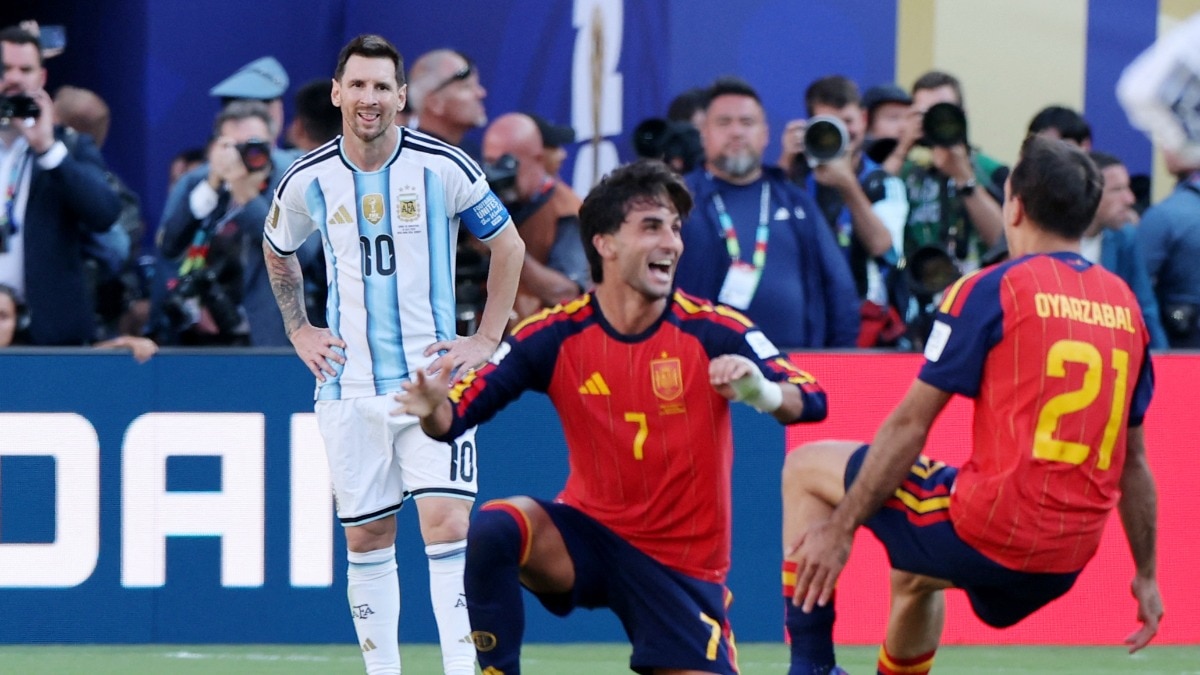
Lionel Messi had arrived in New Jersey hoping to add one final chapter to an international career that had already delivered football’s greatest prize. Instead, the World Cup ended with Spain writing the story from the opening whistle to the last.
Luis de la Fuente’s side did not simply edge past the defending champions. They dominated them. Spain controlled possession, dictated the tempo and denied Argentina any attacking rhythm before Ferran Torres’ extra-time strike secured a deserved 1-0 victory and a second FIFA World Cup title.
Spain vs Argentina, FIFA World Cup final: HIGHLIGHTS
The scoreline barely reflected Spain’s superiority. Argentina failed to register a shot for the opening 70 minutes, the longest wait for a first attempt in a World Cup final since records began in 1966. Messi, the heartbeat of Lionel Scaloni’s side, managed just 22 touches during that period as Spain’s midfield cut off the supply lines that have so often brought the eight-time Ballon d’Or winner to life.
Even then, Spain had to wait. Emiliano Martinez repeatedly frustrated them with a string of outstanding saves, while Mikel Merino headed wide from close range and two Spanish goals were ruled out. By the end of normal time, Spain had created an expected goals (xG) figure close to 1.0 while Argentina had yet to test Unai Simon.
The breakthrough finally arrived 37 seconds into the second period of extra time. Pedro Porro’s looping cross looked to have drifted beyond the far post before Nico Williams reacted brilliantly to head it back across goal. Torres timed his run perfectly, arriving to hammer a left-footed finish into the roof of the net for his first goal of the tournament and the one that ultimately settled the final.
Argentina threw bodies forward in the closing minutes, but Spain remained composed. Messi produced one dangerous cross that flashed across the six-yard box and Merino bravely blocked another effort with his face, yet the holders never truly looked capable of forcing penalties.
When referee Slavko Vincic blew for full-time, Spain were deserved world champions. They had spent almost two hours controlling every aspect of football’s biggest match before finally receiving the reward their performance deserved.
MESSI KEPT ON A LEASH
Much of the build-up centred on another meeting between Messi and Spain’s new generation, particularly teenage sensation Lamine Yamal. Instead, the contest quickly became a demonstration of Spain’s collective organisation.
Rodri dictated the rhythm from midfield, while Pau Cubarsi repeatedly stepped into passing lanes before the ball could reach Messi. Every time Argentina’s captain received possession, two or three Spain shirts immediately closed around him, forcing him backwards or wide.
The numbers reflected Spain’s control. Argentina became the first team since records began in 1966 to go through the opening half of a World Cup final without attempting a shot. They still had not managed an effort after 70 minutes, while Messi’s influence remained unusually limited.
Spain’s dominance was evident across the pitch. Dani Olmo found pockets of space between the lines, Nico Williams continually stretched Argentina down the left and Yamal repeatedly troubled Marc Cucurella’s opposite flank with his direct running. The only thing missing was the finishing touch.
MARTINEZ KEPT ARGENTINA ALIVE
Had Argentina somehow retained the trophy, Martinez would have been the overwhelming reason why.
The Aston Villa goalkeeper denied Olmo from close range, tipped Yamal’s curling free-kick around the post and produced another excellent stop to keep out Williams. He also watched Merino head narrowly wide before Torres had another finish ruled out for offside during extra time.
Argentina’s evening became even more difficult after injuries forced Lisandro Martinez and Cristian Romero off before the hour mark, leaving Nicolas Otamendi to lead a reshuffled defence. Enzo Fernandez’s late red card only increased the pressure as Spain continued to push for a winner.
Despite everything, Martinez continued to keep Argentina in the contest, forcing Spain to remain patient long after they had established themselves as the better side.
TORRES DELIVERS THE DECISIVE BLOW
Spain’s winner reflected the pattern of the contest.
Porro’s cross looked to have carried too far until Williams improvised brilliantly to head it back across the face of goal. Torres arrived six yards out and struck his finish emphatically beyond Martinez, ending a frustrating tournament in front of goal with the most important finish of his career.
The forward had hit the woodwork against Cape Verde and Uruguay and even lost his place in Spain’s starting XI after the group stage. Yet when the biggest chance of the tournament arrived, he took it without hesitation.
Messi tried to inspire one final comeback, sending a dangerous ball across the six-yard box and later forcing Merino into another brave block, but Spain comfortably managed the closing stages.
It was a fitting end to a final they had controlled from beginning to end. Spain finished with the greater share of possession, created the clearer chances and restricted the defending champions to one of the quietest attacking displays seen in a World Cup final.
Messi had lifted the World Cup four years ago by inspiring Argentina to football’s summit. This time, he found himself watching a team that refused to let him shape the occasion. Spain did not need penalties, moments of fortune or individual brilliance.
They simply outplayed the defending champions from start to finish, reclaiming the biggest prize in football and announcing themselves as the world’s new benchmark.
FIFA World Cup | FIFA World Cup Schedule | FIFA World Cup Points Table | Football News
– Ends



