








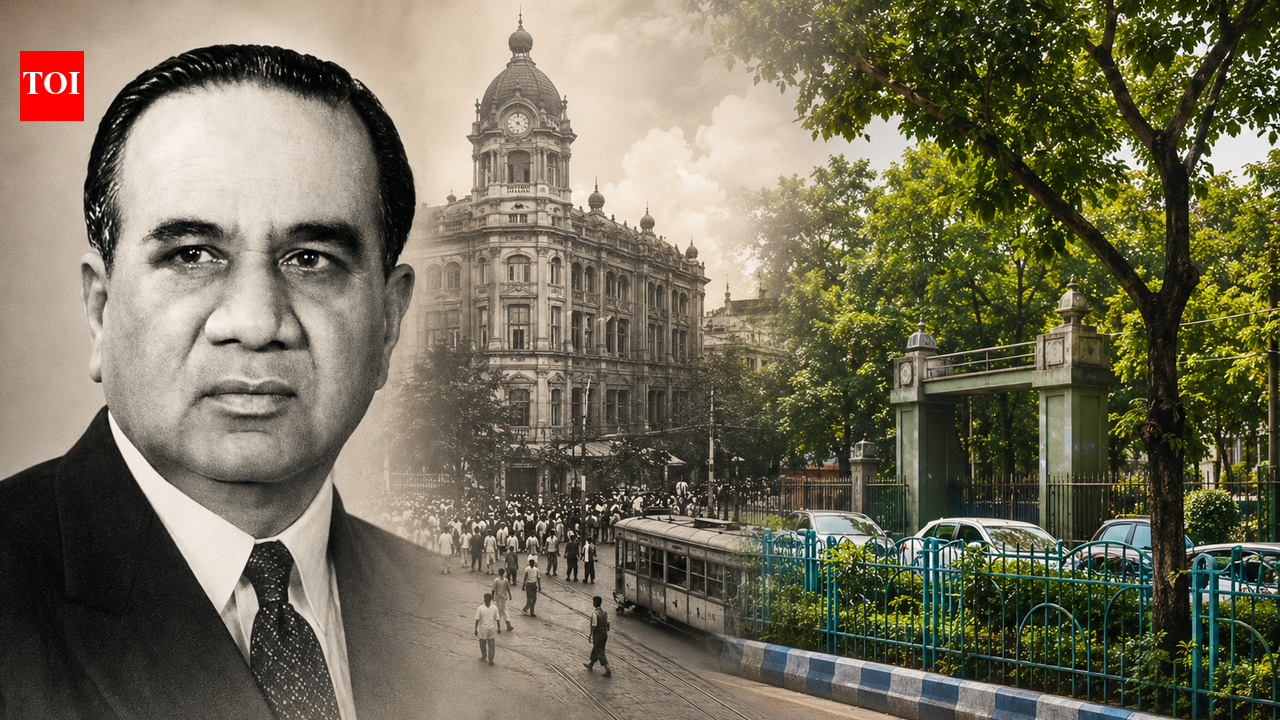
“No roads will be named after Mughals or Pathans,” Suvendu Adhikari said in the Bengal assembly, while defending the renaming of Kolkata’s Suhrawardy Avenue.The question, though, remains, which Suhrawardy was the road really named after? Huseyn Shaheed Suhrawardy, Bengal’s last premier before Partition and one of the most despised figures of the 1940s? Or his maternal uncle, Sir Hassan Suhrawardy, the surgeon and Calcutta University vice-chancellor? Or, as another view holds, Hassan’s father, Maulana Ubaidullah al-Obaidi Suhrawardy? Incidentally, the family’s history over the last 200 years links back to Midnapore, which is also the home district of current Bengal CM Suvendu Adhikari.For many in Bengal, Suhrawardy means Huseyn Shaheed Suhrawardy. His name is tied to the Bengal famine, Direct Action Day and the Great Calcutta Killing of August 16, 1946. Either through omission or commission, Suhrawardy’s role in one of the darkest chapters of Bengal’s history cannot simply be wiped away. It is only natural that this would be his lasting memory in India, particularly in West Bengal.
A family trapped inside history
However, the Suhrawardy family, though consigned to the annals of infamy, was much more than the moniker “Butcher of Bengal”. Over the last two centuries, as per public records, the family has produced educationists, judges, surgeons, university administrators, art critics, diplomats, parliamentarians, UN delegates, human-rights lawyers and later public figures in Bangladesh, Pakistan, Jordan and Canada.The Suhrawardys were not zamindars, unlike many elites of Bengal in the bygone era. Their influence came through their deeply entrenched presence in institutions of power. They embodied the rise of a Bengali Muslim elite shaped by modern education, law and public office.The family traced its older origin to Suhraward in the Persianate world and to the Suhrawardiyya Sufi order. Jordanian Princess Sarvath El Hassan’s official family history says the Suhrawardys claimed descent from the Baghdad-based Sufi Shaikh Shahabuddin Suhrawardy, author of Awarif al-Ma’arif.
From Midnapore to modern Bengal
The modern record begins in nineteenth-century Bengal. The key figure was Ubaidullah al-Obaidi Suhrawardy, born in 1832 in Chitwa, Midnapore. Versed in Arabic, Persian and English, he taught Anglo-Arabic at Hughli College from 1865 and became the first superintendent of Dhaka Madrasah in 1874. He was associated with the Mohammedan Literary Society, the Central National Mohammedan Association, the Bengal Social Science Association and the Aligarh Mohammedan Anglo-Oriental College.Sir Hassan Suhrawardy was Ubaidullah’s son, a surgeon and public figure who served as vice-chancellor of Calcutta University from 1930 to 1934. He was Huseyn’s maternal uncle. Justice Sir Zahid Suhrawardy, Huseyn’s father, belonged to the Calcutta High Court, where he was a leading light. Huseyn’s mother was Khujista Akhtar Banu. Hasan Shaheed Suhrawardy, often called Shahid Suhrawardy, was Huseyn’s elder brother and later an art critic, writer, professor and diplomat. Shaista Suhrawardy Ikramullah was Sir Hassan’s daughter, making her Huseyn’s first cousin.
Huseyn’s rise
Huseyn was born into this distinguished Midnapore family in 1892. He studied at Calcutta Alia Madrasa and St Xavier’s College, Kolkata. He graduated in science, completed an MA in Arabic from Calcutta University, studied law at Oxford, obtained a BCL, and was later called to the Bar at Gray’s Inn in London. After returning from England, he practised law in Calcutta and entered active politics around 1920.In the 1920s, Suhrawardy was general secretary of the Calcutta Khilafat Committee. He organised as many as 36 trade unions among seamen, railway employees, jute and cotton mill workers, rickshaw pullers, cart drivers and others. He founded the Independent Muslim Party before the 1926 council elections, organised the Bengal Muslim Election Board before the 1929 elections, and later founded the United Muslim Party in Kolkata before the 1937 elections.His rise was rapid. After the 1937 elections, he became Labour and Commerce Minister in A K Fazlul Huq’s Praja-League coalition government. As general secretary of the Bengal Provincial Muslim League from 1937 to 1943, he helped organise the party across the province. He later became Civil Supplies Minister in the Khwaja Nazimuddin ministry during 1943-45. In 1946, after the Muslim League’s sweep in Bengal’s Muslim seats, he became premier of undivided Bengal. He later served as Pakistan’s law minister in 1954-55 and prime minister in 1956-57.
The wound of 1946
As Civil Supplies Minister during the famine years, he was part of the food-administration machinery. The famine was not the work of one provincial minister. But Suhrawardy cannot be removed from the administrative history of that failure.Then came Direct Action Day. The Great Calcutta Killing occurred during Suhrawardy’s chief ministership on August 16, 1946. In much of Hindu Bengali memory, this became the central fact of his life that he was the premier when Calcutta descended into communal violence. His alleged connivance, and the state failure under his watch, became his lasting legacy.Yet in 1947, there was a volte-face. Suhrawardy supported the idea of a united, sovereign Bengal. He envisioned a state comprising Bengal, Assam and adjoining districts of Bihar, and collaborated with Sarat Chandra Bose, Kiran Shankar Roy, Satya Ranjan Bakshi and Abul Hashim on a United Independent Bengal as a third dominion alongside India and Pakistan.Critics saw it as a sinister plan to preserve Muslim League influence over undivided Bengal. But it was also a recognition of an economic reality that an undivided Bengal would have remained an economic powerhouse. The plan was a non-starter because Suhrawardy was already persona non grata in popular Hindu imagination. For many Bengali Hindus, especially after 1946, Partition had become a form of protection. For the Muslim League, Pakistan remained the central demand. Interestingly, as per Bangladesh’s national encyclopedia Banglapedia, after Partition, Suhrawardy stayed in Calcutta for a time and worked with Gandhi during the city’s peace mission.
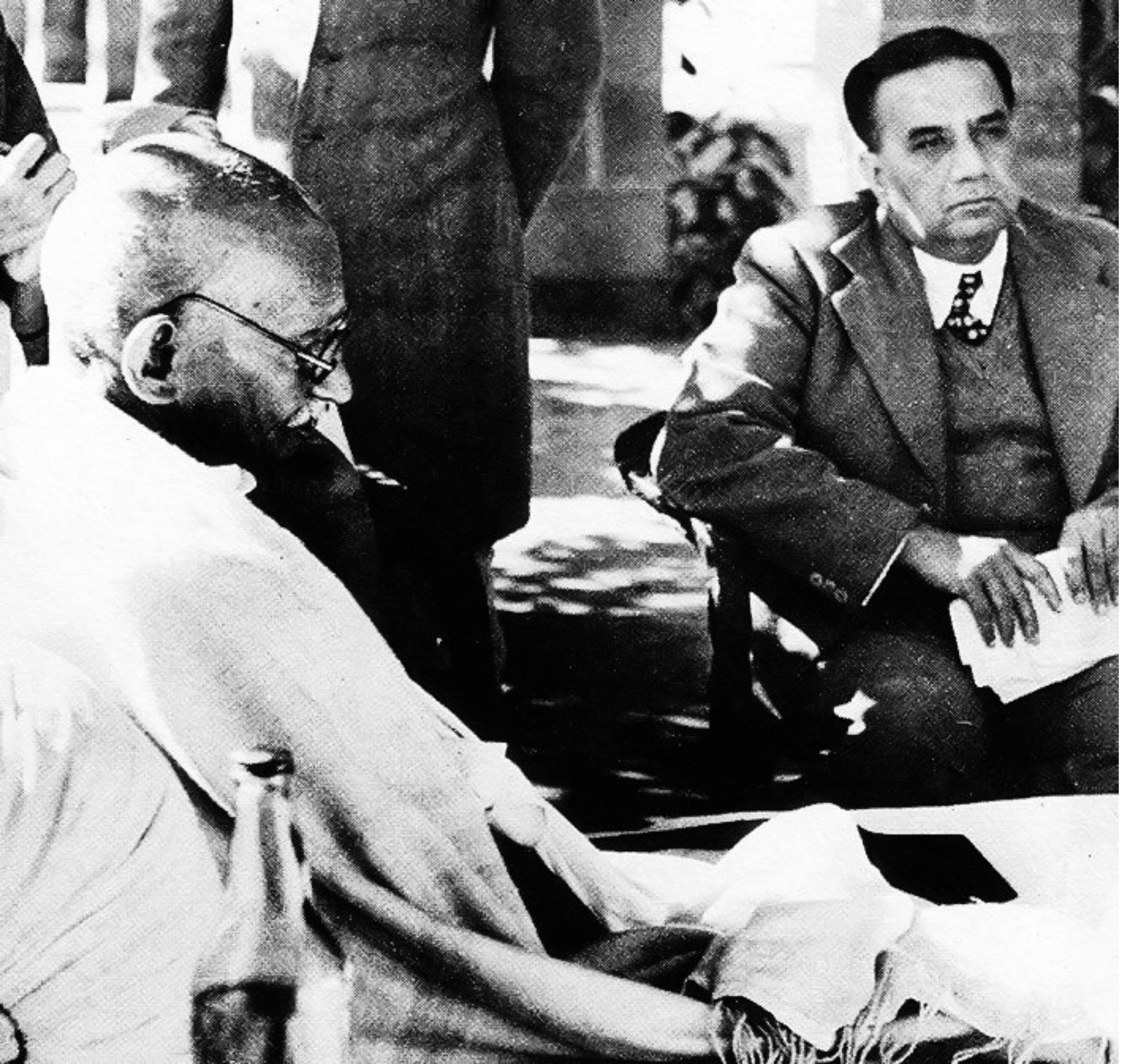
Suhrawardy (right) with MK Gandhi.
Rejection and reinvention
His post-1947 career in Pakistan had two phases. His membership of Pakistan’s Constituent Assembly was terminated in 1949 on the ground that he was not a permanent resident. He rebuilt himself through East Bengal’s opposition politics. The Awami League was founded in Dhaka in 1949 by a faction of Bengal Provincial Muslim League leaders associated with Suhrawardy and Abul Hashim.In 1954-55, Suhrawardy joined Mohammad Ali’s cabinet as law minister. It was a striking turn for a politician once pushed out of Pakistan’s Constituent Assembly. As law minister, he made a significant contribution to the framing of Pakistan’s 1956 Constitution by facilitating the 1955 Murree Pact.In 1956, Suhrawardy became Pakistan’s prime minister, heading a coalition government at the centre for barely 13 months. His premiership was short, but not insignificant. His government is credited with adopting parity between Pakistan’s two wings, holding a session of Pakistan’s National Assembly in Dhaka for the first time, and getting a bill passed introducing the joint electorate system. He was known for political pragmatism, which aided his meteoric rise in Pakistan’s political ecosystem. He managed to forge good relationships with both the USA and China.After Ayub Khan’s military takeover, Suhrawardy became one of the most prominent opponents of the regime. He was banned from politics and was arrested on January 30, 1962, under security laws. He was held in Karachi Central Jail without trial and released in August that year. After his release, he helped organise the National Democratic Front as an anti-Ayub platform.By the time Suhrawardy died in Beirut on December 5, 1963, Pakistan had moved firmly under military rule. His death helped clear the way for Sheikh Mujibur Rahman to become the sole leader of the Awami League. But the family’s other branches continued active participation in various facets of public life.
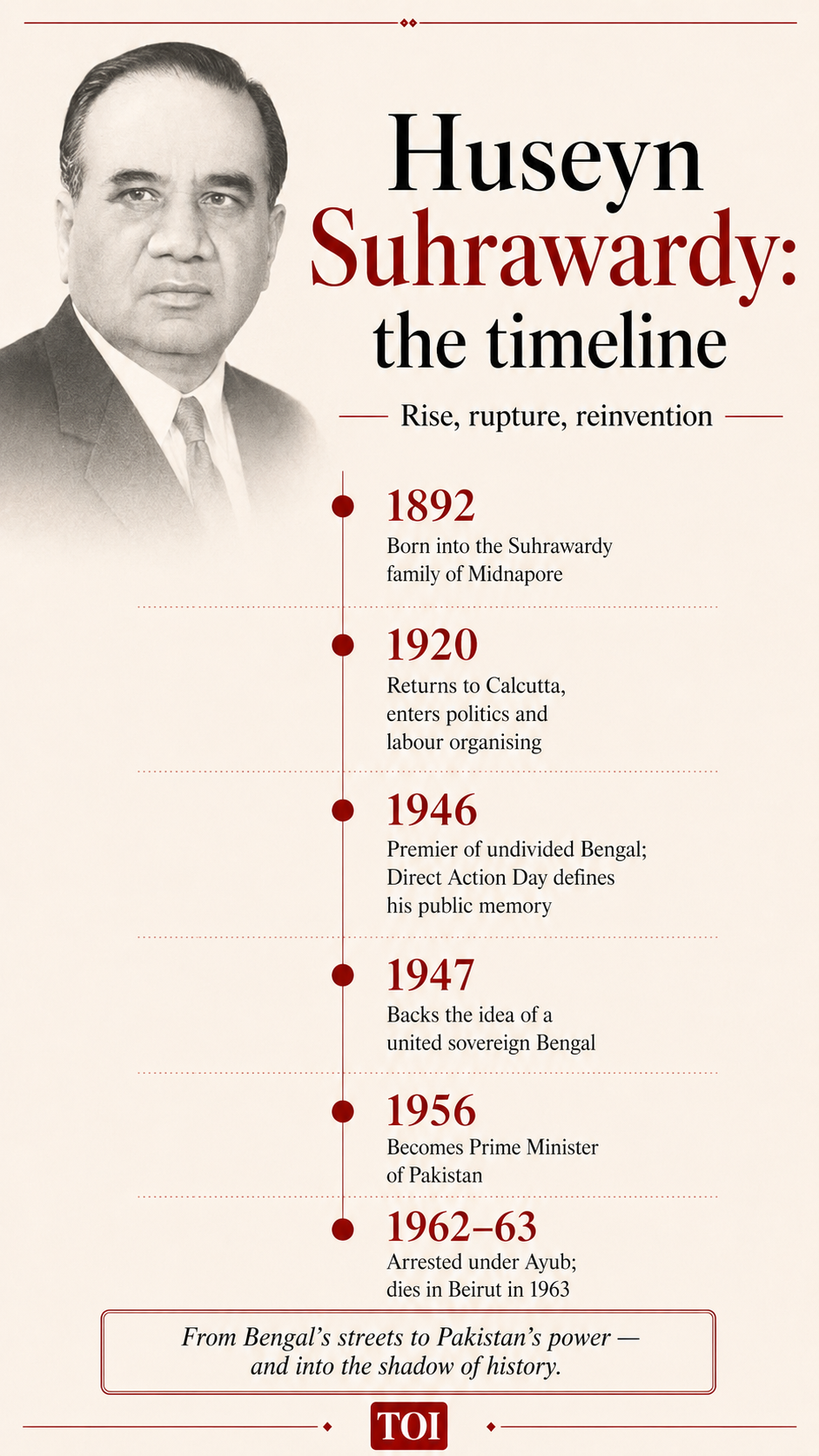
Suhrawardy timeline
The other Suhrawardys
Sir Hassan belonged to medicine, public service and university administration. Although his reputation regarding the capture of freedom fighter Bina Das tarnishes his legacy, as Suvendu Adhikari alluded to in the assembly. Hasan Shaheed belonged to art and diplomacy. He worked with the Moscow Art Theatre, edited the Fine Art Section of the League of Nations in Paris, came to Visva-Bharati at Rabindranath Tagore’s invitation, taught comparative art at Calcutta University and later served Pakistan as ambassador to Spain, Morocco, Tunisia and the Vatican, as per available records.Shaista Suhrawardy Ikramullah took the family into another arena. Sir Hassan’s daughter and Huseyn’s cousin, she became Pakistan’s first woman member of Parliament, ambassador to Morocco and a delegate to the United Nations. The UN Human Rights Office identifies her as one of three non-Western women who influenced the Universal Declaration of Human Rights, especially Article 16 on equal rights in marriage.
A family scattered across countries
After 1947, the family scattered across countries. In Bangladesh, Shaista’s daughter Salma Sobhan became a lawyer, academic and human-rights activist. One of Pakistan’s first women barristers, she later taught law at the University of Dhaka and co-founded Ain o Salish Kendra. Her son Zafar Sobhan carried the family’s public role into journalism, becoming a lawyer, columnist and founding editor of the Dhaka Tribune.The Jordan line came through Princess Sarvath El Hassan, born Sarvath Ikramullah in Calcutta in July 1947. She married Prince Hassan bin Talal in Karachi in 1968 and became part of Jordan’s Hashemite royal family. Her work in Jordan has focused on education, women’s issues, social welfare and health. Her children include Princess Rahma, Princess Sumaya, Princess Badiya and Prince Rashid.Huseyn’s immediate family followed the same scattered geography. His first wife was Begum Niaz Fatima, daughter of Justice Sir Abdur Rahim, and she died in 1922. His second wife was Begum Vera Suhrawardy, a Russian actress. One son, Shahab, died young of pneumonia. Another son, Rashid Suhraward, adopted the screen name Robert Ashby, appearing in the film Jinnah. His daughter, Begum Akhtar Sulaiman, became a Pakistani social worker and political activist. Her daughter, Shahida Jamil, later served as Pakistan’s law minister.In Canada, Naz Ikramullah Ashraf, another daughter of Shaista, became a British-Canadian artist and film producer.The Suhrawardy name survives because it sits at the intersection of archive and anger. The truth is that the sins attributed to one man have probably eclipsed everything else. That is why Suvendu’s strident words in the assembly echo the broad contours of public memory.