


Washington:
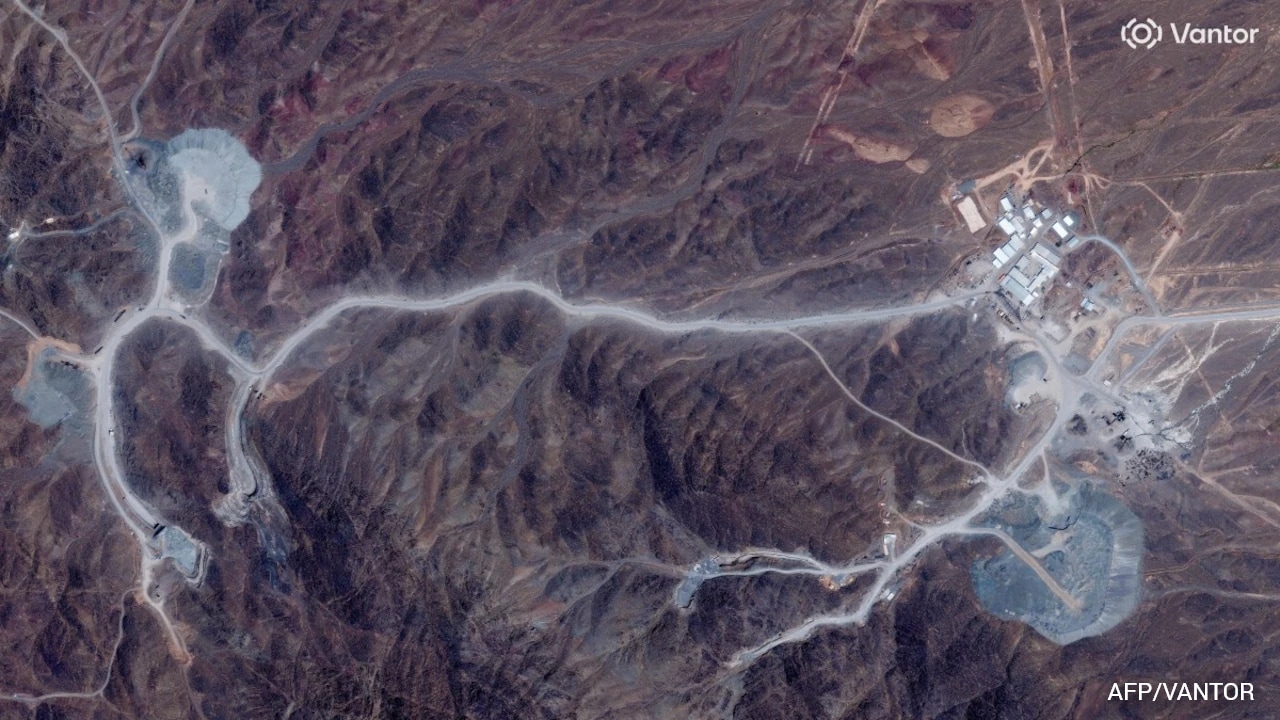
A suspected Iranian nuclear site, deep inside Pickaxe Mountain, has seen a surge of construction this year, even as the war in the Middle East continued, according to a group of analysts who reviewed six years of satellite imagery. Buried deep under granite, the site near the Natanz nuclear complex, roughly 140 miles south of Tehran, has been under the watchful eyes of global intelligence agencies as a likely location for Iran’s new and undeclared enrichment facility.
Analysts at the Centre for Strategic and International Studies (CSIS), a Washington-based think tank, reviewed satellite imagery spanning six years, the latest from August 9, and found “a clear surge in construction activity” this year, with Iran erecting “a security perimeter around the facility.”
“Multi-source imagery analysis of Pickaxe Mountain and the Natanz Nuclear Facility from 2020 to the present reveals a clear three-phase activity signature across the five key points of interest and the roads connecting them, indicating a site that has shifted from active excavation toward probable internal construction and continued exterior reinforcement,” the CSIS analysts wrote in their report.
“Together, these images reveal more road activity at Pickaxe Mountain in 2026 than at any point in the site’s history. There is a clear surge in construction activity in 2026 that corresponds to the raising and hardening of the portal accesses, paving of the internal road network, reinforcement around access areas, and the flattening and removal of excavation spoil,” they added.
However, the analysts added that they could not refute or substantiate a reported Israeli intelligence claim that Iran has moved uranium centrifuges and centrifuge parts into Pickaxe Mountain last fall.
What New Activity Could Mean
Iranian President Masoud Pezeshkian in September said the satellite imagery of the site was insufficient to determine what was happening at Pickaxe Mountain and called for the UN’s nuclear watchdog on the ground to verify the site’s purpose. However, Tehran never facilitated the move.
Analysts at CSIS noted that the surge in activity at the site could indicate Tehran may be building a centrifuge assembly facility, as indicated in 2020 by then head of Iran’s nuclear program, Ali Akbar Salehi, who announced an underground centrifuge assembly facility near Natanz.
Iran could also be expanding activities at Pickaxe Mountain to house a uranium enrichment facility, with the hopes that this facility could enrich Iran’s existing stockpile of around 440 kilograms of 60 per cent enriched uranium to weapons-grade material, they said.
“Iran could be moving additional research and activities related to nuclear weapons into the underground facility, such as the metallurgy and chemical conversion facilities that the United States and Israel destroyed in Isfahan during Operation Midnight Hammer, the limited strikes against Iran’s nuclear program in June 2025,” they added.
Trump’s Threats
The report about the surge in activity at Pickaxe Mountain came despite US President Donald Trump’s repeated threats to strike the site.
“We may hit Pickaxe very soon,” Trump told reporters last week, adding that “we know everybody that’s moving” at the site.
About the Nuke Site
Pickaxe Mountain, or Kuh-e Kolang Gaz La in Farsi, is a large underground tunnel complex 2 kilometers south of the Natanz uranium enrichment facility in Iran. It is a deeply buried granite fortification, and analysts noted that it will be difficult to destroy the facility even with the heaviest non-nuclear US munitions, such as the GBU-57 Massive Ordnance Penetrator.
The International Atomic Energy Agency (IAEA), a UN nuclear watchdog, has requested Tehran to provide information about Pickaxe Mountain and access to the facility. However, Iran has reportedly never responded to the IAEA requests.


