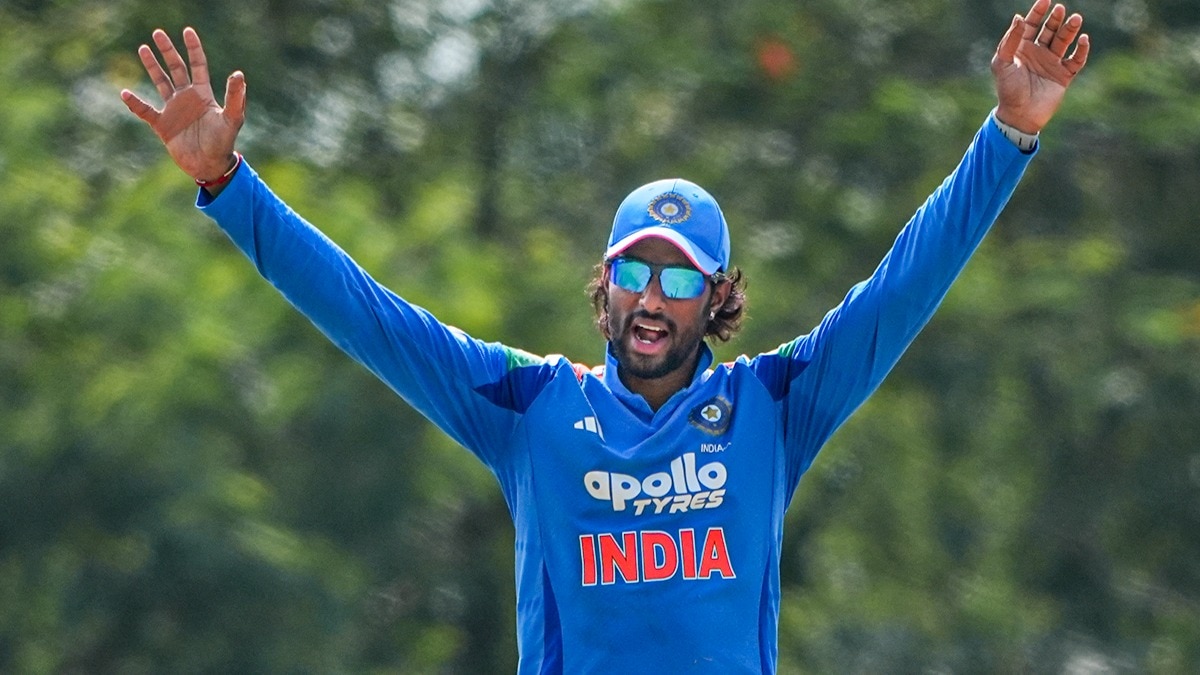
In his first assignment as captain, Tilak Varma briefly lost control of his ship. Leading the India A side in Dambulla, Tilak’s team lost their cool, culminating in an ugly post-match brawl where his 15-year-old opening batter, Vaibhav Sooryavanshi, ended up in a physical altercation with the Sri Lankan team.
Sooryavanshi, just 15 years of age, snapped at select opposition players who celebrated wildly after the hosts beat India in a controversy-filled Super Over. Driven by the raw emotion of the moment, Vaibhav ended up shoving a Sri Lankan player and had to be physically dragged out of the fray by his teammate and batting partner, Suryansh Shedge.
For a cricketer like Tilak, who is being considered as a future leader of the senior Indian team, the incident came as a massive blot. While Tilak wasn’t the one throwing shoves, his own actions had stoked the fire. His animated, furious gestures at the on-field umpires during the final stages of the game had allowed the team’s temper to boil over, setting the stage for the chaos that unfolded after the final whistle.
Social media was quick to crucify the young side. Former India batter Sanjay Manjrekar led the calls for strict disciplinary action, demanding Sooryavanshi be dropped for the subsequent must-win match against Afghanistan A.
“If I was India A coach or manager, I would have left Vaibhav Suryavanshi out for this game v AFG. Only to let him know that it’s not OK to get physical on the field. Whatever the provocations,” Manjrekar posted on X.
But Sanjay Manjrekar is 60. Tilak Varma is 23. The impressionable minds of this ultra-young Indian squad have been nurtured on a vastly different competitive philosophy: ‘Ye naya Hindustan hai. Ye ghar me ghusega bhi, aur marega bhi.’
A decade ago, a scuffle like this might have flown under the radar. But with modern broadcast cameras capturing every inch of the grass, there was nowhere to hide. Traditional cricketing wisdom would suggest dropping the volatile teenager to protect the establishment’s “reputation” – sending him to the sidelines as a punishment.
The dressing room conversation was perhaps about learning from bad experiences, owning up to their actions, and taking responsibility to ensure that the incident would not repeat.
But this was not a match where it was easy to right the wrongs.
Yet, righting those wrongs on the field is never an easy task. When a disciplinary blot is compounded by the terrifying brink of tournament elimination, things can go wrong real fast, real soon. India walked into the next match against Afghanistan A carrying the heavy baggage of consecutive defeats.
With the bat, India put up a decent showing, scoring 319 runs. Tilak anchored in the middle overs, putting up a 104-run partnership with Kumar Kushagra. The captain eventually got out for 59 in the 44th over, when India were at 271 runs, set for another 300+ score.
A GAME-CHANGING MOVE
Tilak’s real test awaited in the second innings, where he had to manage his bowlers, his fielders, and above all, his own temper. Things were not perfect, but he pulled off a fantastic move that completely broke open the game.
Just beyond the 20th over mark, when Afghanistan A had two of their best batters on the pitch, Tilak brought in spin from both sides. The move helped India A break the 87-run stand between Faisal Shinozada and Bahir Shah, who were looking extremely comfortable in the game.
Shinozada, one of the most prolific run-scorers in Asia, gave a leading edge to Anukul Roy. Once the partnership was broken, Tilak put in a slip, pulled back long-on, and asked Bahir Shah to hit big through the leg side. Shah put his foot in the trap and paid the price. A miscued shot went straight to long-off, where Suryansh Shedge was waiting for exactly that.
One of the major points of difference was India’s fielding, where they threw their bodies around to pick up some impressive catches. Vaibhav Sooryavanshi, Ashok Sharma, and Priyansh Arya made the half-chances count, sinking Afghanistan to a 101-run defeat.
You cannot do that unless you have been rallied on. It could have been Tilak, it could have been someone else, but India looked motivated today. From the brink of elimination, India A stormed to the final of the tri-series, and it is an achievement that Tilak should be proud of.
At 23, Tilak remains one of the main fixtures in the Mumbai Indians camp. The way he walks, the way he talks, and the way he responds to the umpires have a mix of Rohit Sharma, Suryakumar Yadav, and Hardik Pandya in him.
On the Monday day against Sri Lanka, it was a little more Hardik-passionate, feisty, and borderline reckless. Yesterday against Afghanistan, it was far more towards Rohit-calm, calculated, and tactically supreme while maintaining just a bit of that necessary Hardik edge.
Tilak is not entirely clear on his own identity yet, but he will find it in time. Through the trial by fire of leadership, he will walk out of those giant shadows and emerge as the first true Tilak, eventually.
What we saw on Monday was the chaotic, unfiltered reality of a young Indian team that refuses to back down. But what we saw on Wednesday was the birth of a captain who knows how to channel that aggression into a winning formula. Leaders aren’t born in peaceful waters; they are forged when things go entirely wrong. By bringing sanity back to the dugout and executing a tactical masterclass on the field, Tilak didn’t just save India A from elimination-he proved he can govern the very fire his team plays with.
The messy, triumphant steps we witnessed in Dambulla are just the beginning. The “Raaj Tilak” has officially begun.
– Ends