Your pillow is one of the most powerful tools to help you fall asleep, remain in your slumber and improve your posture.
But what actually makes a good pillow? Should you be going firm or soft? Feather, foam or something space-age? And is the expensive one really worth it?
In the latest instalment of our series on buying everyday products like an expert, we’ve gathered the facts with help from the people who know their fill from their fluff.
It’s time for some pillow talk.
Find personal finance tips and news in the Money blog
How important can a pillow really be?
The average human spends seven years of their life trying to get to sleep and a further 26 years actually sleeping, so investing some time and money into your pillow choice is well worth it.
The wrong pillow can severely affect the quality of your sleep, damage your neck and spine alignment, cause tension headaches and shoulder pain, worsen airflow (leading to snoring) and even give you allergies as dust mites and skin cells gather over time.
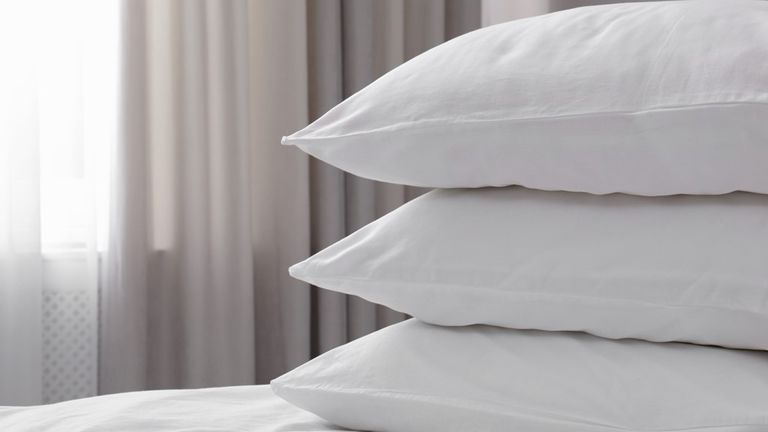
Pic: iStock
When should I think about replacing my pillow?
Joseph Gannon, chief sleep physiologist and clinical lead at The Sleep Disorders Clinic, says if you’ve started waking up with neck pain, it’s a good indication your pillow might need to go: “In general, down pillows need to be replaced after around a year, while it’s three years for good foam pillows.”
There are also some more practical ways to test if your pillow is done for, as explained by James Leinhardt, founder and chief sleep posture expert at Levitex: “If you have to fold, squish or reshape your down pillow, it’s generally time to replace it. If you want to be absolutely sure, put the pillow on your forearm, and if it looks like a sad face, it’s time for a new one.”
So what are the options?
There are plenty of pillow types on the market in 2026, but most still fall into a few major categories.
The best choice usually depends on your sleep position, body temperature, allergies, and whether you want softness or support…

Pic: iStock
‘The single most important thing about your pillow’
The idea that one pillow height suits all sleepers is one of the most persistent and damaging myths in the bed industry, according to Leinhardt.
He says your pillow’s loft (height) is the single most important thing about it. Too low and your head will drop towards the mattress, pulling your neck out of alignment. Too high and you’ll feel like you’re sleeping on a step, pushing your neck into an upward angle.
“The correct height will consider your sleeping position (lower for back sleepers, medium to high for side sleepers), your height (as taller people tend to have wider shoulders) and the firmness of your mattress (if it’s very soft, you’ll need a lower pillow as you’ll sink into your mattress more, making the space between your head and the bed smaller).”
Sleeping on the wrong pillow loft can also affect snoring. Around 41% of adults in the UK snore, roughly 15 million people, of whom 40% are men and 30% are women.
“If the pillow you’re sleeping on is too thick and you regularly sleep on your back, it can bring your chin closer to your chest and occlude the airway,” says Gannon.
This, he adds, can increase your chances of having snoring and potentially sleep apnoea.
If you’re unsure of what height you should be using for your pillow, several websites have a height calculator, which makes the process simpler.
Check the pillow, not the label
Most pillow labels will tell you very little about whether what you’re buying is actually a suitable product.
According to the experts, the only thing to look out for is whether the pillow itself is washable or has a washable pillowcase.
“Many memory foam pillows in funky shapes are sold without the ability to wash their outer pillowcase, which isn’t great for allergy sufferers,” Leinhardt says.
By law, a label needs to have the address of the manufacturer – so make sure that’s there, or you could be buying a dodgy product.
Read more from this series:
Don’t buy air conditioning until you’ve read this
Don’t buy a TV without reading this
How to pick out a good steak
Be wary of buzzwords
Some brands will do their best to “greenwash”, advertising their pillows as either eco-friendly or made with “responsibly sourced” down.
But these aren’t regulated terms. As Leinhardt says, these labels “could just as easily be slapped on a 1995 diesel engine”.
He says consumers should instead look out for specifics, like whether the packaging is recyclable or whether the brand offsets its carbon footprint.
When it comes to down and sourcing it responsibly, the Responsible Down Standard (which is independently audited) is the most credible third-party certification, providing chain-of-custody traceability from farm to finished product.
‘I can sell you a brick and call it an orthopaedic pillow’
“Orthopaedic” is another unregulated marketing term. As Leinhardt puts it: “I can sell you a brick and call it an orthopaedic pillow.”
He says any manufacturer can do this with no proof, studies, standards or requirement to back up their orthopaedic claims.
“The word itself has connotations of clinical validation, which sadly doesn’t actually exist in most orthopaedic cases.
“What you should be looking for isn’t whether a pillow carries the label or has the word in the name, but rather whether the design and the material have been clinically tested and the evidence independently published.”

Pic: iStock
How much should I spend?
Many pillows now come with money-back guarantees, but most people would prefer to get the purchase right first time.
Price won’t always dictate quality, but the experts say it does a lot of the time.
“More expensive pillows tend to have more fill (if they’re down or fibre pillows) or higher foam density. These will affect how long the pillow stays supportive for,” Leinhardt says.
“By comparison, a cheap pillow that collapses within a couple of months or never provides support in the first place, and that you need to replace quickly, is hardly economical.”
Leinhardt says it’s worth thinking about the cost per night: a pillow that costs £80 over three years works out at well under 10p a night. When you consider this, the gap between a budget pillow and a premium one becomes much smaller.
“Considering how often you need to replace a cheaper pillow and the difference in sleep quality and recovery through the night, this can be significant,” he adds.
“Of course, there’s an initial investment, but I do believe investing in your sleep is one of the best things you can do for yourself.”