Not hope of watching India playing in the FIFA World Cup, that dream is sitting separately somewhere.
The hope of India enjoying the FIFA World Cup.
For one month, the FIFA World Cup turns parts of India into little pockets of the footballing world. Streets fill with flags, jerseys to office after a messed up sleep schedules, everything is granted.
Even your uncle who hasn’t watched a single minute of club football all year suddenly becomes a tactical expert. He won’t know who’s top of La Liga, but he will absolutely ask for the Argentina score, stay up until 3:00 AM for a knockout match, and debate Messi vs. Ronaldo over morning chai.
In a cricket-obsessed nation, the World Cup is football’s reminder that India may not be part of the tournament, but it absolutely belongs to the audience.
Which is why the uncertainty surrounding the FIFA World Cup 2026 broadcast rights has felt so bizarre.
And, for many supporters, insulting.
Not because Indian fans genuinely believe they will be left without a broadcaster when the tournament kicks off on June 11. Most understand that a deal will eventually happen. In fact, reports suggest Zee is now closing in on an agreement worth around USD 30-35 million, with an announcement potentially arriving within days.
The frustration comes from something deeper.
Football fans can see where this story is heading.
They know that this whole chapter will leave a mark. They have seen it all before.
Almost everyone has started predicting the implications beyond this World Cup.
And once again, the people left waiting are the fans.
WHAT A WORLD CUP MEANS TO INDIA
Football fandom in India has always been a fascinating contradiction.
The country has never played at a FIFA World Cup. The domestic ecosystem remains terribly fragile along with the national team sitting miles away from football’s biggest stage.
Yet every four years, India behaves like a country that belongs at the tournament.
Kolkata is perhaps the most famous example. During World Cup season, the city transforms into a football carnival. Entire neighbourhoods split themselves into Argentina and Brazil camps. Giant cut-outs of Messi, Neymar and Cristiano Ronaldo appear on roadsides. Local club rivalries are temporarily paused as supporters rally behind their adopted international teams.
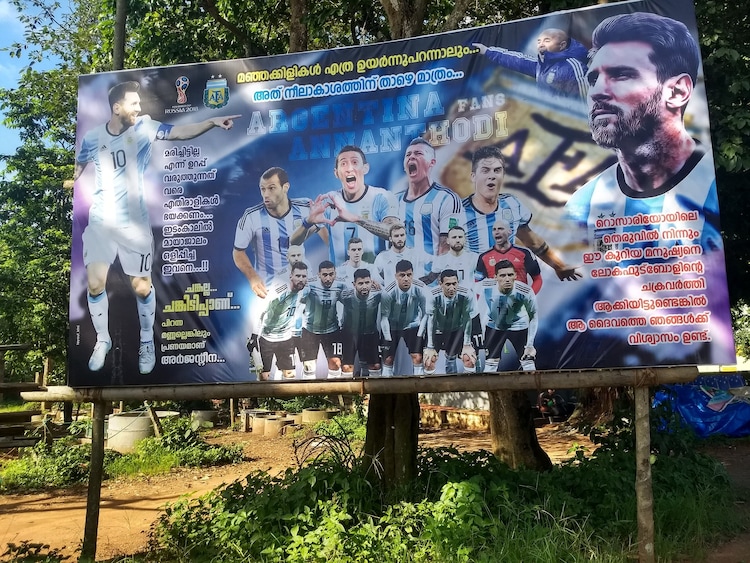
Then down in Mallapuram, where Argentina banners already line the roads.
All of these examples are also reasons why the current situation feels so strange.
Because while fans are preparing for the biggest World Cup in history, the business side of football has spent months arguing over who gets to show it.
THE NUMBERS WHICH STARTED THE WAR
The story gets way more frustrating the moment you follow the money.
What should have been a normal corporate paperwork exercise slowly turned into a massive, very public game of boardroom chicken. This mess left one of FIFA’s most obsessed markets completely stranded without a confirmed broadcaster just days before the opening match.
To understand how we got here:
FIFA initially sought close to USD 100 million for the India package covering the 2026 and 2030 World Cups
The valuation later dropped to roughly USD 35 million
A reported USD 20 million offer from JioStar was rejected
Sony explored the rights but never submitted a formal bid
Only 14 of the tournament’s 104 matches will start before midnight in India
The final itself is scheduled to begin at 12:30 AM IST
The tournament features a record 48 teams and 104 matches
India accounted for 2.9 per cent of FIFA’s global audience reach during the 2022 World Cup
More than 110 million digital viewers reportedly followed Qatar 2022 from India
The irony is impossible to ignore.
The World Cup is getting bigger. More teams. More matches. More stories. More content.
Yet finding a broadcaster in the world’s most populous country became one of FIFA’s biggest commercial headaches.
The debate has largely centred around timings. Broadcasters believe midnight and early-morning kick-offs significantly reduce the tournament’s commercial appeal.
But is that entirely fair?
Football fans would argue that World Cups have always operated differently from normal sporting events. The World Cup is not just another football tournament squeezed into a crowded calendar. It is a global phenomenon. The sort of event where even casual fans suddenly become emotionally invested.
After all, if timing alone dictated popularity, generations of Indian football fans would never have stayed awake until three in the morning to watch Messi, Ronaldo, Zidane, Ronaldinho or Mbappe.
That does not mean the broadcasters are wrong.
It simply means the answer is more complicated.
WHY THE BROADCASTERS AREN’T ENTIRELY WRONG
Now to where football emotion collides with media economics.
Or in simple words, where the heart meets logic.
Speaking to India Today exclusively, Rajesh Sethi, Partner and Leader – Media, Entertainment and Sports at PwC India, believes the issue has been misunderstood from the beginning.
“The delay is not attributable to a negotiation glitch but rather to a straightforward commercial issue,” Sethi explained.
Let’s break it down.
Midnight kick-offs mean lower advertising revenue. A late deal leaves broadcasters with almost no time to sell sponsorship packages. The consolidation of India’s media landscape means there are fewer bidders competing against one another.
As Sethi bluntly puts it, “Indian broadcasters are justifiably unwilling to base their payments solely on population optics.”
To put it simply, India’s population may be enormous.
But advertisers pay for viewers, not census figures.
Sethi also points to a deeper issue that football administrators may not particularly enjoy hearing.
“The underlying uncomfortable truth is that cricket achieved commercial dominance because broadcasters, sponsors and administrators collectively invested decades in building its ecosystem,” he told India Today.
“In contrast, global football bodies have approached India as a market for extraction rather than development.”
That observation perhaps explains why broadcasters have become increasingly cautious.
The era of throwing money at every major non-cricket property simply because it is prestigious appears to be ending.
CAN FIFA AFFORD TO IGNORE INDIA?
The problem with the broadcaster’s argument is that it only tells half the story.
Aahna Mehrotra, Founder of AM Sports Law & Management Co., believes India remains too important for FIFA to casually overlook.
Speaking to India Today exclusively, Mehrotra pointed to India’s growing football footprint and questioned whether any global sports body can afford to dismiss a market of this size.
“I mean no one sacrifices the most populated country in the world, which is the second-largest mobile phone market where mobile data is available at one of the cheapest prices in the world,” she said.
And she has a point.
India contributed approximately 2.9 per cent of FIFA’s global audience reach during the 2022 World Cup despite not having a team in the tournament. More than 110 million digital viewers reportedly followed Qatar 2022 from India.
European leagues already recognise the opportunity. The Premier League aggressively markets itself here. La Liga has established an India office. Trophy tours routinely visit Indian cities. Even rumours of Messi visiting India generate national headlines.
“It must be a concern for FIFA to have weak broadcaster interest in India, which could dent both revenues and its long-term ambition with regard to the growth of football,” Mehrotra added.
That makes the current situation awkward for FIFA too.
Because while India may contribute more reach than revenue today, it represents potential that few global sports organisations can afford to lose.
WHAT CHANGED SINCE QATAR 2022?
Perhaps the most important question is not why the deal got delayed. It is why this never happened four years ago. The answer lies in India’s changing media landscape.
Previous World Cups enjoyed multiple serious bidders. Sony broadcast two editions. Viacom18 paid heavily for Qatar 2022. Competition drove prices upwards.
Today, the Reliance-Disney merger has created a very different environment. JioStar holds enormous leverage. Sony stayed away. Zee only recently returned to sports broadcasting with the launch of its Unite8 Sports channels.
As Mehrotra explained to India Today, FIFA was essentially negotiating with buyers who no longer felt pressure to overpay.
“The broadcaster landscape has fundamentally been restructured,” she said. The result is that FIFA found itself negotiating in a market where broadcasters held more leverage than ever before.
And perhaps that is the real reason this entire saga stretched on for so long.
INDIA’S WORLD CUP MIGHT BE SAFE
The good news is that fans will almost certainly get their World Cup.
Reports suggest Zee is close to securing the rights, with multilingual coverage planned across its sports channels and Zee5. Sources indicate teams have already begun preparations from the broadcaster’s Mumbai studios.
If the agreement goes through, all 104 matches of the tournament will be available in India.
But here’s the catch. This entire episode has established a benchmark. If FIFA ultimately settles closer to USD 30 million than USD 100 million, future negotiations for football rights in India will inevitably start from that reference point.
As Mehrotra notes, that could become football’s new anchor price in India. The consequences may extend far beyond one World Cup.
Other football properties could face tougher negotiations. Global federations may need to rethink their expectations. Broadcasters may increasingly demand revenue-sharing or co-investment models instead of paying large upfront guarantees. The irony, of course, is that none of the people arguing over millions of dollars are the ones waking up at 3 AM to watch Argentina, Brazil or France.
The fans are. They always are. And somehow, they are usually the ones who end up paying the price.
– Ends