


The Samajwadi Party’s decision not to field a third candidate in the Uttar Pradesh Rajya Sabha elections is being viewed by political observers as a strategic call aimed at preventing internal rifts and avoiding potential humiliation ahead of the Assembly elections.
With the BJP having nominated eight candidates and the SP sticking to two, voting has been ruled out, allowing both sides to claim their share without a contest.
Analysts suggest the move is designed to shield the party from the embarrassment of cross-voting. Had the SP put up a third nominee, any shift in loyalty by its legislators towards the NDA could have been publicly exposed the party rift, dealing a blow to cadre morale and projecting weakness within the party ranks and, most importantly, putting it on the back foot in seat-sharing negotiations with its ally, the Congress, for the 2027 UP Assembly election.
The SP appears to have chosen a path that allows it to exit the process with its head held high. Political circles note that this calculated restraint prioritises organisational stability over an uncertain fight for an additional seat, reflecting a pragmatic assessment of ground realities in the state Assembly.
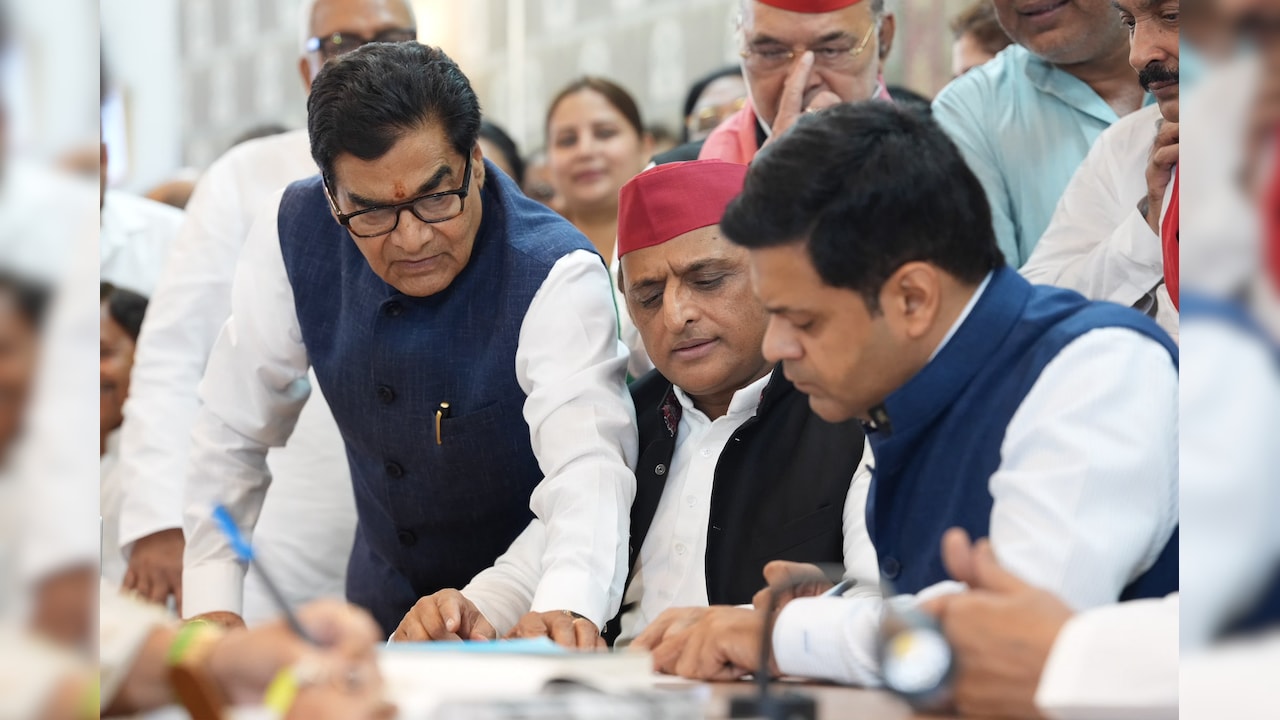
Akhilesh Yadav with SP candidates Ram Gopal Yadav and Dhanraj Parimal Nathwani
Avoiding A Repeat Of February 2024
In the February 2024 Rajya Sabha elections, the BJP was expected to win seven seats and the SP three on the basis of Assembly strength. The BJP, however, fielded a surprise eighth candidate and forced a contest. In the end, all eight BJP candidates won, while only two SP candidates succeeded. This was because around seven SP MLAs had voted for the BJP.
Read | Why Congress Is Turning To Smaller Parties Ahead Of UP Polls
UP Rajya Sabha election is not as simple as it looks.
The Rajya Sabha elections in Uttar Pradesh have taken an intriguing turn, with political arithmetic colliding with the realities of cross-voting and last-minute manoeuvres. According to an NDTV report, the BJP procured a 9th nomination form, signalling aggressive intent. The Samajwadi Party nominated two candidates and was reportedly in the final stages of deciding on a third candidate. With 12 candidates contesting 10 seats, an election would be unavoidable. But after the final day of filing nominations, i.e. October 6, the BJP fielded 8 candidates and the SP put up only 2.
Rajya Sabha Is Not A Direct Election
In place of the public, the representatives of the public, i.e. MLAs of the state Assembly, elect the Rajya Sabha members, if there is an election.
How Is Quota Calculated
The number of first-preference votes required to secure one seat is determined by the formula:
Total first-preference votes needed = [Total sitting MLAs / (Seats up for election + 1)] + 1
With 396 MLAs currently in the Uttar Pradesh Assembly and 10 seats to be filled:
396 / 11 = 36, plus 1 = 37 votes are required for one seat.
The second preference votes come after this.
However, the system followed is of a single transferable vote. So, MLAs who vote in an open ballot in Rajya Sabha polls mark their first, second, third, etc preferences, depending on number of candidates. If the 1st preference votes do not fill all the seats, the surplus votes of those already elected are transferred to the second preference candidates of MLAs whose first preferences have already won. This process goes on until all the seats are filled up.
Here’s a look at the numbers as they stand in the Assembly.
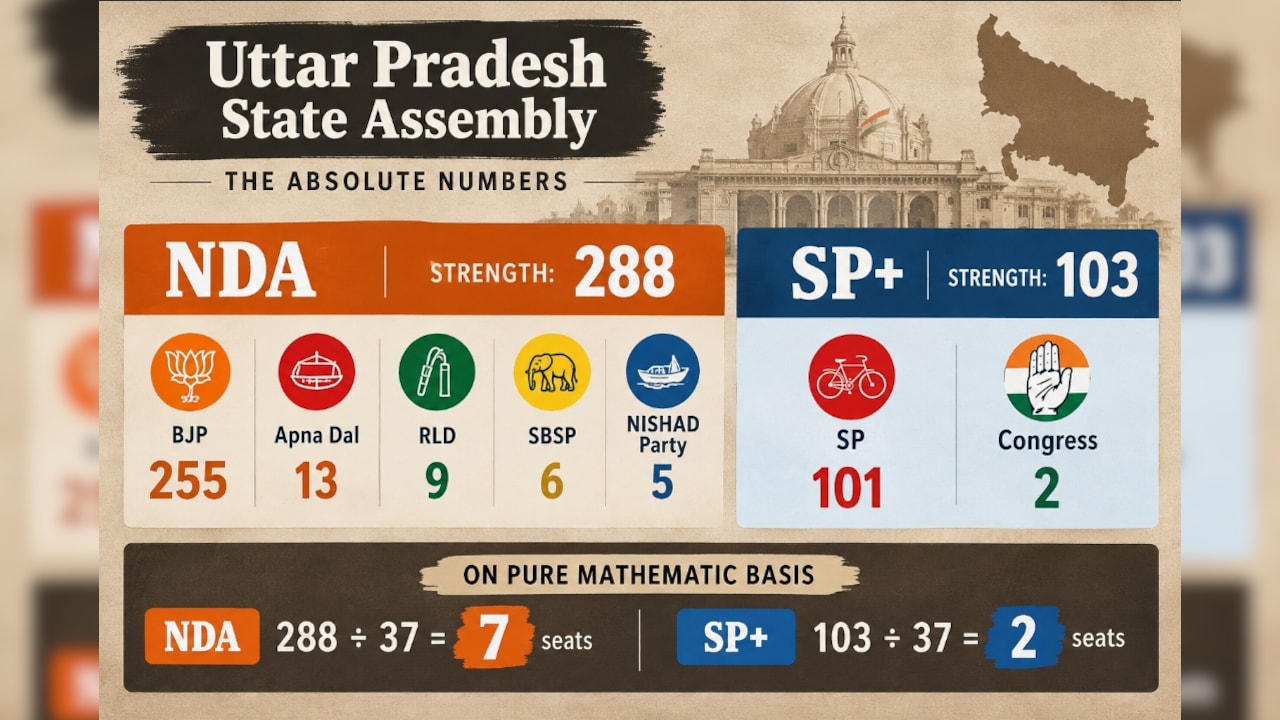
Neither alliance appears positioned to claim the 10th seat on numbers alone, if election took place.
NDA’s Hidden Strength
SP MLA Pooja Pal has openly expressed support for the BJP. Three other SP legislators – Abhay Singh, Rakesh Pratap Singh and Manoj Kumar Pandey – had voted for the BJP in the 2024 Rajya Sabha election. Additional SP MLAs Rakesh Pandey, Vinod Chaturvedi and Ashutosh Maurya are also reported to be inclined towards the NDA, potentially lifting its effective strength to 295. Support from two Jansatta Dal (Loktantrik) MLAs associated with Raja Bhaiya could push the figure to 297.
However, two Muslim MLAs of the SBSP and two of the RLD are expected to either vote against the NDA or abstain, bringing the effective tally down to around 293.
INDIA Bloc Numbers
SP and Congress together account for 103 members. One MLA, Ramakant Yadav, is in jail and may not be able to vote, reducing the strength to 102. Four SP MLAs (Pooja Pal, Rakesh Pandey, Vinod Chaturvedi and Ashutosh Maurya) are widely expected to support the NDA, further lowering the alliance’s reliable votes to 98. Conversely, the four Muslim MLAs from SBSP and RLD could back the SP, restoring its effective strength to around 102.


