


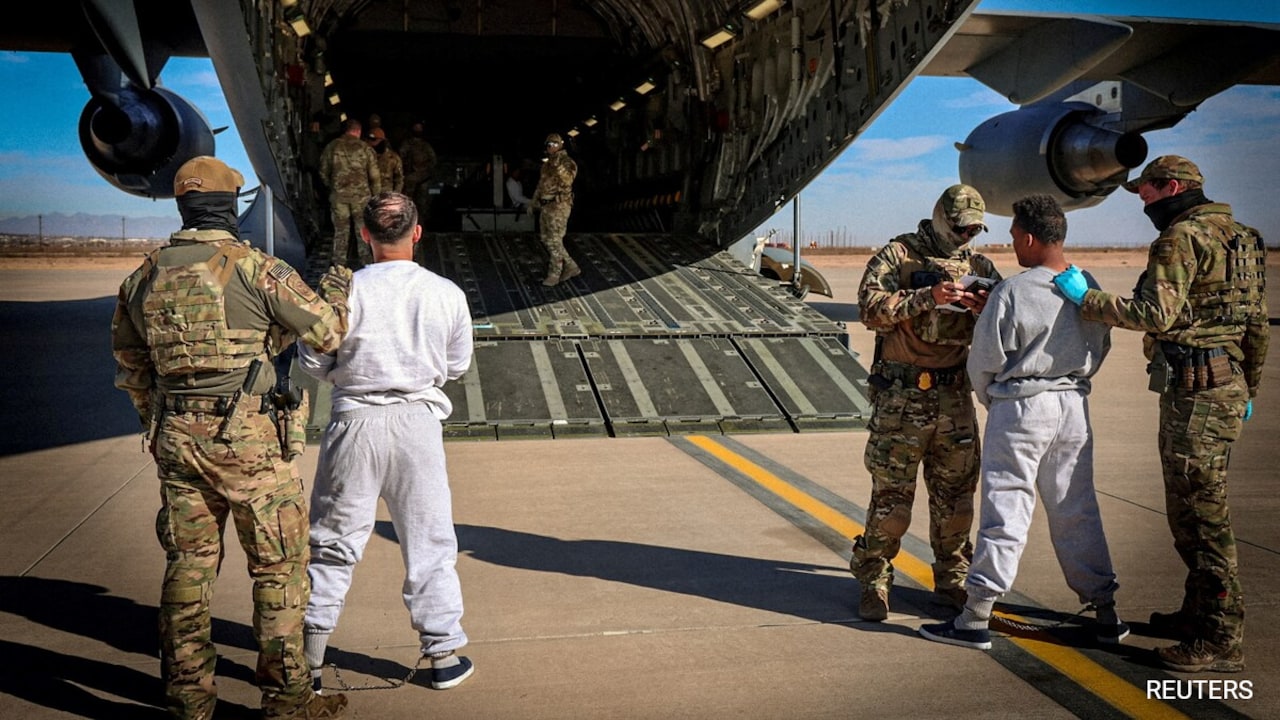
The Donald Trump administration has turned a small office in the US State Department into a key part of its plan to deport migrants to countries they do not belong to, according to an investigation.
The US has approved at least $410 million for deals with 31 countries to help deport migrants to third countries, according to internal State Department records reviewed by The Washington Post. The deals include at least $81 million in direct payments to 13 foreign governments.
The deals are being handled by the newly created Office of Remigration, which has around 15 employees. It is led by US diplomat Christian Ehrhardt.
Ehrhardt travelled to several African countries in June, including Ivory Coast, Gambia, Guinea-Bissau, Togo and Gabon. He met government officials to discuss deals under which these countries could accept migrants deported from the US.
The migrants sent under these deals are not citizens of the countries receiving them. Some early deals sent migrants to Costa Rica and the African country of Eswatini. The migrants included people from China, Russia, Iran, Afghanistan, Vietnam, Laos, Cuba and Jamaica.
The US has also promised $179 million to the International Organization for Migration (IOM) and $124 million to the UN Refugee Agency for projects linked to refugees and infrastructure in these countries.
The money is being offered as part of negotiations with countries agreeing to take deported migrants, according to current and former US officials. In some cases, the funds are being sent to international organisations rather than directly to governments.
The programme has been strongly associated with Stephen Miller, a senior White House official and long-time Trump adviser who has focused heavily on immigration restrictions.
The State Department’s Bureau of Population, Refugees and Migration (PRM) traditionally worked on refugee resettlement and humanitarian aid. However, soon after taking office in January 2025, Trump suspended most refugee processing, with an exception for White South Africans. His administration also ended contracts with US refugee resettlement groups.
Around $250 million from refugee programmes was redirected to a Department of Homeland Security programme called Project Homecoming, which encourages migrants to leave the US voluntarily. The State Department later created the Office of Remigration inside PRM.
Employees who had previously worked on refugee and humanitarian programmes were moved to work on deportation-related tasks. According to former State Department employees, officials were told to move quickly and avoid delays in setting up deportation deals.
The US has created different types of agreements with countries to make the deportations possible. Some deals depend on diplomatic promises rather than stronger legal protections. Another type, called a “Lilypad” arrangement, allows countries to accept migrants temporarily before they are moved to another country.
Uganda, for example, will accept only African nationals. The Democratic Republic of the Congo, however, will not accept African nationals. Some countries have agreed to accept people with criminal records. Others will accept only people who have not committed violent crimes.
Eswatini has agreed to accept up to 150 deportees in return for $5.1 million. The Democratic Republic of the Congo has agreed to accept up to 2,000 migrants, with $75 million pledged to organisations linked to the deal.
Costa Rica has agreed to accept 25 migrants every week. The US is not paying Costa Rica directly but has promised $22.6 million to the IOM and $10 million to the UN Refugee Agency. The Central African Republic deal includes $85 million for the IOM, including money for roads and other infrastructure.
The Trump administration says third-country deportations are needed for migrants who cannot be sent back to their own countries.
So far, more than 25,000 people have been deported to at least 28 third countries, according to an analysis using data from several independent sources. Around 20,000 of them were sent to Mexico, which has an informal arrangement with the US.
Some of the agreements have also faced problems. The US agreed to pay Palau $7.5 million to accept up to 75 deportees. But only three migrants had been sent there by June, according to State Department records.


