


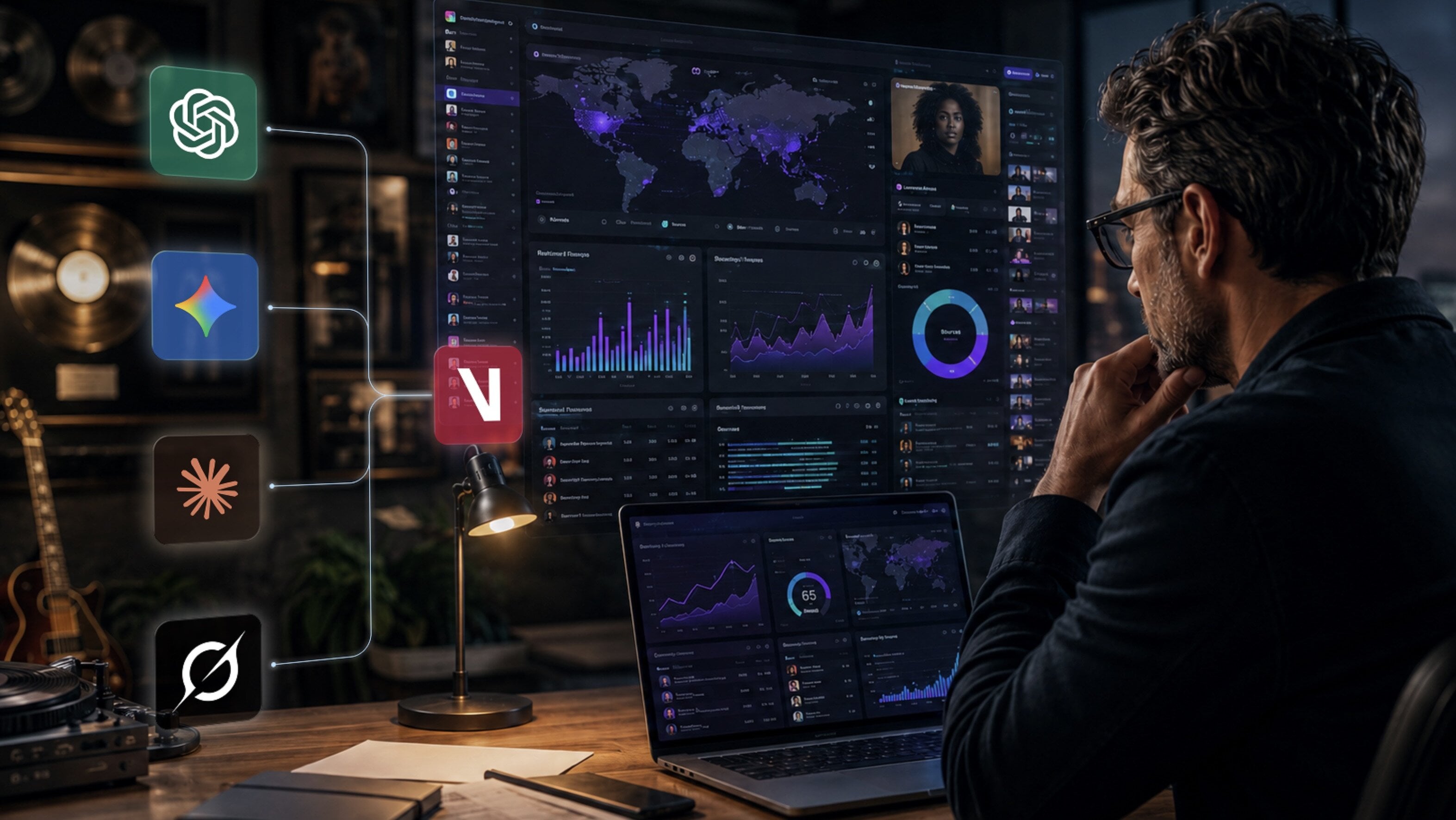
AI is changing the way music is created, licensed, and discovered. Viberate thinks it is about to change how the industry uses its data, too.
The music data company has a prediction: within a couple of years, it says, more people will use its numbers inside an AI assistant than on Viberate’s own platform.
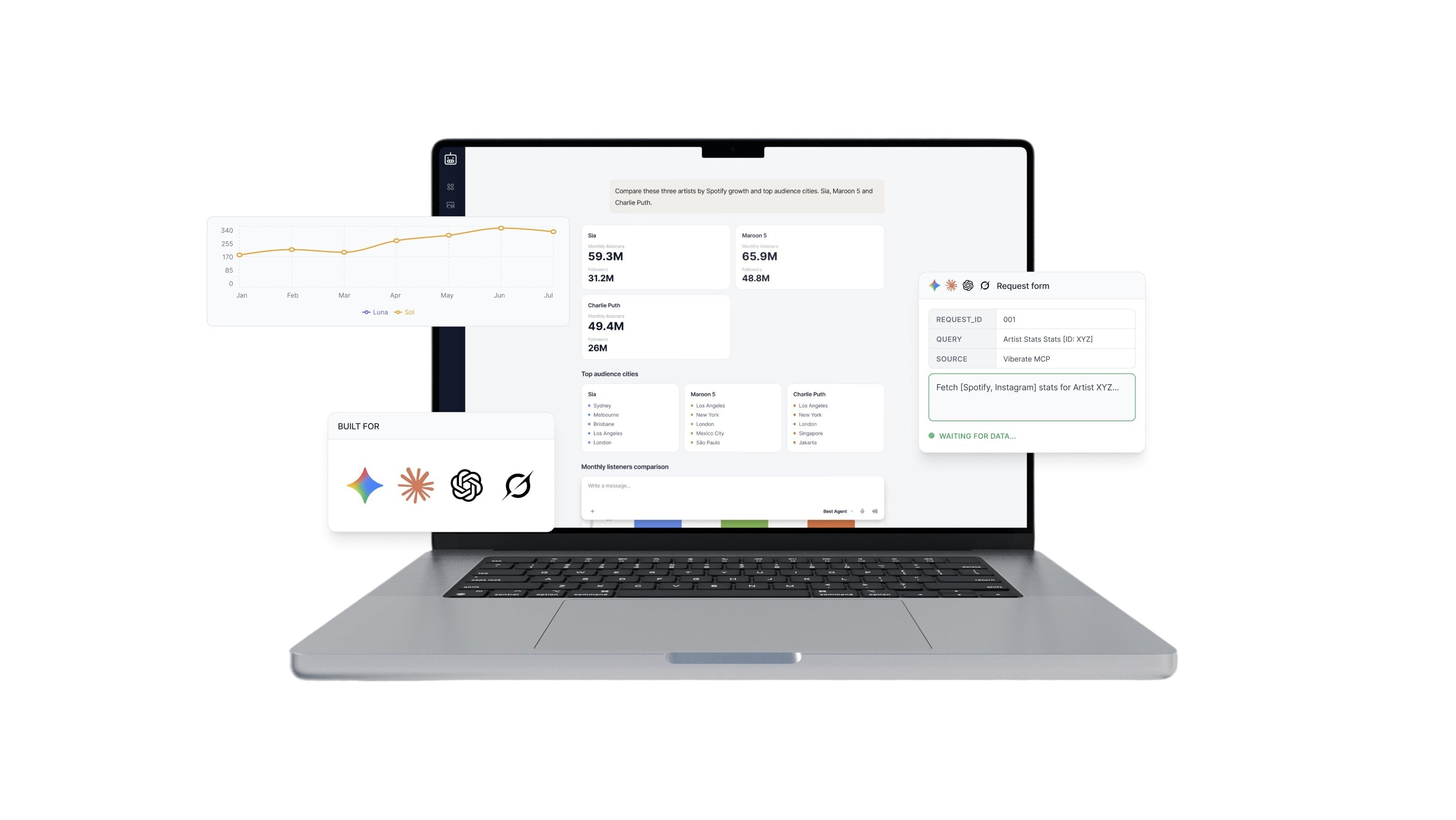
To that end, the analytics company has launched an official MCP server that lets users of Claude, ChatGPT, Gemini, Grok, and other AI services tap its data by asking questions in plain language.
The MCP server, Viberate says, is the first step in an “AI-first” pivot for the company, which was founded in Slovenia in 2015 and has offices in Ljubljana (Slovenia) and Los Angeles.
The Viberate platform offers stats on more than 11 million artists, 100 million songs, and 19 million playlists, plus over 160,000 labels and 7,000 festivals.
Using the company’s new MCP server, that vast pool of data can now be queried in natural language and turned into artist predictions, lineup suggestions, or marketing strategies via any compatible AI assistant, Viberate says.
The Model Context Protocol (MCP) is an open standard, introduced by AI giant Anthropic and since adopted across the AI industry. It lets AI agents connect to outside data sources and act on them.
Since Anthropic introduced the protocol, it has been adopted by other major AI platforms, including OpenAI’s ChatGPT, Google‘s Gemini, and xAI’s Grok.
Viberate describes it as a “USB-C for AI,” a universal bridge that lets any compatible AI plug into a tool or database to retrieve context and run tasks without a custom-built integration.
“It’s like having a consultant with the combined IQ of all the best data scientists in the world times a million.”
Vasja Veber, Viberate

“We strongly believe that the entire business intelligence industry will sooner or later shift to becoming a data layer for AI agents to read and process,” said Viberate co-founder and CCO Vasja Veber.
“AI models are only as good as the underlying data they’re tapping into, and here we’re at the top of our game,” Veber added.
“So far, the two main ways of using Viberate have been platform access and API,” he said. “The MCP server introduces a third way, and we think this will soon become the prevailing way of using any data analytics service. It works incredibly well.”
Asked about Viberate’s wider AI roadmap, Veber described the MCP server as “a toolbox” that users can use to build their own services, search for promising acts, run deep dives or pull charts.
“Anything they can do on the platform, they can do in their AI app ten times better and faster,” Veber said.
“But so can we, and we are already using the toolbox to produce our own highly focused services that will solve individual problems some of our niche target groups have,” Veber added.
In practice, that means Viberate is building standalone AI apps tailored to specific client needs. Users of those apps “won’t need to make up prompts,” Veber said, but will enter an artist, label, or track name and have the AI pull data from Viberate’s API into a predefined template.
“Each app can be trained on an individual client’s existing data, so it’s fully customizable,” Veber said.
The apps are currently in private beta with select clients, Viberate says.
“We might say we’re a little late to the AI game, but it was our conscious decision that until we find a really kickass solution that will solve actual problems, we won’t do anything AI-related,” Veber said.
Veber said the shift to AI-powered analytics will reshape daily life for labels, A&Rs, managers, and artists, starting with a basic problem: most of them don’t enjoy using data platforms.
“The music industry is the coolest industry in the world,” Veber said. “The statistics industry, on the other hand, is probably the least cool.”
“That is very obvious in our niche, and although our clients know that they need to use data platforms to stay ahead of the game, they don’t love it,” Veber said.
“There is a learning curve, and if you are not very data-savvy you often have problems or use only a fraction of what’s available,” Veber said. “Instead of spending your mornings staring at graphs and benchmarking stats, or hiring us to do it for you, you will simply ask [the AI assistant] questions and get answers.”
Veber added: “You are now able to organize your artists or tracks into individual projects inside your AI assistant and then have it learn about them through the data we provide daily.”
“Until now it was a big advantage if you knew your way around numbers to be a good A&R, manager, promoter, etc., but now the only differentiator is the size of your imagination and how well you can translate that into questions.”
Viberate was co-founded by Veber, Matej Gregoričič and Slovenian techno DJ UMEK (Uroš Umek), who originally built the platform as an internal tool for their own artist management business before pivoting to serve the wider market.
In 2023, the company told MBW that its analytics tools process more than 1 billion data points a day.
The company works with thousands of clients, including major record companies, independent labels, DSPs, distributors and promoters, according to Viberate.
Viberate says setting up the MCP connector “takes seconds,” with a free tier offering basic access and a paid plan unlocking more than 20 advanced tools.
For three months from launch, the company says it is offering a 20% “founding discount” on the paid plan, with subscribers locking in the reduced rate for as long as they keep their subscription.
Looking to the future, for music analytics, Veber argues that integration with AI services is “an ‘adapt or die’ dilemma.”
“We strongly believe that in a couple of years, more users will use our data in their favorite AI service than go directly to our platform, and sooner or later platforms will become obsolete,” Veber said.
The difference, he said, is that the platform leaves it to the user to interpret the metrics, whereas an AI such as Claude or ChatGPT applies its own reasoning to the same dataset and tells the user what to do with it.
“When we were testing this in our staging environment, our minds were blown away,” Veber said.
Viberate has spent more than 13 years extracting information from raw data, Veber said, but added that the way AI combines metrics, identifies patterns, and generates answers goes far beyond what a human analyst can do.
“It’s like having a consultant with the combined IQ of all the best data scientists in the world times a million,” Veber said.
Still, Veber cautioned that the technology is only as good as its underlying data. “It doesn’t matter how advanced AI algorithms get – without a reliable data source, none of this works,” he said.
Music Business Worldwide



