


The year was 1984. That was the first time when the possibility of machines taking over humans became established firmly in collective human consciousness because of the gritty and intense ‘The Terminator’. Arnold Schwarzenegger’s stoic, mechanical demeanour turned the T-800 into an unforgettable pop-culture villain. In the decades since, technology has evolved through a rapid, compounding acceleration that marks a distinct shift in human history. Artificial intelligence (AI) has moved beyond solving mathematical problems and writing poems and is playing a crucial role in modern warfare.
AI has transformed warfare by compressing decision-making, timelines, automating target identification and lowering the technical barrier for building lethal weapons.
Former CIA Director and US Army Commander General David Petraeus, who studies, advocates for, and analyzes the rise of autonomous systems, drones, and AI in modern warfare, will be an esteemed guest at the NDTV World Summit where he will present his views in a session titled ‘War in the time of AI: How Technology Is Rewriting the Battlefield’.
General Petraeus had recently stated on the Forecast 2050 podcast that autonomous AI staff officers and systems capable of gathering data and making decisions with little to no human input could be deployed on battlefields within four years (by 2030).
And early strides are already visible. The war waged by the US in Iran is the first large-scale test of US military’s AI-focussed military ecosystem.
In April, more than 13,000 targets were struck under Operation Epic Fury, 1,000 of which were hit on the opening day alone, according to US Central Command (CENTCOM). This was a classic example of an AI-powered attack that showed how time to take targeting decisions was reduced from days to just seconds, raising questions about accountability and the cost of civilian life.
The US military’s AI strategy is driven by the Maven Smart System (MSS), developed by technology company Palantir as part of Pentagon’s 2017 initiative.
The Heart Of An AI-Powered Warfare System
The MSS uses data from National Geospatial Intelligence Agency to give live view of the battlefield to commanders. The system is continuously analysing data through machine learning models, identifying objects and assigning confidence scores to potential targets.
Once a target is confirmed, the system recommends strike options, suggests weaponry and ranks courses of action. The final go-ahead rests with a human, who can either order a strike seek further approval.
At the heart of the MSS is Anthropic’s Claude.
Russia-Ukraine War Was The Testing Ground
Maven, as a project, was put to trail on the frontlines of the Russia-Ukraine war before the full-scale rollout. US Lieutenant General Christopher T Donahue had described the conflict as Project Maven’s ‘laboratory’, as per a 2024 New York Times report.
At that time, however, Project Maven was deliberately stripped of advanced capabilities, such as delivering precise targeting data, as per the report.
Israel Also Tested AI System
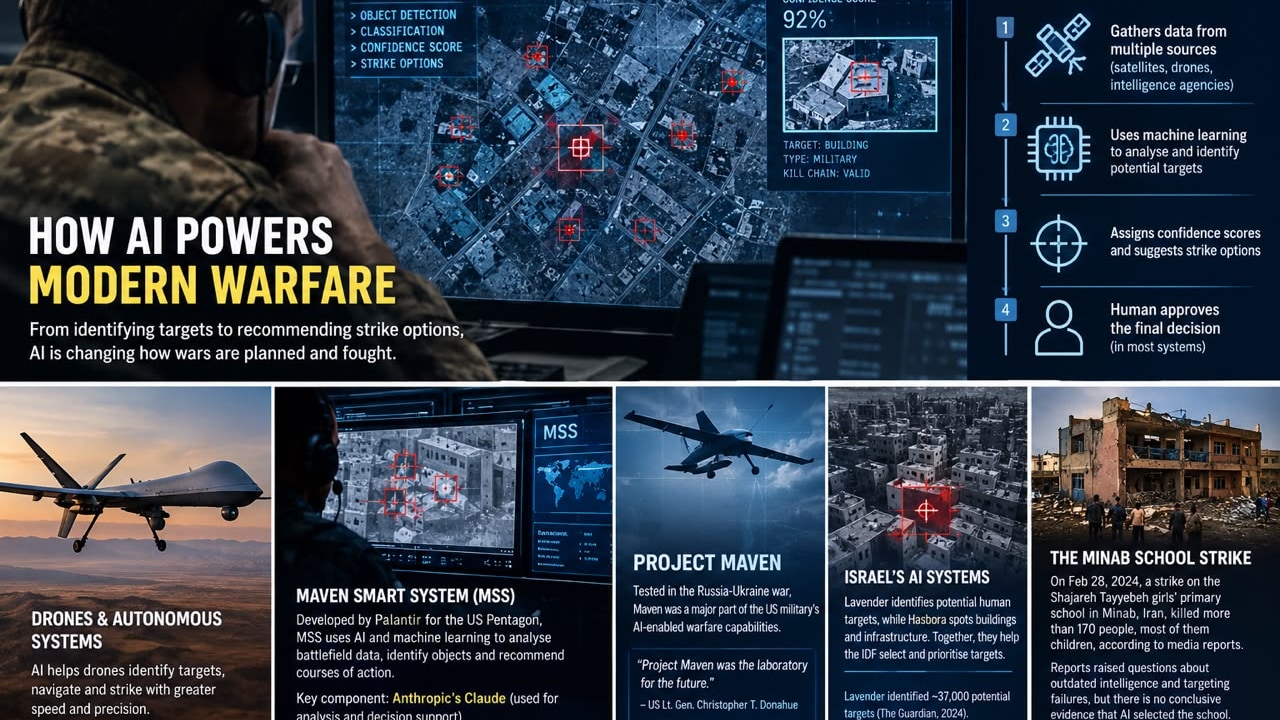
Tel Aviv used AI to identify potential targets during its ongoing offensive in Gaza. In fact, Israel’s Defence Ministry Director-General Eyal Zamir described AI as “complete game-changer” in eliminating targets more effectively.
The AI systems used by Israel military, the IDF, are Lavender and Hasbora. While Hasbora identifies targets like buildings and other infrastructure, Lavender chooses human targets, which according to a Guardian report, identified 37,000 potential targets.
The Ethical Problem With AI Choosing Targets
The dangers of AI-assisted warfare came into sharp focus on February 28 this year, when a strike on the Shajareh Tayyebeh girls’ primary school in Minab, southern Iran, killed more than 150 people, most of them children. Subsequent investigations raised questions about whether outdated intelligence and failures in the targeting process contributed to the tragedy, amid the US military’s wider use of AI-enabled systems such as Palantir’s Maven Smart System. However, publicly available reporting has not conclusively established that AI selected the school as a target. The incident has intensified a critical debate: when technology helps accelerate military decisions, can human oversight prevent a mistaken target from becoming a civilian catastrophe?
The biggest concern with AI-powered warfare is not just how quickly it can identify targets, but how reliably it can distinguish a legitimate military target from a civilian – and who takes responsibility when it gets that decision wrong.
In conventional warfare, military personnel assess intelligence, verify targets and decide whether an attack is justified under the laws of armed conflict. AI can assist with these tasks, but its recommendations are only as reliable as the data it analyses and the assumptions built into the system. A high confidence score is not, by itself, proof that a person is a combatant or that an attack is lawful.
The larger question is whether human oversight remains meaningful when technology generates targets at a pace that makes detailed scrutiny difficult. If a person merely approves an algorithm’s recommendation without independently examining the evidence, does the presence of a human in the decision-making process offer sufficient protection?
The International Committee of the Red Cross (ICRC) has warned that autonomous weapons raise serious humanitarian, legal and ethical concerns because they can select and attack targets without further human intervention. It has called for limits on their use and for human control to be maintained over decisions involving the use of force.
There is also the question of accountability. An algorithm cannot be held morally responsible for a mistaken identification or a civilian death. Responsibility must remain with the people and institutions that develop, deploy and authorise the use of these systems.
AI may make warfare faster, more precise in some circumstances and less dependent on human operators for certain tasks. But speed is not the same as judgement, and technological sophistication does not guarantee that a military decision is lawful or justified.


