


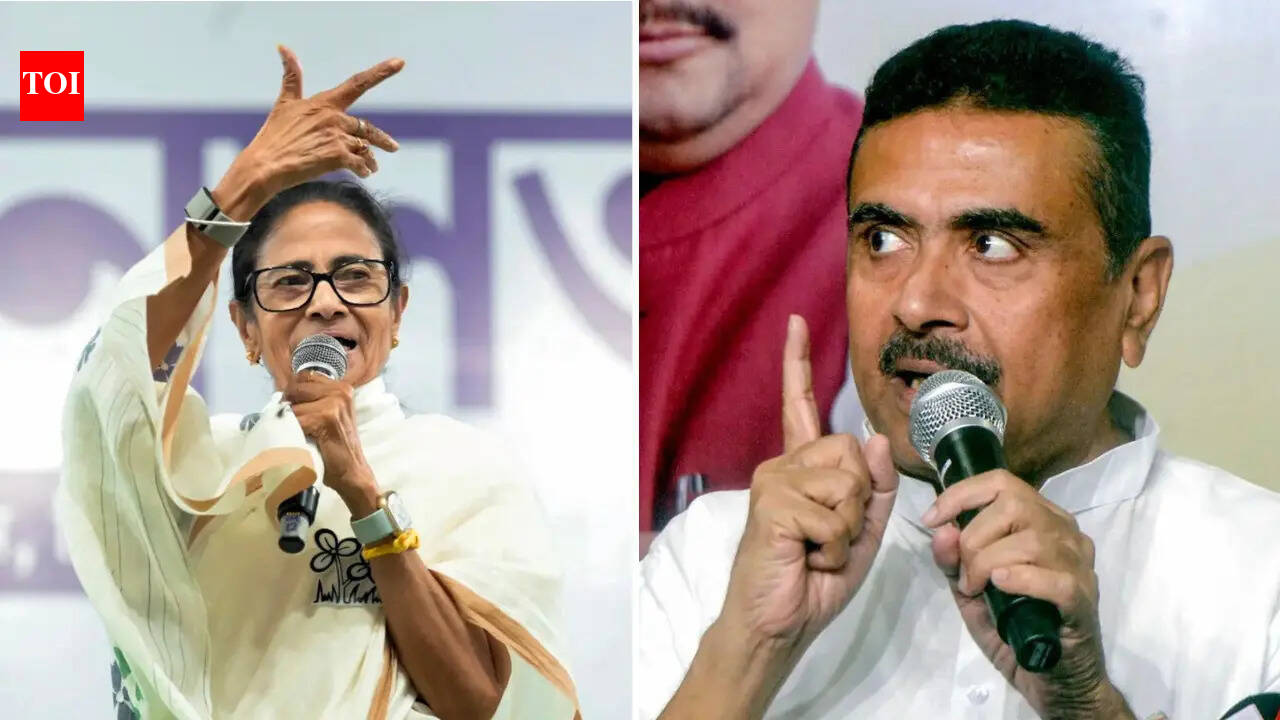
NEW DELHI: West Bengal’s 2026 assembly election is unfolding as a tightly contested battle between the ruling Trinamool Congress (TMC) and the Bharatiya Janata Party (BJP), with exit polls suggesting a sharply divided mandate. While several projections give the BJP an edge, others point to a neck-and-neck race, underlining the uncertainty surrounding the outcome. Chief minister Mamata Banerjee has rejected these forecasts, insisting her party is set for a sweeping victory.Beyond the headline numbers, however, the election is being shaped by two powerful undercurrents — the controversy over the Special Intensive Revision (SIR) of voter rolls and a series of high-stakes battles involving prominent political figures. The deletion of lakhs of voters has triggered anger across districts, potentially influencing close contests.Here are the heavyweights to watch out for
Mamata Banerjee
Mamata Banerjee enters the election seeking a fourth consecutive term, positioning herself as the face of welfare governance and Bengali identity. Contesting from her stronghold, she remains the TMC’s central figure and its most potent campaigner.Her campaign has combined sharp attacks on exit polls with allegations around voter deletions, which she claims have disproportionately affected her party’s support base. Despite anti-incumbency concerns, Banerjee is banking on welfare schemes and grassroots networks to retain her dominance.
Suvendu Adhikari
Suvendu Adhikari continues to be the BJP’s most prominent face in the state, carrying the momentum of his 2021 victory over Banerjee in Nandigram.Facing challenges from within his former support base, Adhikari is attempting to consolidate the BJP’s gains by focusing on governance issues and alleged irregularities. His performance is crucial to the BJP’s hopes of translating electoral gains into power.
Dilip Ghosh
Dilip Ghosh, a former state party president, is aiming to reclaim his influence after a turbulent period within the BJP.Returning to familiar political ground, Ghosh is relying on his organisational experience and grassroots connect. However, voter roll deletions and shifting local dynamics have made his contest far from straightforward, turning it into a key test of his political relevance.
Arjun Singh
Arjun Singh finds himself in a fight to remain politically significant after multiple party switches in recent years.Once a dominant force in the industrial belt, Singh is projecting confidence, but faces a challenge from a younger TMC leadership. His performance will indicate whether personal clout can outweigh organisational strength in a changing political landscape.
Trinankur Bhattacharya
Trinankur Bhattacharya represents the TMC’s attempt to inject fresh energy into its ranks.As a younger leader taking on seasoned opponents, Bhattacharya’s candidacy reflects the party’s strategy of renewal. His success or failure could shape how effectively the TMC transitions to a new generation of leadership.
Aroop Biswas
Aroop Biswas, a long-serving TMC heavyweight, is campaigning on a platform of development and urban transformation.He has highlighted infrastructure improvements and civic upgrades, presenting himself as a results-driven administrator. However, criticism from opponents over alleged civic neglect poses a challenge to his narrative.
Papia Adhikari
Papia Adhikari has emerged as a vocal critic of the TMC’s governance model, particularly in urban constituencies.Her campaign focuses on highlighting gaps in civic infrastructure and questioning the sustainability of development claims. She represents the BJP’s push to expand its footprint in urban Bengal.
Swapan Dasgupta
Swapan Dasgupta brings a high-profile presence to the BJP’s campaign, combining policy critique with electoral outreach.Focusing on corruption allegations and governance issues, Dasgupta is attempting to connect with urban, middle-class voters while countering perceptions of being an outsider.
Debashish Kumar
Debashish Kumar represents the TMC’s entrenched organisational strength, particularly in urban strongholds.With decades of political experience, he is relying on grassroots networks and local development work to hold his ground against an increasingly assertive BJP challenge.
Soma Thakur vs Madhuparna Thakur
Soma Thakur and Madhuparna Thakur are locked in a politically significant family contest that has drawn attention across the state.Their battle reflects deeper currents within the influential Matua community, with voter concerns around citizenship and electoral roll deletions playing a decisive role. The outcome could influence voting patterns beyond a single seat.
Mausam Benazir Noor
Mausam Benazir Noor is attempting to revive her family’s political legacy while navigating a complex triangular contest.Her return to Congress after a stint with the TMC adds another layer of intrigue, with her performance likely to determine whether legacy politics still holds sway in parts of Bengal.
Adhir Ranjan Chowdhury: Battle for survival
Adhir Ranjan Chowdhury faces one of the toughest challenges of his career as he seeks to re-establish himself in state politics.Once a dominant figure in his region, Chowdhury now confronts both BJP and TMC in a high-stakes contest that could define the Congress’s future in Bengal.



 and the Bharati.)