


Moderna and Merck’s mRNA melanoma shot just delivered a landmark Phase 3 win, sending Moderna’s stock soaring. At the centre of the therapy is a concept that is likely to come up often in oncology coverage from here on: the neoantigen vaccine. Here is what it means, curated from some of the leading science publications and cancer research bodies tracking this field.
The Basic Idea: Teaching The Immune System To Spot Cancer
According to Technology Networks, a publication that covers peer-reviewed life sciences research, every cell in the body carries antigens, markers on its surface that the immune system uses to tell “self” from “foreign”. Healthy cells are normally ignored because their antigens look familiar to the immune system.
Cancer cells are different. As a tumour grows, it accumulates DNA mutations, and per Technology Networks, some of these mutations alter the structure of proteins on the cell surface, producing what are called neoantigens, literally “new antigens”, because they did not exist in the patient’s body before the cancer developed.
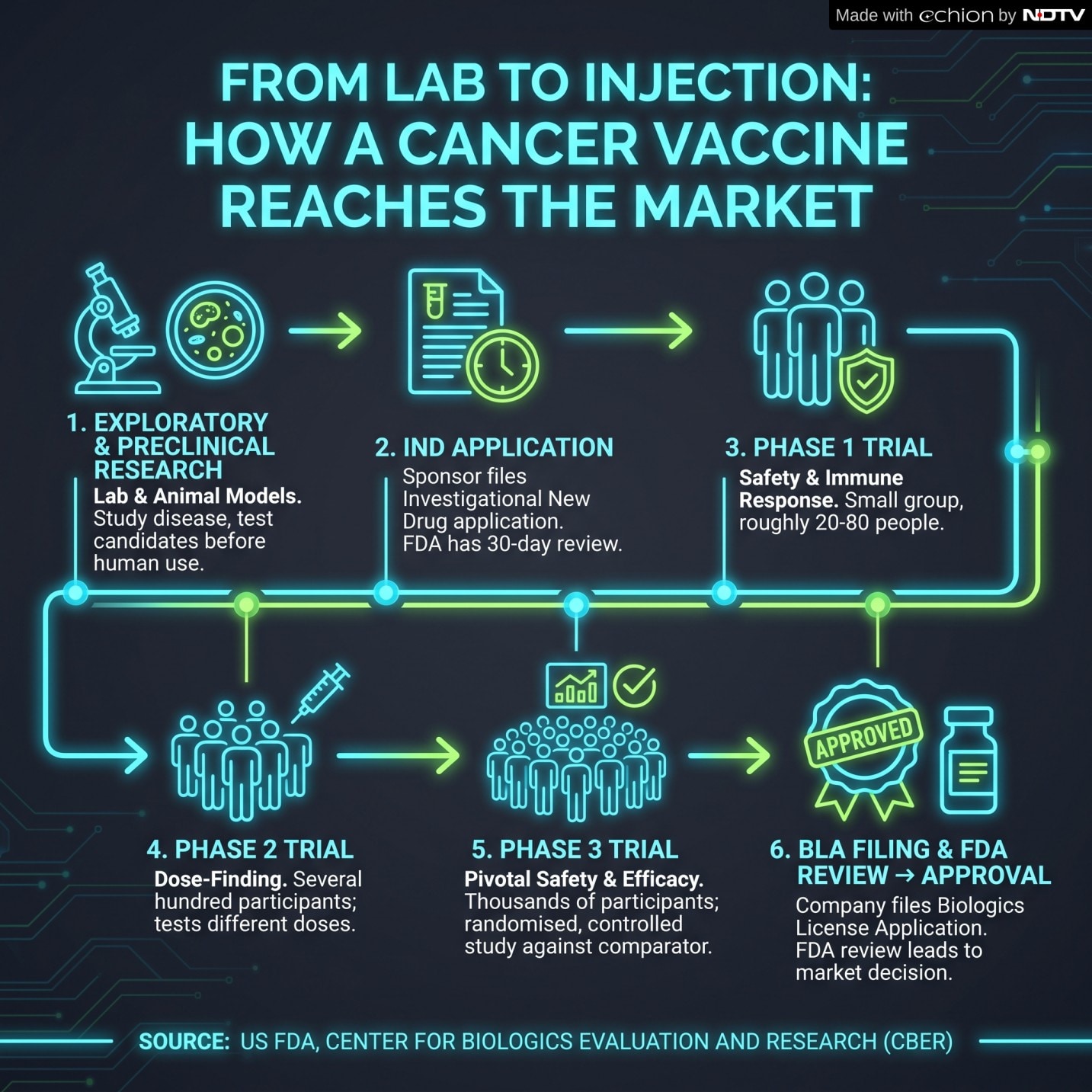
The typical journey of a vaccine.
Photo Credit: NDTV Profit
ALSO READ: Moderna Shares Rocket Over 100% On Cancer Drug Trial Success
According to the Cancer Research Institute, a US non-profit that has funded cancer immunotherapy science for over 70 years, these markers appear only on cancer cells and not on healthy ones. This is what makes them such a precise target: a therapy built around them can, in theory, attack the tumour while sparing normal tissue and reducing side effects.
A neoantigen vaccine works by presenting these markers to the immune system in concentrated form, training T cells, the immune system’s frontline killer cells, to recognise and destroy any cell carrying those specific mutations.
Shared Versus Personalised Neoantigens
Not all neoantigens are treated the same way by researchers. According to Technology Networks, they are broadly split into two categories.
Shared neoantigens arise from mutations that recur across many patients with the same cancer type, often “driver” mutations that help the tumour grow. Because they are common, the publication notes they are seen as promising targets for off-the-shelf vaccines that could, in principle, be manufactured in advance for use across a patient population.
Personalised (or private) neoantigens, by contrast, are unique to an individual’s tumour, arising from that patient’s specific set of mutations. No two patients’ tumours mutate in exactly the same way, so a vaccine built on personalised neoantigens has to be custom-made for each person. This is the category Moderna and Merck’s melanoma therapy, intismeran autogene, falls into.
How A Personalised Vaccine Like Intismeran Gets Made
According to a review published in Cancer Biology & Medicine, a peer-reviewed oncology journal, the clinical workflow for a personalised neoantigen vaccine typically runs in four broad steps.
1. Sequencing the tumour. After a patient’s melanoma is surgically removed, researchers sequence the tumour’s DNA and RNA alongside a sample of healthy tissue, comparing the two to identify mutations unique to the cancer.
2. Predicting the neoantigens. Bioinformatics algorithms scan those mutations to predict which ones are most likely to be presented on the cell surface and provoke a strong immune response. The same journal notes that researchers typically narrow an initial pool of mutations down to a shortlist of roughly 20 to 30 candidates.
3. Manufacturing the vaccine. In Moderna’s case, the genetic codes for the selected neoantigens are built into a strand of mRNA, the same messenger-RNA platform used in its Covid-19 vaccine. Once injected, a patient’s own cells use that mRNA as instructions to produce the neoantigen proteins internally.
4. Triggering the immune response. According to the Utah Cancer Immunotherapy Resource, a research and patient-education initiative run out of the University of Utah, antigen-presenting cells such as dendritic cells pick up these proteins and use them to activate T cells, which then multiply into an army capable of attacking and killing any cell carrying those same mutations.
Because the vaccine is built from an individual patient’s own tumour profile, no two doses are identical, which is also why manufacturing timelines and cost have historically been among the biggest practical hurdles for this approach.
Why Pair It With Keytruda
Melanoma tumours are often able to suppress T cell activity even after those cells have been trained to recognise them, a defence mechanism cancers use to survive. Keytruda, Merck’s checkpoint inhibitor, works by blocking the molecular “brakes” tumours use to switch off T cells. Combining the two is designed to be complementary: the vaccine trains the immune system on what to look for, while Keytruda stops the tumour from disarming the T cells that go looking for it.
Speaking to CNBC on the trial results, Dr Jane Healy, Merck’s head of oncology early development, said the combination showed a clinically meaningful improvement over Keytruda alone, which is the existing standard of care for melanoma, and was well tolerated by patients in the study.
Where The Science Stands
According to STAT News, the health and medicine outlet that first reported details of the trial, neoantigen vaccines have long been seen as having potential in oncology, but the Moderna-Merck melanoma trial marks the first randomised Phase 3 study aimed at definitively proving that benefit.
Separately, according to the National Cancer Institute, the US government’s principal agency for cancer research, personalised neoantigen vaccines have also shown promise in kidney and pancreatic cancer, two of the hardest cancers to treat. The agency’s researchers found that immune cells trained to recognise the target neoantigens were still detectable in many patients’ blood several years after their last dose, alongside a favourable safety profile.
According to the Cancer Research Institute, the broader promise researchers point to is durability. Unlike a drug that needs to be taken continuously, a successful vaccine could in theory prime the immune system to keep watching for recurrence long after treatment ends, which is what “recurrence-free survival” data in trials like this one is designed to measure.
ALSO READ: Indian Startup Leans On Cancer-Sniffing Dogs And AI For Early Detection
Essential Business Intelligence,
Sharp Market Insights,
Practical Personal Finance Advice, Daily Fuel, Gold and Silver Prices and Latest Stories — On NDTV Profit.


