


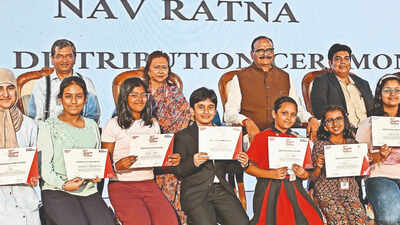
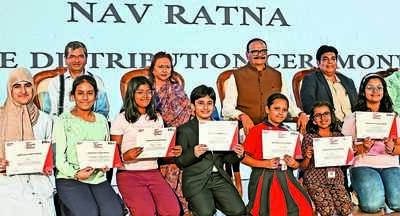
NEW DELHI: Hands hovered over buzzers as students listened intently to each question, ready to hit the button before their competitors. Every few moments, a buzzer broke the silence and another answer was put to the test. But points were not won through recall alone, as the questions pushed students to reason, judge, analyse and think beyond the obvious.The questions came thick and fast. “If a meteor crashes on the Moon and an astronaut is 1,000km away, when will they hear the sound?” A student quickly buzzed in with the answer: they wouldn’t – sound cannot travel through the vacuum of space.Then came a word puzzle: “Which word becomes shorter when you add two letters to it?” Buzzers went off again. The answer was “short” – add “er” and it becomes “shorter”.That was the scene at the auditorium of DPS RK Puram on Friday as students went head to head in the semi-final and final rounds of the AM/NS India Times Critical Thinking Championship 2026, conceived and conducted by Times Foundation. The Nav Ratna prize distribution ceremony was held soon after, during which chief guest Brajesh Pathak, deputy chief minister of Uttar Pradesh, handed over certificates to the winners.Pathak, who spoke of the “immense effort” involved in reaching so many schools and students, urged participants to never stop asking questions. “Human beings are not machines meant to follow the same routine. We have the ability to think, understand and show the world a new direction,” he said.The championship has been designed to encourage students to move beyond rote memorisation and develop the ability to question, analyse information and arrive at conclusions independently. The students who reached Friday’s rounds had already made their way through a much larger field. From thousands of participants, 140 were shortlisted for written and oral assessments. The field was then narrowed to 36 students for the buzzer rounds, with nine winners emerging. The gathering included their parents, DPS teachers and other representatives.“Critical thinking is very important for the younger generation because students need to learn to ask questions, reason and analyse before reaching conclusions. We see this initiative not as a one-off event but as a long-term process,” said Vikas Yadvendu, head, CSR, AM/NS India.Impact catalyst Aruna Goenka said, “Critical thinking is the need of the hour. With young people exposed to so much information through social media, they can sometimes lose sight of their own judgement or be misled. So, such initiatives are important.”DPS RK Puram principal Anil Kumar said, “This initiative encourages children to think, reason and analyse. Over 10 lakh students have participated across languages, and next year, we aim to reach one crore.”Over the past six months, TCTC reached more than one million students from over 20,000 schools, spanning Grades III to XII across 28 states and eight Union Territories, with the programme conducted in 14 languages.
Share your thoughts in the comments
Be respectful · TOI community guidelines
But amid those numbers were students from different corners of the country, each with their own interpretation of what it meant to think critically.Bhanvi, a Class V student from Kerala, summed it up simply: “Critical thinking is not agreeing with something just because everyone thinks it is right. Don’t always listen to others. Use your own mind.” Aaryahi Hazarika, a Class IV student from Assam, said it helped people find solutions carefully, while Sarah from Kashmir described it as the ability to “think out of the box”. Divisha, a Class IV student of DPS East of Kailash, described it as “finding solutions by thinking with our own minds” rather than blindly following others.


