


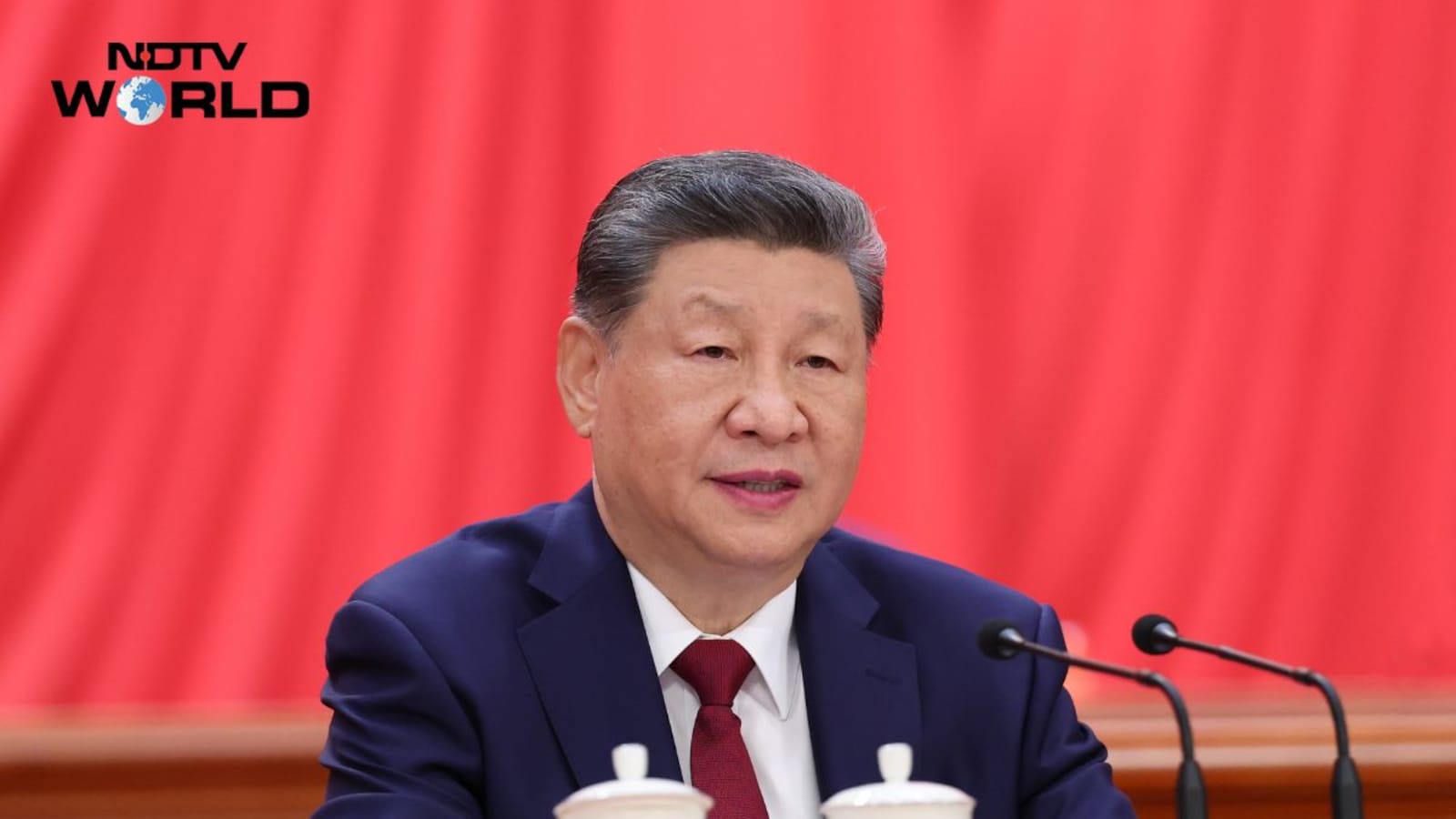
President Xi Jinping presents China’s vision for the development and regulation of artificial intelligence on Friday, at a major conference showcasing cutting-edge technology he hopes will soon rival that of the United States.
Chinese AI models are gaining ground on the most powerful offerings from the United States, while attracting global users with lower costs.
But how to govern the booming sector has become a key topic, as concerns over the deployment of AI in military combat, or its potentially nefarious use by hackers or terrorists grow.
Xi will speak at the World Artificial Intelligence Conference (WAIC) in Shanghai on Friday, with his first attendance at the gathering underlining the strategic importance Beijing is placing on AI.
It is “the most important annual event for understanding the direction of China’s AI industry”, although does not yet have global “must-attend” status, said Poe Zhao, founder of analysis publication Hello China Tech.
“The United States retains a clear lead in advanced chips, frontier computing infrastructure and the most capital-intensive model development,” Zhao told AFP.
But “China is its closest and most comprehensive competitor”, Zhao added.
The four-day event draws more than 1,000 of the country’s tech firms together with officials, researchers and other industry figures.
Around 3,000 products will be on display, from powerful semiconductor systems for AI computing to a smartphone that can autonomously operate apps on command.
But all eyes will be on Xi’s vision of how the world should handle the potential impact of AI on cybersecurity and conflict, as well as on jobs and the world economy.
From AI models to everyday use
Premier Li Qiang announced at last year’s WAIC the establishment of a China-led organisation for international AI cooperation, but few details have emerged.
This year, Xi is expected to expand on that idea.
“China opposes drawing lines on the basis of ideology and technological blockades,” foreign ministry spokesperson Lin Jian told a news briefing on Thursday, in an apparent reference to restrictions imposed on Chinese tech imports by the United States and European Union.
“Taking this conference as an opportunity, China will have candid exchanges with all parties and build consensus… so that technological progress can truly promote the development and prosperity of human society,” he said.
Leaders including UN chief Antonio Guterres, Cambodia’s Hun Manet and Thailand’s Anutin Charnvirakul are expected to attend the conference, which will lay out the cutting edge of China’s AI technology.
Among this year’s highlights at WAIC are MiniMax’s M3 model, the first phone equipped with an autonomous AI agent, and Huawei’s Atlas 950 “supernode”, a cutting-edge AI architecture for learning and reasoning.
“The main theme will be the transition from AI models to systems that can be deployed at scale” in everyday life, said Hello China Tech’s Zhao.
AI agents — tools capable of conversing with users, but also of managing software or performing complex tasks -– will also take centre stage, he added.
Mega AI consumption
AI has become a strategic pillar of China’s industrial policy, driven by colossal state investment aimed at building a domestic ecosystem, from chip production to consumer use.
Daily consumption in China of “tokens” -– the industry unit of AI usage — has increased a thousandfold over the past two years, according to state media citing officials.
The Chinese market was valued at 1.2 trillion yuan in 2025 ($177 billion), and is expected to grow more than 30 percent this year, according to official data.
And more than 6,000 AI companies were active in China in 2025.
China has far more patent filings for generative AI than any other country, according to the World Intellectual Property Organisation (WIPO), which recorded more than 43,000 such filings between 2024–2025.
A growing number of companies abroad — like Siemens this year — are adopting Chinese open-source AI models, attracted by their performance, lower cost and ability to customise, in contrast to the closed systems of US giants such as OpenAI and Anthropic.
Meanwhile, Chinese consumers are embracing generative AI tools on a massive scale, with 602 million users last year, according to the China Internet Network Information Centre — around 43 percent of the population.
(Except for the headline, this story has not been edited by NDTV staff and is published from a syndicated feed.)



