


Bogota:
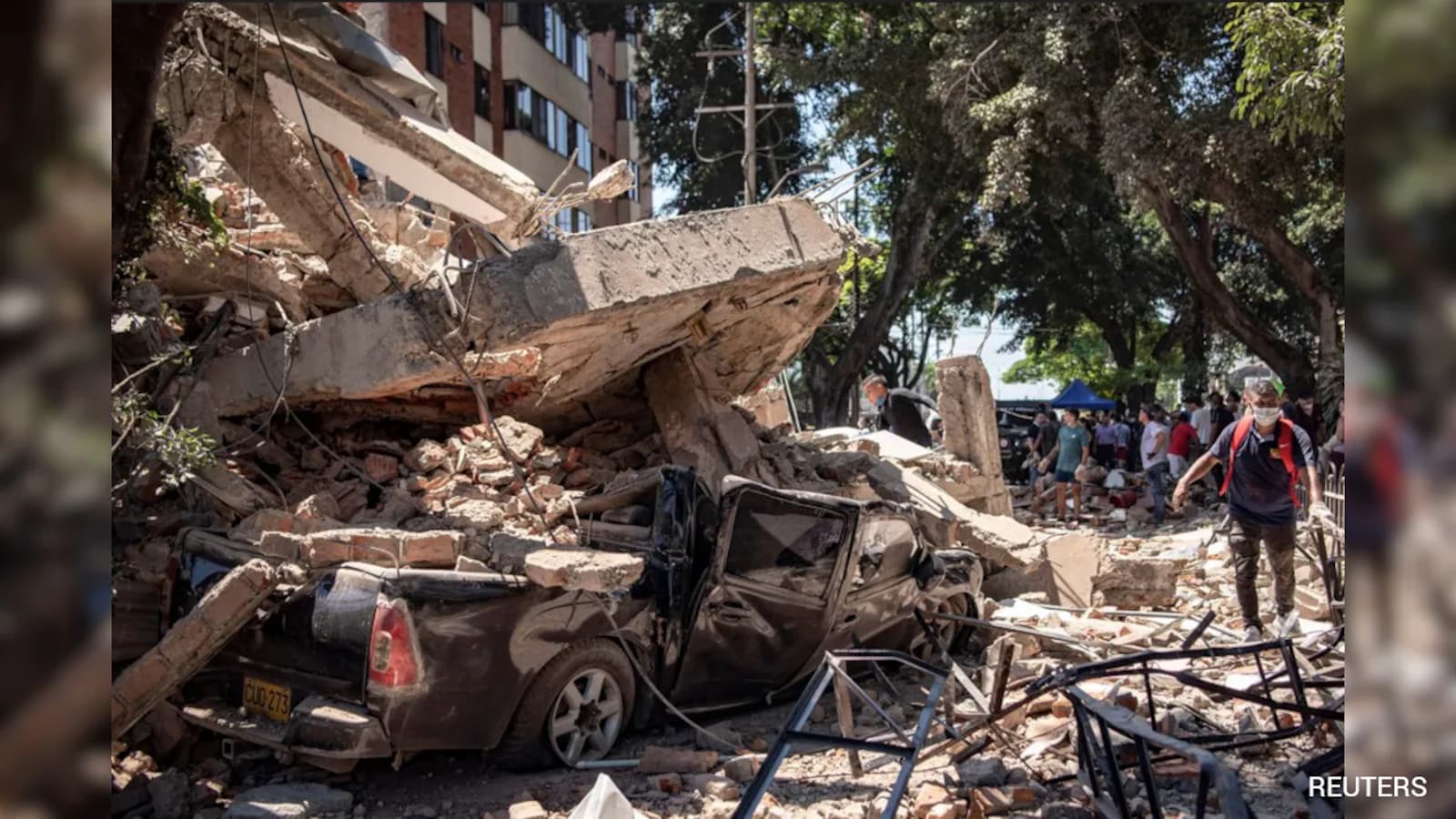
A powerful 7.4-magnitude earthquake struck western Colombia, rattling much of the country and setting off a desperate search and rescue of survivors trapped under the rubble of hundreds of collapsed buildings in several cities. At least 169 people have died, and around 570 others have been injured in the South American nation’s strongest earthquake this century.
The deaths are likely to rise as rescue crews and residents continued to dig through flattened buildings, even as the Colombian Geological Service has warned of additional tremors.
The disaster struck just days after President Abelardo De La Espriella took over the highest office in the country, thrusting the new administration into its first major crisis, with memories still fresh of devastating twin earthquakes in neighbouring Venezuela in June.
According to Espriella, at least 1,575 homes, 18 health centres, and 52 schools had been damaged in the powerful quake that was followed by 21 aftershocks. The president said at least 61 buildings had completely collapsed as he declared an emergency to expedite funding for the quake recovery.
“We aren’t going to leave people alone. They are in our hearts and we are going to tend to people with our full determination,” he said.
The Visuals
Visuals shared on social media sites showed a four-story building crumbled in Pereira during the quake, while footage from Manizales showed one of the side towers of the city’s landmark neo-Gothic cathedral collapsing and scattering debris onto nearby streets.
JUST IN: At least 111 killed, 87 injured after 7.4 M earthquake in Colombia; 1,575 homes damaged — President de la Espriella pic.twitter.com/xgf8bgdPgj
— Rapid Report (@RapidReport2025) August 10, 2026
Colombia’s Geological Service said Monday’s quake was the country’s strongest recorded “in the 21st century,” and that it was followed by several aftershocks.
🚨🇨🇴BREAKING: Apocalyptic scenes in Colombia as the Cathedral in Manizales collapses under the force of the earthquake.
People watch in fear and disbelief as the towers of one of Colombia’s oldest Christian cathedrals come crashing down.
Pray for Colombia.…
— Mario ZNA (@MarioBojic) August 10, 2026
A video broadcast by Caracol Television showed a group of people pulling a small baby covered in dust from under a pile of rubble. Caracol reported the six-month-old girl and her mother were rescued from under a five-story building in Cali.
Colombia rescuers DIG OUT MONTHS-OLD BABY from BUILDING RUBBLE after 7.4 earthquake https://t.co/bo29pen6PM pic.twitter.com/vW1xXlt0Wj
— RT (@RT_com) August 10, 2026
Another clip from the city of Cali showed rescue workers rappelling people out from the windows of a local hospital.
More footage from Colombia shows part of a hospital collapsing onto ambulances below, as widespread damage is reported in Cali, Pereira, Manizales and across the Chocó region following the powerful earthquake. pic.twitter.com/oyJMoGtGNn
— Breaking911 (@Breaking911) August 10, 2026
Ring of Fire
Colombia’s Pacific region around the epicenter lies along the “Ring of Fire,” the line of seismic faults encircling the Pacific Ocean where most of the world’s earthquakes occur.
The Pacific, particularly the Choco region, is one of Colombia’s poorest, nestled in dense jungle. Much of Choco is only reachable by boat or plane, which may pose difficulty in assessing the wider toll.
Northwestern University seismologist Suzan van der Lee told news agency Reuters that the quake’s powerful magnitude, inland location and strike-slip motion may have amplified damage in populated valleys despite its considerable depth.
“This one was far below the crust, and in theory it shouldn’t cause as much shaking. At this magnitude, it did actually cause a lot of shaking,” she said, adding Colombia is particularly difficult for seismologists to analyze due to the interaction of several major tectonic plates.



