


I’ve just flown back from Palma, Mallorca, where I was made to feel a little uncomfortable. (Fear not, I was game.)
I appeared on stage at the IMPF Global Music Summit alongside BMI CEO Mike O’Neill – longtime boss of the New Mountain Capital-backed performing rights giant.
In a mischievous role reversal, O’Neill played interviewer, insisting on asking me five key questions about the music biz.
As he warned the gathered crowd of indie publishers, these weren’t gonna be softballs. “I must maintain my journalistic integrity,” he deadpanned.
And so we tackled public vs. private market valuations, AI licensing, industry consolidation, catalog vs. frontline, and other thorny conversational vines.
One of O’Neill’s questions in particular stuck with me: If I gave you $10,000 to invest in any area of the music business right now, where would you put it, and why?
I prefaced my answer by stressing that it was in no way qualified financial advice – particularly as it leaned heavily on the strategy of a public company: Live Nation.
What it was, however, was a reminder of the wildly differing pricing power of two corners of our industry.
It also raised an awkward question: Has one of them gotten things right – and the other gotten things… less right?
My answer: I’d probably invest the $10,000 in local live music promoters in a “high-potential” market outside the US and Europe – such as Indonesia, Brazil, or India.
The rationale: Live Nation CEO Michael Rapino regularly talks up – with some glee – territories such as these.
In his telling, there’s now “opportunity all around the globe” for live promoters, thanks to “this new young consumer with the jukebox in their phone.”
Rapino’s logic: TikTok, Spotify, and YouTube build the fandom; Live Nation then sells the phone-gawpers scarcity, thrill, and the real thing. And it’s happening everywhere.
Last month, at Goldman Sachs’ Communacopia + Technology conference, Live Nation President & CFO Joe Berchtold underlined the size of the opportunity outside North America and Europe, revealing that 30% of the company’s Top 50 tours are now by artists whose primary language isn’t English.
That’s up from 8% pre-Covid – and, said Berchtold, “it’s not going to be that long” before the figure tops 50%.
More to the point: Berchtold added that 47 of the top 75 markets outside the US currently lack modern arena infrastructure – with São Paulo and Rio among the cities he name-checked.
Unsurprisingly, Live Nation is ready to build, baby, build.
(Naturally, there’s a potential exit baked in for my hypothetical $10k investment: as I’ve written before, one of the other ways Live Nation is jacking up its global market share is by acquiring a string of ex-US promoters and venues.)
Which all got me thinking: Why is Live Nation quite so excited about India, Indonesia, Brazil, and so on, when per-capita spending power in these countries sits significantly below that of the United States?
Then it hit me: because fans in these markets are already paying ticket prices comparable to those in “mature” markets such as the US.
Below are the cheapest – and most expensive – primary ticket prices for a selection of recent and upcoming superstar concerts in these countries.
The numbers may surprise you.
Especially when you set them against the local price of a monthly Spotify Premium subscription.
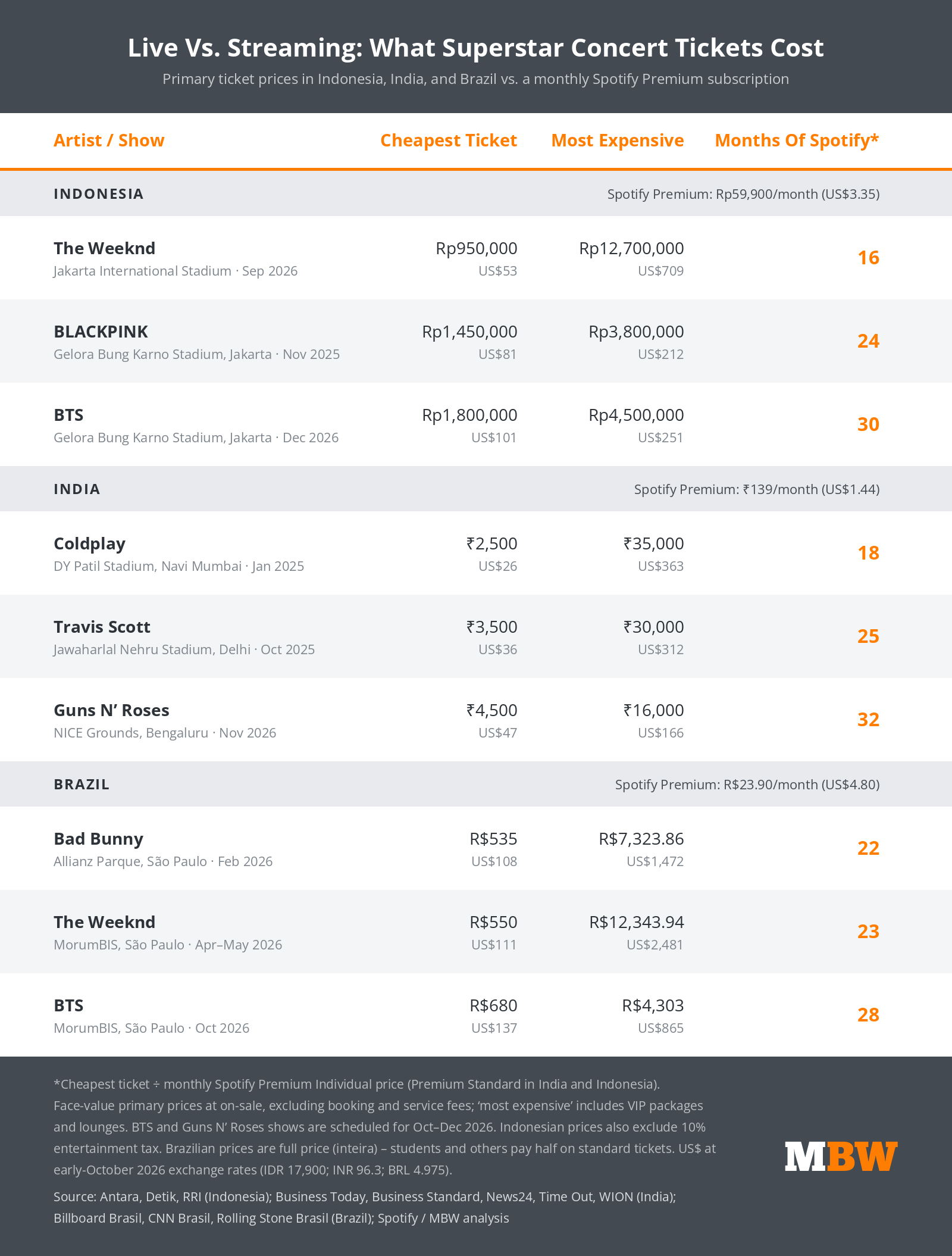
Take Indonesia. Right now, a Premium Standard subscription to Spotify there costs USD $3.35 a month – roughly a quarter of the US price ($12.99).
Yet if you want to see BTS at Jakarta’s Gelora Bung Karno Stadium this December, the cheapest ticket will set you back just over $100.
Yes: that’s around 30 months – two and a half years – of Spotify Premium.
Even The Weeknd, who priced his cheapest seats more affordably for his Jakarta shows last month, set a floor of USD $53. That’s equivalent to 16 months of Spotify.
It’s a similar story in India, where a Spotify Premium Standard sub costs just USD $1.44 a month – around a ninth of the US price.
Yet the cheapest ticket for Guns N’ Roses in Bengaluru next month will cost you USD $47. Again: that’s nearly three years of Spotify wrapped up in a single ticket.
Coldplay, meanwhile, charged just ₹2,500 ($26) for their cheapest ticket in Mumbai early last year.
But look at the other end of the scale: a VIP lounge ticket (including food, drink, and parking) to Coldplay went for a whopping USD $363.
That’s the equivalent – ready for this? – of around 250 months of Spotify Premium in India.
Yup: more than 20 years.
And Brazil? The Weeknd‘s top VIP package in São Paulo earlier this year cost more than 40 years’ worth of Spotify Premium!
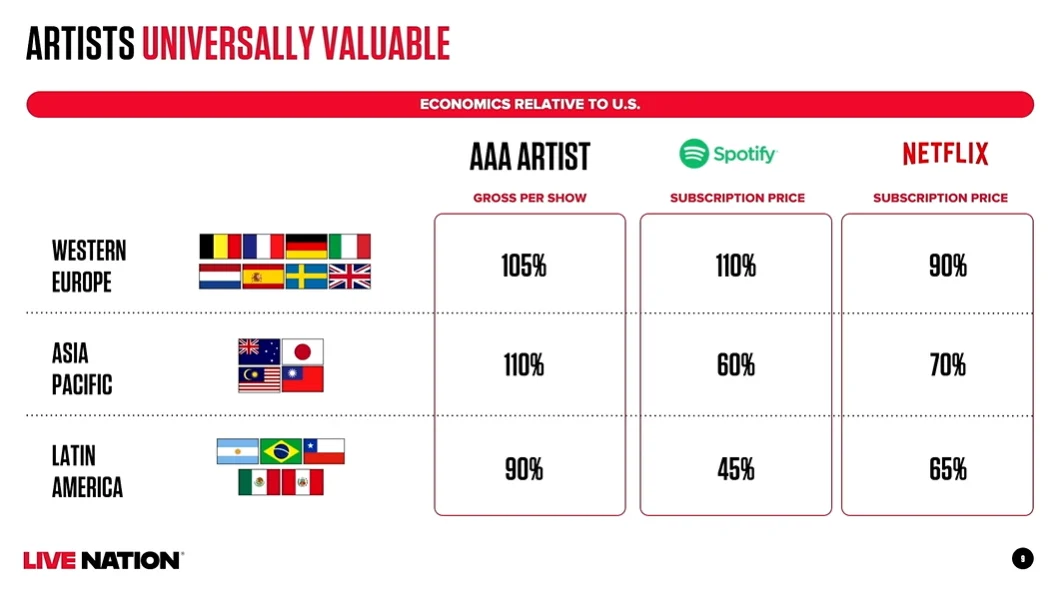
Live Nation spotted this phenomenon back in November 2023, when it showed investors the slide below at Liberty Media’s annual investor meeting in New York.
On the streaming side, at least, the gap has only widened since.
Back then, Spotify Premium in India cost ₹119 a month (USD $1.43). Today it’s ₹139 – which, thanks to a weaker rupee, still works out at just $1.44.
Over the same period, Spotify’s US price has climbed from $10.99 to $12.99.
Another illuminating little experiment: check out the price of a premium car in these supposedly “emerging” markets.
A new BMW 3 Series costs roughly USD $65,000–75,000 in India, Brazil, and Indonesia (including local taxes), versus around $50,000 in the US.
It’s a useful reminder that luxury goods aren’t sold to the mainstream. BMW’s buyers in these countries are a tiny, wealthy minority; music streaming, by contrast, is priced for the masses.
Superstar concertgoers sit somewhere in between: comparatively well-off, but numbering tens of thousands a night, rather than a relative handful of car buyers each year.
The bigger point: in markets this unequal, a price is really a decision about who you’re selling to.
Live Nation is selling to the top of the pyramid – and the top of the pyramid in a country of more than 280 million people (Indonesia), let alone 1.4 billion (India), can fill a lot of stadiums.
Spotify is selling to the whole pyramid. And when it tried to push prices up, it swiftly backed down.
A new Spotify Premium structure, launched in India and Indonesia in November 2025, raised the price of full-featured Premium substantially in both markets (by 43% in India). By May this year, Spotify had reversed the rise.
Now the record industry is pulling other levers.
Since late August, for example, Universal Music Group‘s new releases in India have gone exclusively to paying subscribers for their first 72 hours, before reaching ad-supported tiers.
Spotify and its paid streaming rivals would no doubt point to the elephant in the room: YouTube, and the long-established expectation, across much of the world, that music comes free.
(Interestingly, French rapper Tiakola recently released the video for his track Caméléon on X rather than YouTube – in protest at the platform’s failure to monetize Afro-Francophone artists’ videos. Only 13 of Africa’s 55 countries are currently eligible for YouTube’s Partner Program.)
Netflix, too, charges far less in India, Indonesia, and Brazil than in the US – but its discount is notably shallower than Spotify’s. (By my math, Netflix Premium costs 25–45% of its US price across the three markets; Spotify Premium costs 11–37%.)
Which all raises a question the record business might not enjoy answering.
If fans in Jakarta, Bengaluru, and São Paulo will hand over between 16 and 32 months’ worth of Spotify for the cheapest ticket to a superstar concert, is streaming’s problem in these markets really what fans can afford to pay?
Or is it what they’ve been taught recorded music is worth?
The music industry keeps talking up the future pricing potential of subscription streaming – and I agree. Right now, it’s too cheap, in too many places.
My hypothetical $10,000, though, is betting on a different ballgame entirely – one Michael Rapino summed up at that same 2023 Liberty Media meeting:
“In our business, we don’t actually create the demand. The demand gets created and then we sell the demand.”
In India, the demand gets created for $1.44 a month.
It sells for up to $363 a ticket.Music Business Worldwide


