


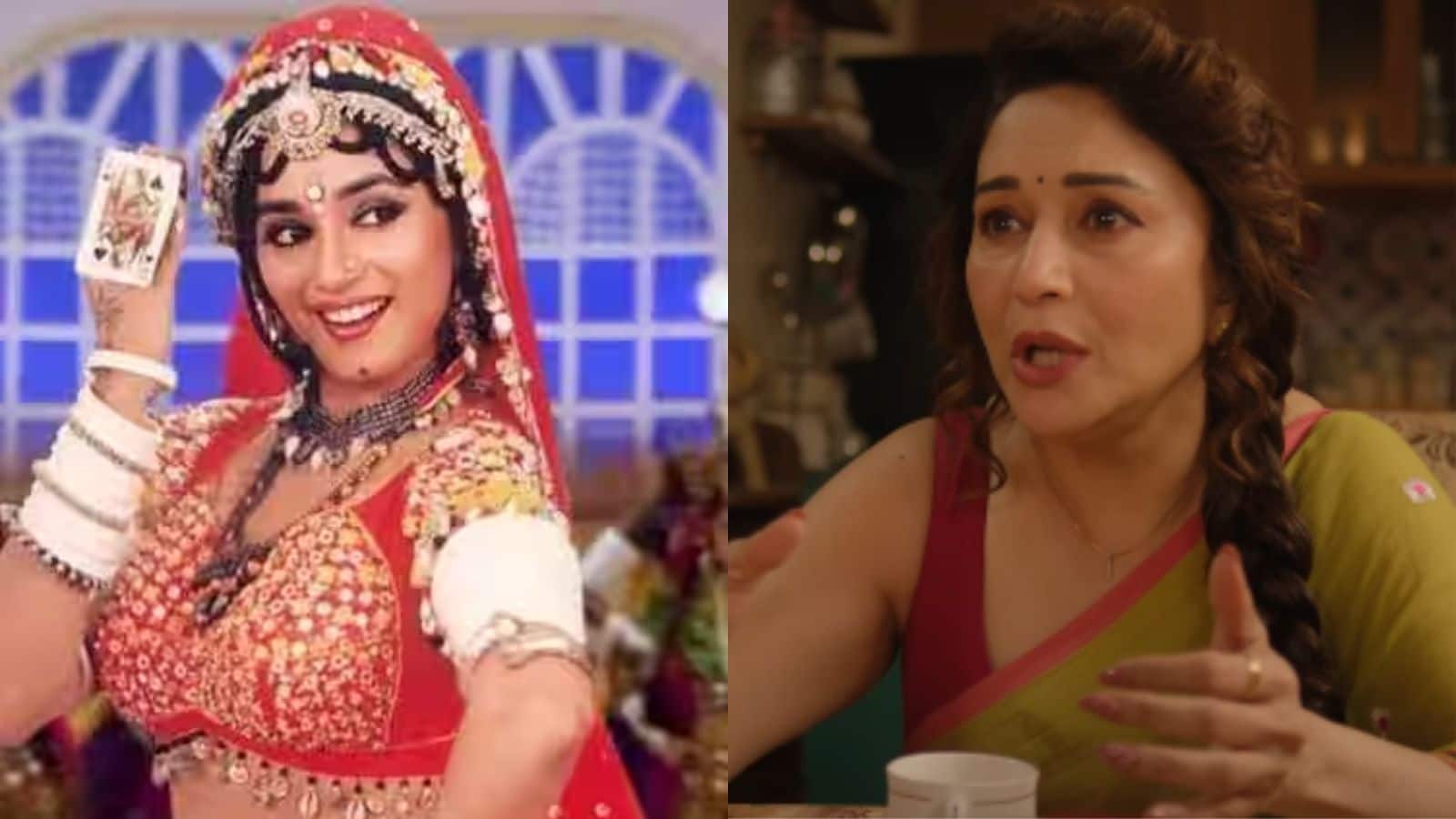
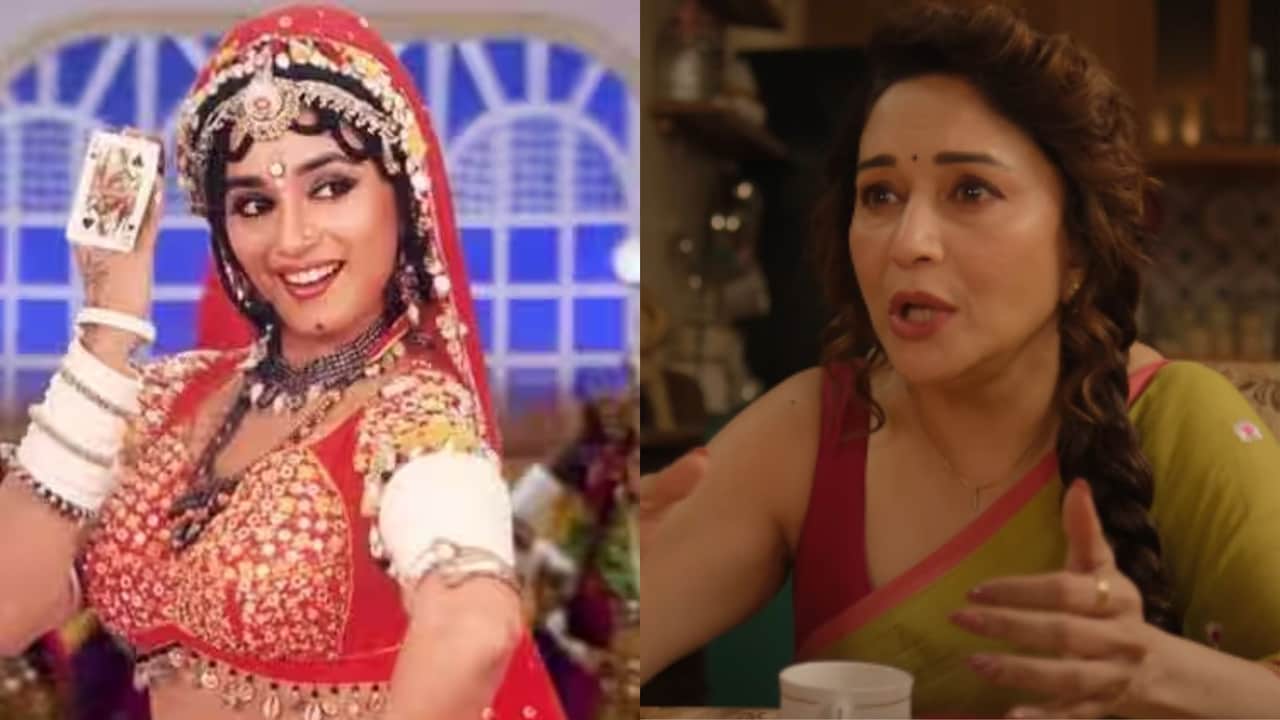
At first glance, Madhuri Dixit starrer Maa Behen unfolds as a dark comedy about chaos, secrets, and a fractured family. But beneath the humour and tension lies a sharp commentary on how women’s bodies, choices, and identities continue to be policed – a theme that quietly echoes the memory of Choli Ke Peeche from Khal Nayak, not just in theme, but in how a piece of clothing becomes central to the plot.
(This article contains spoilers.)
In Khal Nayak, Madhuri Dixit’s character uses her identity as a folk dancer – complete with the choli (blouse) – as a disguise to infiltrate a criminal network and trap the antagonist. Decades later, in Maa Behen, the blouse once again becomes part of a crime narrative in a chaotic setting. Here, Rekha (Madhuri’s character) uses her sleeveless blouse to gag Gupta ji (Ravi Kishan’s character) after an altercation, and that very garment ends up becoming the key detail that exposes her. What once helped catch a criminal now becomes evidence of a crime.
A Woman Who Refuses To Conform
At the centre of Maa Behen is Rekha, a widow who has lived life on her own terms since the age of 25. She refuses to mould herself according to social expectations, whether in behaviour or appearance. Even something as simple as her choice to wear sleeveless blouses becomes a point of contention.
Her presence unsettles those around her. The discomfort she evokes is less about morality and more about control – about a woman refusing to shrink herself. The line, “Dayaan ki umar nahi badhti” (A witch never ages), captures this gaze, suggesting that women are judged relentlessly, regardless of age or circumstance.
Three Generations, Same Scrutiny
Rekha’s equation with her daughters, Jaya (Triptii Dimri) and Sushma (Dharna Durga), reflects how this scrutiny carries across generations. Jaya is caught in a suffocating domestic setup shaped by patriarchal rules, while Sushma navigates a performative digital life that masks her own confusion. Rekha, in contrast, resists these structures – yet she too is constantly judged.
Despite their differences, all three women remain bound by the same system, negotiating its pressures in different ways.
When Clothing Turns Into Evidence
The film’s turning point – a ‘death’ in Rekha’s house – quickly spirals into panic and cover-up. Rekha calls her daughters one night, claiming her neighbour, Gupta Ji, was “killed” in her house. What follows is a chaotic spiral of panic, cover-ups, and questionable decisions. In that chaos, the blouse becomes a practical tool: Rekha uses it to silence Gupta ji when things get out of hand.
But the irony lies in what follows. When Gupta Ji regains consciousness, the same blouse becomes the clue that reveals Rekha’s involvement. It is not just an object anymore; it is proof.
This is where the connection to Choli Ke Peeche sharpens. In Khal Nayak, the choli is part of a performance designed to deceive criminals. In Maa Behen, the blouse accidentally becomes the thread that unravels the truth. In both cases, clothing moves beyond aesthetics – it drives the narrative.
The Politics Behind The Detail
Even as the blouse plays a literal role in the plot, it continues to carry symbolic weight. Rekha’s choice of sleeveless clothing draws constant judgement from her neighbourhood, reducing her identity to what she wears.
This mirrors the reaction to Choli Ke Peeche, where the focus shifted from the character’s purpose to the perceived boldness of her attire.
The 1993 song Choli Ke Peeche sparked widespread controversy across the country due to its suggestive phrasing and perceived focus on the female body. Many critics objected to the song’s title, which translates in Hindi to “What is behind the blouse,” calling it inappropriate and provocative.
Responding to the backlash, lyricist Anand Bakshi defended the song, stating that its meaning was being misunderstood. He explained that the lyrics were not vulgar and pointed to the line “Choli mein dil hai mera” (My heart is in the blouse) to clarify his intent.
Bakshi also emphasised that the song drew inspiration from traditional Rajasthani folk music, suggesting that its roots were cultural rather than sensational.
In an excerpt of her autobiography, Ila Arun, who sang the song, wrote, “I was suddenly catapulted to fame or infamy, depending on which side you were on; there were several discussions on the song, people calling out for my blood, court cases being filed against me in remote towns of India, accusing me of obscenity; the police from the Santa Cruz station arrived at my doorstep one morning, saying I had not responded to a summons sent to me, a word that I had never heard before!”
She also said, “I had several press interviews where I gave examples of so-called ‘obscenity’ throughout Indian myths and art. The sringar ras in Indian art and music contains elements of eroticism, mentioning the choli or the angana as accessories to enhance a woman’s beauty. I would give several examples of folk songs in Punjabi, Hindi, Bhojpuri, and Marwari, which had all the naughty nuances that were being condemned in this song. I reminded the moral brigade that every young girl, including myself, had encountered these questions from the eve teasers who hung around girls’ colleges. Anand Bakshi had only answered that question with dignity. ‘Choli mein dil hai mera’ – the choli contains my heart – he wrote, admonishing the vicarious and lewd comments of boys and men.”
In Maa Behen, the conversation remains trapped in a similar space.
The blouse is judged, discussed and scrutinised – whether as a sign of morality or as incriminating evidence – while the woman wearing it is rarely understood.
From Tool To Trigger
What makes this connection particularly compelling is the reversal of agency. In Khal Nayak, Madhuri’s attire is part of a calculated plan – it gives her control. In Maa Behen, the blouse is used in a moment of desperation – and ends up taking control of the narrative.
This shift reflects a deeper reality: even when women use their choices to assert agency, those very choices can be turned against them.
Judgement That Doesn’t Change
Ultimately, Maa Behen suggests that while contexts evolve, the gaze remains the same. Whether it is a dancer in a staged performance or a widow in her own home, the woman’s body becomes a site of attention – often overshadowing everything else.
The blouse, in both stories, is not just fabric. It is a trigger – for desire, for judgement, for suspicion, and, ultimately, for consequence. The connection between Maa Behen and Choli Ke Peeche lies in this striking use of costume as a narrative device. What begins as a visual detail transforms into something far more powerful – a tool, a clue, and a symbol.
Maa Behen turns a familiar cultural reference into a sharp storytelling device. It reminds us that while the roles may change, the scrutiny around women and what they wear – remains stubbornly constant.
Also Read: Maa Behen Review: Madhuri Dixit And Triptii Dimri Smash The Patriarchy In Netflix’s Quirky Dramedy



