


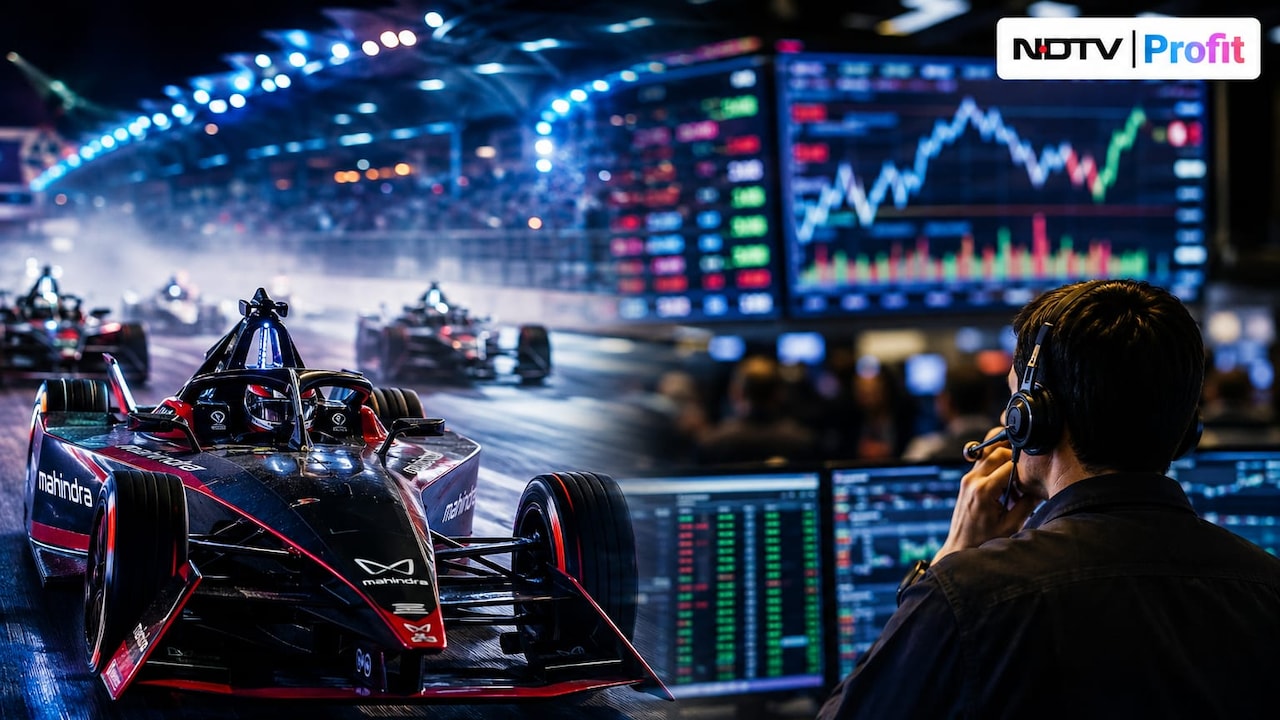
I’m in London for the Formula E season finale – a double-header that will decide the championship under the roof of the ExCeL and out onto the tight, technical outdoor section. Mahindra Racing from India is here, and that makes it just the perfect finale on the Independence Day in India. The cars are noisy, and the entire paddock feels like a high-stakes trading floor with better branding and worse sleep schedules. Watching teams work, you realise motorsport isn’t just spectacle. It is one of the purest laboratories for decision-making under uncertainty, capital allocation under constraints, and performance under pressure. Investing, at its best, looks a lot like that.
The intersection is not metaphorical fluff. Both domains demand the same core disciplines — continuous information processing, rapid yet disciplined decision-making, risk management that survives variance, and the ability to compound small edges over time. The difference is that in motorsport the feedback loop is merciless and public. A bad strategy call is measured in tenths of a second and championship points. In markets the same mistakes are often buried, for never to be found again.
Marginal Gains Compound — The Rest Is Noise
Formula E and Formula 1 teams live by the doctrine of marginal gains. A slightly better energy deployment strategy, a tyre that holds temperature two degrees longer, a software tweak that saves 0.05 seconds per lap — none of these look dramatic in isolation. Over a season they separate champions from the also-rans. The same principle applies to investing. Most wealth is not created by one brilliant stock pick. It is created by consistently making slightly better decisions on position sizing, cost of capital, opportunity cost, and behavioural discipline than the market’s average participant.
Retail investors often chase the equivalent of a hero overtake — the 10-bagger that will be life changing. Professional capital allocators who last do the opposite. They obsess over process edges that look boring – reducing leakage in execution, improving the quality of the information diet, tightening the feedback loop between thesis and outcome. Over a decade those small advantages compound into something that looks like genius from the outside.
Data Is Oxygen — And One Needs Lot Of It
Frederic Bertrand, the CEO and Team Principal of Mahindra Racing, spoke to me about how modern motorsport is telemetry-heavy. Teams collect more data per lap than most listed companies publish in a year and yet, the edge is not in having the data. It is in the speed and quality of interpretation, and the willingness to act when the numbers contradict the narrative. Drivers and strategists update their models in real time. Markets punish the same failure more slowly, but just as ruthlessly.
The lesson for investors is uncomfortable. Most of us already have more data than we can usefully process. The constraint is not information. It is the ability to distinguish signal from the noise that our own biases generate. Championship-winning teams build processes that force them to confront disconfirming evidence quickly. The best investors do the same. They treat every earnings release, every macro surprise, and every thesis violation as a pit-wall radio call: update or get left behind.
Teams Beat Heroes — Culture Is The Real Chassis
A Formula E car is the product of hundreds of people. The driver gets the glory and the criticism, but the competitive difference often sits in the engineering group, the strategy cell, and the culture that allows bad news to travel upward without fear. Mercedes’ dominance in the hybrid era, Red Bull’s recent run, and the quieter improvements at teams like Mahindra all show the same pattern – the organisation that learns faster and aligns better wins more often than the organisation with the single best individual.
Investing organisations that scale successfully understand this. A star fund manager without a robust process and a culture that challenges him eventually becomes a risk factor. The parallel is direct. Capital is the engine. Process and culture are the chassis and the aerodynamics. You can have a powerful engine and still finish mid-pack if the rest of the package is compromised.
Risk Isn’t Avoided — It Is Priced In Real Time
Motorsport does not eliminate risk. It prices it constantly. Teams choose how aggressive to be on energy deployment, when to attack/boost, when to conserve, and when the probability of a crash or a safety car makes the expected value of an aggressive call negative. Capital preservation is not the goal. Intelligent risk-taking is.
Investors who survive multiple cycles internalise the same distinction. Absolute risk avoidance produces underperformance. Unpriced risk produces permanent capital loss. The skill is in knowing the difference between variance you can live with and variance that can take you out of the game. Championship teams run scenarios. Good portfolio managers do the same. They ask what the position looks like if the thesis is only partially right, if the macro turns, if liquidity disappears. They size accordingly.
Time Horizons Matter More
A Formula E season is a series of races, but the competitive architecture is multi-year. Car development, software, battery management, and driver development all operate on longer cycles than any single weekend. Teams that optimise only for the next race eventually fall behind those that invest in the platform.
Markets constantly tempt participants into the opposite behaviour. Quarterly performance pressure, social media scoreboards, and the availability of leveraged products all push towards short-termism. The investors who generate durable results treat the portfolio more like a multi-year development programme than a series of weekend races. They accept that some periods will look suboptimal in isolation because the underlying capability is compounding.
The Broader Ecosystem Lesson
There is also a capital-markets observation that is hard to ignore while standing in the London paddock. Formula E, and motorsport more broadly, has become a sophisticated platform business. Scarcity of calendar slots, global media rights, sponsor ecosystems, and technology transfer create economic value far beyond the prize money. The same structural characteristics — scarcity, network effects, and emotional engagement — appear in the highest-quality businesses investors seek.
Watching teams prepare for a title-deciding double-header is a useful reminder. Performance under uncertainty is not glamorous in the moment. It is process, data, culture, risk calibration, and the discipline to keep compounding small advantages while the noise is loudest. Markets reward the same habits, usually with a lag, and almost never with the same adrenaline.
The lights will go out in London this weekend. Some teams will be able execute. Some will not. Some will face a car crash in front of them which will uproot plans. Some will be luckier. The difference will be visible in real time. Investors rarely get that clarity. That is precisely why the lessons from the pit wall remain useful long after the championship is decided.
ALSO READ: Independence Day: A Proud Indian’s View On Why India Is Inevitable
Essential Business Intelligence,
Sharp Market Insights,
Practical Personal Finance Advice, Daily Fuel, Gold and Silver Prices and Latest Stories — On NDTV Profit.


