


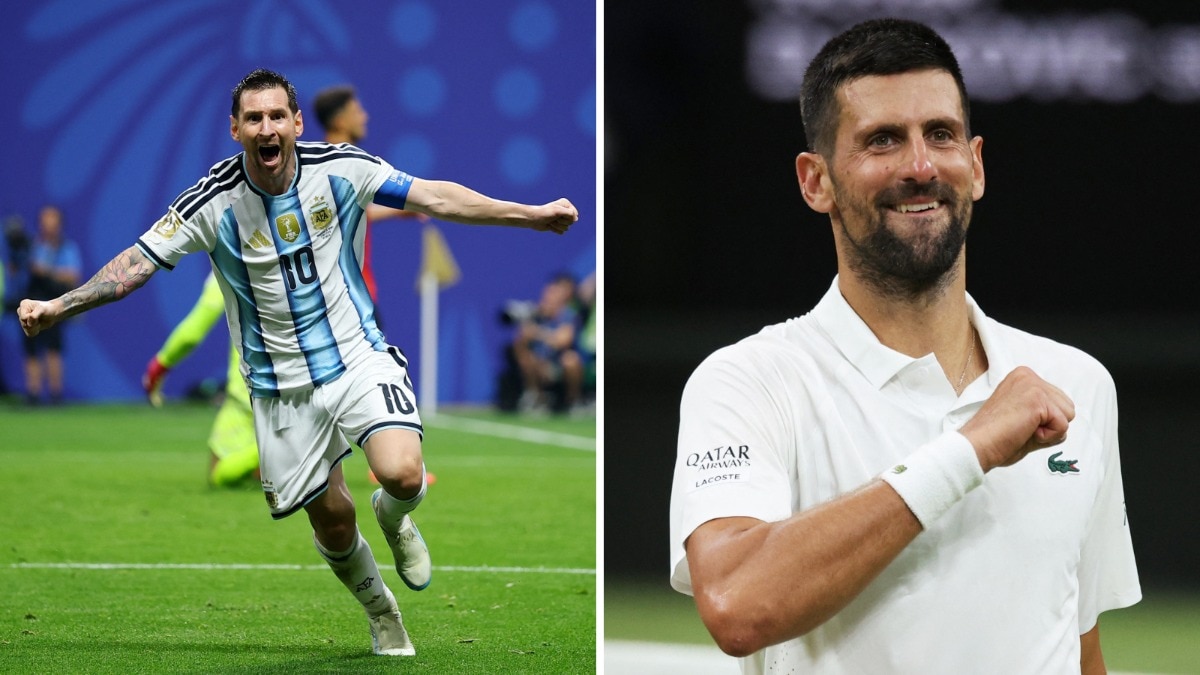
“These are the kind of moments that I still play tennis for, for sure,” said Novak Djokovic, barely able to stand on his own legs. He had just played five hours and fifteen minutes, the longest quarter-final in Wimbledon history, against an opponent 14 years his junior. Meanwhile, he is 39 years and 44 days old and won it in a fifth-set tie-break.
His opponent, World No. 4 Felix Auger-Aliassime, was one of us by the time he reached the net. A fanboy, shaking his head, still not able to comprehend what the old man had conjured on a Centre Court that has staged more than its share of such moments.
This was London, close to midnight. A few hours earlier in Atlanta, USA, a footballer had offered his own lesson in refusing to give up. Lionel Messi. Another 39-year-old. He had inspired a comeback that looked, for long stretches, entirely improbable, as Argentina beat Egypt in the Round of 16 of the FIFA World Cup.
“These are the kind of moments that I still play tennis for, for sure.” Djokovic said that.
“These are the kind of moments that I still play football for, for sure.” Messi would have thought it.
And these were the moments that kept fans up on a Tuesday evening, watching two champions who have nothing left to prove put their bodies on the line anyway, absorbing the agony of pressure just to pull off the improbable one more time. That’s the pull of it.
In London, Djokovic beat a higher-ranked Felix, 7-6(10), 3-6, 6-3, 6-7(4), 7-6(10-4), the longest quarter-final Wimbledon has ever seen, to become its oldest-ever semi-finalist.
In Atlanta, Messi inspired Argentina back from two goals down, providing one goal and scoring another. Argentina scored three times in fourteen minutes to complete one of the great comebacks in World Cup history.
Two spectacles. Two great athletes. Two great matches. One shared feeling of awe among those watching.
LONGEST WIMBLEDON QUARTERFINAL
On the Centre Court where Djokovic has produced magic for the better part of two decades, there was another chapter, arriving at a stage of his career when most of his peers have long since swapped the baseline for the Royal Box.
He had no right to win that match. Felix, slowly but surely growing into his talent, was firing winners at will, his serve and his heavy ball-striking giving Djokovic no rhythm to settle into. A leg injury scare didn’t help. Djokovic called for a timeout, took treatment, and somehow found a way to win the first set after being dragged into a tie-break. He won it 12-10.
The second set went in a whisker. 3-6, in less than half the time the first had taken. Felix was crunching his forehands, landing 90 per cent of his first serves, and Djokovic looked rattled for the first time all match.
Then the roof closed, at 7:40pm, to hold back the fading light. Neither man wanted it shut. But it was only after the roof came across that the real contest began.
The ball-striking that followed was several notches above anything before it. Djokovic found his rhythm on the back of an altercation with a tournament official over the closed roof, arguing there’d been no uniformity in when the rules got applied, that it was too early to have shut it at all. The exchange seemed to light something in him. He won the third set 6-3, serving markedly better than a Felix whose level had dipped.
What looked, briefly, like a routine fourth set for Djokovic turned on its head when Felix rediscovered his range. The big serve returned, and he matched Djokovic winner for winner off both wings, playing with the discipline of a man who has learned, the hard way, how to hold his nerve under pressure. Whenever Djokovic pounced, Felix had an answer ready, and it came immediately. He dragged Djokovic into another tie-break, one of the very few Djokovic has lost on this court, and took it.
Decider. Four hours gone and still no separation.
The Centre Court crowd wanted more, and so, it turned out, did Djokovic’s family. “I was telling the kids to go to sleep after the fourth set, but they didn’t want to listen. I’m glad they stayed, because it was honestly one of the best matches I’ve been a part of on this court in my career,” he’d say afterwards.
The fifth set was the crescendo the match had been building towards. Felix played like a man with 24 Grand Slam titles to his name. Djokovic played like a man who actually has them.
At 4-4, serving, Djokovic found himself 0-30 down, one loose point from 0-40. Instead, he chased down a wide ball, stretched like elastic, and found a line with a curling backhand down the line. Somehow, it caught the paint. Hold.
For long stretches of that final set, Djokovic was stretching his back, twisting at the hip between points, the kind of small, careful movements that brought to mind my own 64-year-old father’s evening walk around the community park. He was doing that, on Centre Court, in a Wimbledon quarter-final. He pushed when Felix served to stay in the match, and the 25-year-old answered with outrageous winners and first serves that landed exactly where they needed to.

6-6. Nothing between them. A 10-point deciding tie-break.
“Five sets, five hours, five stars,” the commentator said. He wasn’t wrong.
It was in that tie-break that Djokovic finally found another gear, pouncing on every mistake Felix offered him, and closed it out.
“How did you win that?” the presenter, Rishi Prasad, asked him afterwards.
MESSI INSPIRES A GREAT ESCAPE
Someone could have asked Messi the same question. A few hours earlier and four thousand miles away, in Atlanta, another 39-year-old had been made to work just as hard for a very different kind of miracle.
Egypt had a 2-0 lead, Yasser Ibrahim’s early header added to by Mostafa Zico’s close-range strike on the counterattack, and with just over 10 minutes left, Argentina looked exactly like a team about to be shown the door, uninspired, hurried, throwing long balls into a well-organised Egyptian back line and getting nothing back for it.
Messi had already missed a penalty, saved low to his left, his second penalty miss of the tournament after a similar failure against Austria in the group stage. On a lesser night, at a lesser age, that miss is the story.

Then, with Argentina’s off-the-ball desperation the only thing to show for the previous quarter of an hour, Messi produced the first real piece of quality Argentina had managed all evening: a left-footed curler from the right, whipped into the box, the kind of ball nobody else on that pitch looked capable of finding. Cristian Romero rose to head it in.
Four minutes later, Messi found the net himself, a shot that rattled in off the crossbar to make it 2-2, before Enzo Fernandez headed home in the second minute of stoppage time to complete a comeback no Argentine had any right to expect. It was the first time in World Cup history a team had won a knockout match in regulation after trailing by two goals as late as the 75th minute.
“We suffered a lot, but that’s the World Cup for you,” Messi said afterwards, characteristically underplaying what he’d just done.
That goal was his eighth of the tournament, a clear goal ahead of Mbappe and Haaland in the race for the Golden Boot, and it extended his scoring streak to a record nine consecutive World Cup matches. Whatever is left in those 39-year-old legs, on this evidence, it is still exactly enough.

There is something almost impertinent about it, two men who could reasonably have retired to punditry by now, refusing to let the script end the way age says it should. Djokovic, stretching a back that has earned the right to rest, finding a line that shouldn’t have been there. Messi, missing a penalty that would have buried a lesser man’s night, then conjuring the pass and the goal that buried Egypt’s instead.
Neither owed anyone a miracle. Both produced one, on the same Tuesday, an ocean apart, and reminded a watching world why the scoreline was never really the point. That’s what 39 looks like when it refuses to behave.
FIFA World Cup | FIFA World Cup Schedule | FIFA World Cup Points Table | Football News
– Ends



