


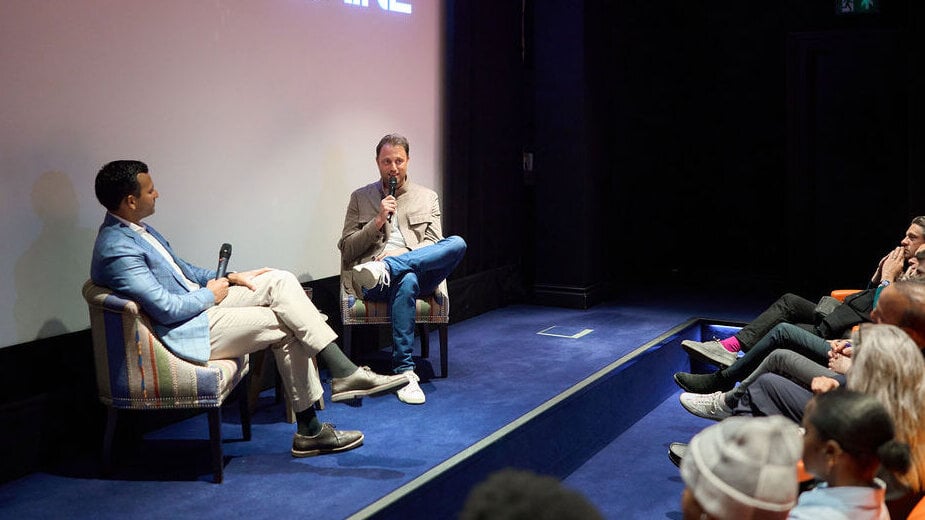
John Chapman, who manages the family office behind Chord Music Partners, has expressed optimism for the future value of premium music catalogs. In fact, he says music is undergoing a seismic shift, driven by a new source of capital: the insurance sector.
“Nobody understands how much insurance money is coming this way,” Chapman said on Tuesday (May 19) at an invite-only industry breakfast co-hosted by MBW and The Raine Group at the Charlotte Street Hotel in London. “This is actually the hottest take that I will have today.”
Chord has rarely spoken publicly since emerging as one of the largest independent music rights platforms in the world – making Chapman‘s remarks among the most detailed the company has offered on its strategy, its relationship with Universal Music Group, and the forces reshaping music investment.
Alongside Sam Hendel, Chapman runs Dundee Partners, the investment office of the Hendel family, which has been deploying capital into music for roughly three decades.
In 2021, Dundee joined forces with KKR to form Chord Music Partners, acquiring a USD $1.1 billion portfolio of copyrights from a Kobalt Capital fund.
Then, in early 2024, Universal Music Group acquired a 25.8% stake in Chord for $240 million, in a deal that saw KKR exit the business. Dundee retained its majority position.
“this last month, we went back to the ABS market. I did 120 meetings with institutional investors – not five. We were overwhelmed with interest.”
John Chapman, Chord/Dundee Partners
That deal – which valued Chord at $1.85 billion – established a template: Warner Music Group subsequently launched a $1.2 billion catalog-buying joint venture with Bain Capital, and Sony Music Group formed a $2 billion+ partnership with Singapore sovereign wealth fund GIC.
In August 2025, MBW exclusively reported that Chord had raised more than $2 billion in investable capital, with another $1 billion-plus on the way, following a strategic investment from Searchlight Capital Partners.
Chapman says Chord now manages a $3 billion catalog spanning 80,000 songs and more than 3,000 artists, with interests in music by The Weeknd, Ryan Tedder/OneRepublic, David Guetta, Lorde, Diplo, ZZ Top, Twenty One Pilots, and Morgan Wallen.
Speaking at the event in a discussion with Raine’s Joe Puthenveetil, Chapman argued that the institutional appetite for music debt is helping to keep private-market valuations buoyant – and that the next phase will be even larger.
“In 2022, [Chord] went to the ABS market and got a $730 million deal done,” said Chapman. “I crawled over broken glass trying to get insurance money to invest in that deal. I got a spread of 220 basis points over the five-year.”
“Then, this last month, we went back to the ABS market. I did 120 meetings with institutional investors – not five. We were overwhelmed with interest. [Chord] had the lowest ABS spread of all time [in music].”
The reference to Chord‘s latest ABS activity aligns with a $500 million debt issuance through a newly established vehicle called Canon Music Issuer Trust, which priced in late April at a spread of 160 basis points – confirmed as the tightest-ever pricing for a music royalty ABS. The notes received A ratings from both Kroll Bond Rating Agency and S&P Global Ratings.
Chapman believes that the long, often decades-long, time horizons of debt lenders – compared with other capital sources – can be of particular benefit to music rights-holders.
“the catalog market’s foundation is built on the demand for debt. And there is so much demand from [lenders to provide] that debt.”
John Chapman, Chord/Dundee Partners
Breaking from typical industry rivalry between competing platforms, Chapman specifically credited Blackstone, Recognition Music Group, and Ben Katovsky with helping to institutionalize the music ABS market.
Recognition secured two ABS deals across 2024 and 2025 against its catalog, with total proceeds topping $1.8 billion.
“In the face of rising interest rates, everyone in this room thought that multiples would go down,” said Chapman. “The reason why they didn’t go down is because the catalog market’s foundation is built on the demand for debt. And there is so much demand [from lenders to provide] that debt.”
The next inflection point for the catalog business, Chapman argued, will come when insurance companies move from lending against music royalties to owning them outright.
“When the insurance market moves from the credit investments in this space to equity investments, there’s just going to be a wall of capital that people are not really thinking about,” he said.
“What insurance companies have is a much longer time horizon. And with [music catalogs] you have a cash-flow stream that matches up with that.”
Asked about the gap between public-market and private-market valuations of music assets – with listed companies trading in the low double-digit multiples while recent private transactions have exceeded 20x – Chapman offered a domestic analogy.
“My four-year-old daughter [is watching a film] which was created in 1950 by the Walt Disney Company for two and a half million dollars,” he said, referring to Cinderella.
“Good Lord – I’m paying $20 a month for Disney Plus so that my daughter can watch Cinderella whenever she wants. That is just an incredible thing to think about as it relates to music on a catalog basis and the value of music over time.”
On the question of whether AI-generated content poses a threat to catalog values, Chapman was direct.
“I think I’m supposed to say yes. But I don’t believe it at all,” he said. “In a world of infinite supply, I think that familiarity is a scarce resource.
“You’re going to go back to the thing that you love, because that’s what human behavior does, over and over again. I’m very comfortable betting on that.”
“You’re going to go back to the thing that you love, because that’s what human behavior does, over and over again. I’m very comfortable betting on that.”
John Chapman, Chord/Dundee Partners
Chapman highlighted what he described as the measurable advantage of Chord‘s partnership with UMG – and the proprietary deal flow it provides.
“I had a great partnership with the team at KKR for a couple of years, but the reality is that during that time period, I bought eight catalogs for roughly $350 million,” he said. “And then last year, I bought 20 catalogs for $800 million.
“It is just a clear, fundamental difference – a pipeline of opportunities that I see as a direct result of our partnership with UMG. The people in this space that have figured out a way to get a proprietary pipeline are benefiting from that.”
He added: “Every time I’ve tried to sprinkle magic pixie dust on my catalog, it has not worked. But every time we’ve thoughtfully approached something, it’s succeeded.
“For example, we have Diplo‘s catalog: he performed at the [Winter Olympics] closing ceremonies, and UMG, six months beforehand, scheduled a meeting with me to think about a marketing campaign around the closing ceremonies.
“As a result, we had a 350% uptick in the listenership of that catalog, because we were prepared for it.”
Asked what he was most excited about in the music biz beyond Chord, Chapman cited a statistic from a consulting firm commissioned last year: in 2024, 60% of all vinyl sales in America were sold to individuals who did not own a record player.
“It shows how desperately people want to prove fandom,” he said. “That gets me so excited – connecting that feeling of someone’s love for [an artist] and giving them more than just a portion of a $12-per-month streaming subscription.”Music Business Worldwide



