


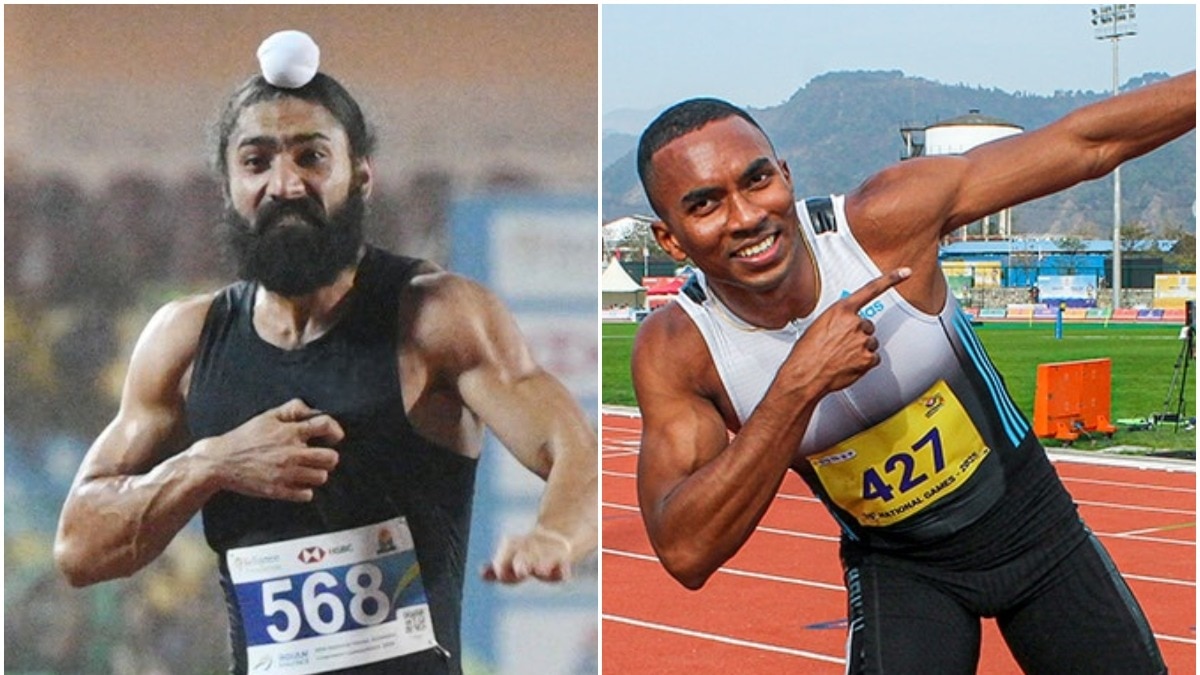
On a Friday evening at the Birsa Munda Stadium in Ranchi, Gurindervir Singh, twenty-five, from Jalandhar in Punjab, ran 10.17 seconds in the 100m heats. A new Indian national record. Within minutes, Animesh Kujur, a young sprinter from Jharkhand, ran 10.15 in a separate heat and broke it. The national record had changed hands twice before dinner.
Saturday’s final had the quality of a duel. Gurindervir settled it with 10.09 seconds – the first Indian in history to break the 10.10-second barrier. Three national records. Two athletes. One stadium. Twenty-four hours.
For anyone who follows athletics, that sequence of events requires a moment of stillness. Not because an Indian broke a national record — those happen. But because of which record, and what breaking it means in the global context of the sport’s most coveted, most politically loaded, most argued-over event.
There is a race that lasts less time than it takes to read this sentence aloud. And for over a century, India has not been part of it. Until, perhaps, now.
A STORY ABOUT TWO AFRICAS — AND NEITHER IS INDIA
To understand why India’s absence from the sprint has felt so total, you first need to understand the most striking geographic pattern in all of athletics. It divides an entire continent in half.
East Africa — Kenya, Ethiopia, Tanzania — has for decades produced the greatest distance runners the world has ever seen. Their muscles are dense with slow-twitch fibres — built for endurance, for running long and steady at altitude without burning out. For most of that period, the sprint was simply not Kenya’s event. The country’s athletic identity was built on the marathon, the 5,000, the 10,000 — on suffering over distance, not explosiveness over ten seconds.
That picture has begun to shift. Kenya’s Ferdinand Omanyala ran 9.77 seconds in Nairobi in 2021 — the African continental record, and one of the fastest times in history. He is the exception, and a remarkable one, but he has largely remained just that — an exception. Kenya has still not produced a generation of elite sprinters, and Omanyala himself has struggled to translate his raw speed into Olympic or World Championship medals against the depth of the Caribbean and American circuits.
West Africa — Nigeria, Ghana, Ivory Coast, Senegal — has historically produced something different. Not marathoners. It has produced sprinters. The muscle architecture in this part of the world leans toward fast-twitch fibres — explosive, anaerobic, built for short violent bursts. This is where the sprint story has been written, decade after decade.
But the more precise way to understand modern sprint dominance is not through West Africa itself, but through what the transatlantic slave trade did with West African populations over centuries. The largest concentrations of West African descendants outside Africa are in the Caribbean and the American South. Jamaica, Trinidad, the Bahamas, the African-American community. These populations carry the same genetic inheritance and then, layered over it, built athletic cultures that channelled explosive talent into track and field with extraordinary intensity.
The numbers bear this out with startling precision. Roughly 40% of all athletes who have broken the ten-second barrier have represented Caribbean nations. Around 20% have been Jamaican nationals specifically — from a country that accounts for less than 0.03% of the global population. That is an enrichment of athletic talent almost a hundred times greater than chance would predict. And when you extend the count to include athletes born to Caribbean parents but competing for other nations — Canada’s Andre De Grasse, whose parents are from Trinidad and the Bahamas; Britain’s Linford Christie, born in Jamaica — the Caribbean thread runs even deeper.
The one apparent outlier in recent memory — Italy’s Marcell Jacobs, who won the Tokyo 2020 gold — holds on closer inspection. Born in Texas to a Black American father and an Italian mother, raised in Italy, Jacobs fits the same ancestral pattern. No Asian sprinter has ever made an Olympic 100m final. Japan celebrated nationally when Yoshihide Kiryu broke ten seconds in 2017. China has produced a handful of sub-10.10 performances. India, until this month, had not entered that conversation at all.
WHAT THE SCIENCE ACTUALLY SAYS
Here is where the story gets more nuanced — and more hopeful — than the standard narrative suggests.
The genetic basis of sprint performance is complex, but researchers have identified several key markers. The most studied is the ACTN3 gene, which produces a protein found exclusively in fast-twitch muscle fibres. The sprint-friendly version of this gene is strongly overrepresented in West African-descended athletes. The non-sprint version essentially means your fast-twitch fibres are less efficient at the explosive work that a 100m demands.
In 2013, researchers from the Defence Institute of Physiology and Allied Sciences in Delhi published the first systematic study of sprint-related genes in Indian populations. They tested 598 Indian Army soldiers across four distinct ethnic groups — Rajputs, South Indians, Gorkhas, and Ladakhis — and measured their ACTN3 profiles. The finding was significant: there was no meaningful difference in the sprint gene’s distribution across these groups, and the overall Indian profile closely resembled that of Caucasian Europeans.
Sit with that for a moment. Not West African. But European. The same genetic band that has produced Linford Christie, Marcell Jacobs, and a generation of competitive European sprinters.
The study also found, on the endurance side, that Gorkhas and Ladakhis — both groups of Himalayan and Mongolian ancestry — showed genetic markers more suited to endurance performance. India, in other words, is not one athletic gene pool. A Ladakhi from the high passes and a Rajput from the plains and a South Indian from Tamil Nadu do not share the same baseline. The subcontinent is a continent unto itself, genetically as much as geographically.
There is a further argument that India’s sheer population size makes the genetics question almost secondary. Even if only a small fraction of Indians carry sprint-favourable gene combinations, the absolute number of such individuals — in a country of 1.4 billion — almost certainly runs into the millions. The sprint talent exists somewhere in India. The question has always been whether the system is capable of finding it.
THE LONG STORY OF INDIAN SLOWNESS
That systems failure has deep roots.
Cricket ate the ecosystem. From sponsorship money to coaching attention to parental ambition, the sport has absorbed resources that might otherwise have built athletes across disciplines. A child with explosive speed in rural Punjab or Jharkhand did not, for most of India’s post-independence history, grow up with a clear path to a sprinting career. There was no visible role model, no funded programme, no realistic prospect of financial stability. The talent either went elsewhere or was never found at all.
Milkha Singh’s near-miss at a bronze medal in the 400 metres at Rome 1960 became the country’s most celebrated athletics story, and it remains so partly because it ended in loss. India has a high tolerance for glorious failure. What it has lacked, in sprinting, is the infrastructure for success.
Neeraj Chopra’s javelin gold at Tokyo cracked something open. It proved that an Indian body, properly coached and systematically supported, could stand on the top step of an Olympic podium. But the javelin is a technical event — angles, rotational mechanics, years of specialised training. You can build a javelin thrower. The sprint, the world has long assumed, simply is or isn’t. India, for a very long time, wasn’t.
What 10.09 Actually Means
Let’s be clear about what this is not. Gurindervir at 10.09 is not a world-final contender. The top of the sprinting pyramid runs at 9.7, 9.8 — the rarefied air of the Caribbean and American circuits. That gap is real and not trivial.
But that is the wrong frame. The right frame is what 10.09 does domestically, historically, and psychologically.
Think of English runner Roger Bannister and the four-minute mile. When he ran 3:59.4 in 1954, the barrier had been called physiologically impossible. Within months, others had followed. What Bannister did was break the assumption that the record was unbreakable. Once the mind accepted it was possible, the body followed. Gurindervir has not just set a time. He has set a permission.
Equally important is the presence of Animesh Kujur. India does not have one fast man. It has two, from different states, different backgrounds, pushing each other in real time. Kujur’s 10.15 was itself a national record for roughly forty-five minutes. Rivalry is the most efficient engine of athletic improvement ever invented. Jamaica did not produce Usain Bolt in isolation; it produced a sprint culture, deep and competitive at every level, that made someone like Bolt almost inevitable.
THE POLITICS OF SPEED
There is a reason nations invest in sprint programmes even when Olympic medals are decades away. The 100m is not just a race. It is a statement about what a country believes its people can do. When India produces a sub-10.10 sprinter it disrupts a hierarchy that has felt permanent. It says something that no niche technical discipline can say: we are fast. At the most primal, most universal level of human athletic performance.
Jamaica, a nation of three million people, understood this and built a national identity around it. China understood it. Japan understood it. India is only now arriving at the conversation.
Gurindervir Singh and Animesh Kujur have not made India a sprinting nation yet. What they have done is more foundational: they have proven, against the weight of history and the assumptions of a world that never expected this, that the Indian body belongs on this track. That is the precondition for everything that follows — the funding, the pipelines, the talent identification programmes, and the ten-year-olds in Punjab and Jharkhand who will now grow up knowing that this is possible.
The ten seconds will keep shrinking. The real race has just begun.
– Ends



