
























Nvidia founder and CEO Jensen Huang’s keynote speech at the GTC Taipei 2026 marks a crucial moment for the world of computers, as the largest company in the world announced a partnership with Microsoft to build the next generation of personal computers.
As part of the deal, Nvidia is set to lend its latest ‘superchip’ called the Nvidia RTX Spark, which will run a version of Microsoft Windows designed for agentic AI capabilities and tasks, allowing users greater power and computing ability.
Together, these two companies will power the next generation of personal computers and laptops as well as workstations, which can then be manufactured by companies by like Dell, Lenovo
What’s inside Nvidia RTX Spark?
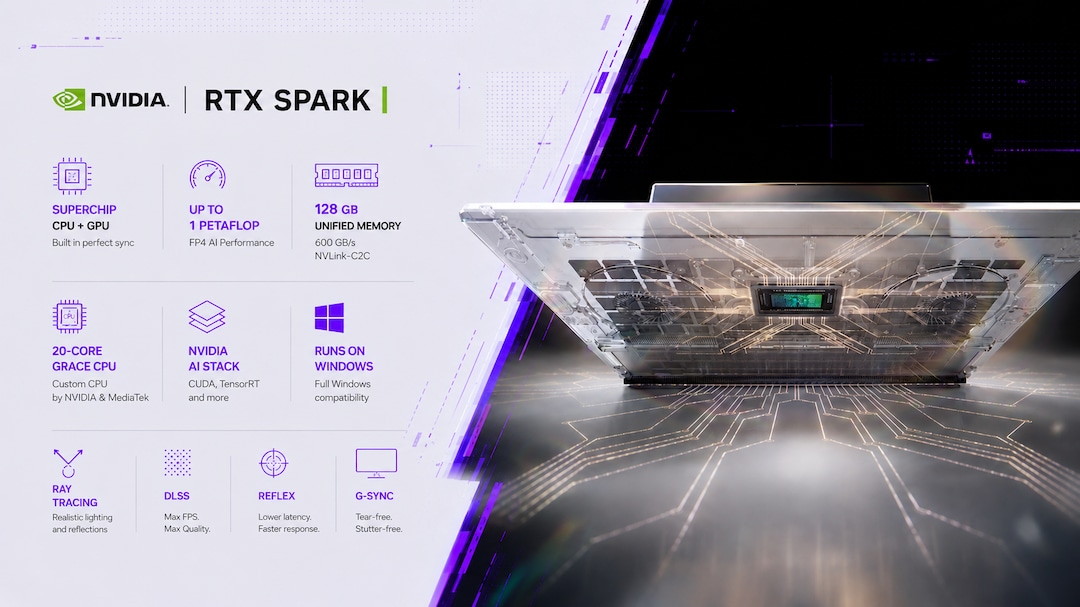
While most computers we know today gets operated by individual units of a CPU and a GPU, Nvidia is calling its new Nvidia RTX Spark a ‘superchip’ that includes both CPU and GPU, working in tandem in one whole unit.
The crux of the new superchip is power and speed. Run by Nvidia’s Blackwell RTX GPU architecture, RTX Spark delivers up to 1 Petaflop of FP4AI performance and features a custom 20-core Grace CPU, which Nvidia has built in partnership with MediaTek.
The superchip also comes with 128 GB of unified memory architechture, supporting ultra-fast 600 GB/s NVLink-C2C bandwidth.
The chip, which can run on MS Windows, has full Nvidia AI stack integration includin CUDA and TensorRT and comes with usual RTX high end features such as DLSS, Ray Tracing, Reflex and G-SYNC, making it an effective tool for gaming.
What does it mean for the industry?
Nvidia’s partnership with Microsoft promises to revolutionise the PC market, as it will directly take on the likes of AMD, Intel and even Apple.
The new series of laptops and PC will run Windows, which will take on Apple’s Macbooks and iMacs, promising power over utility. Nvidia’s full-stack AI integration, a 20-core CPU and its powerful GPU will combine with MS Windows’ accessibility to take on the M-series chips, which are designed by Apple and run exclusively on MacOS.
While Apple still has hold over the laptop industry due to its greater security and hardware-software integration, the partnership between Nvidia and Microsoft could spell trouble for Intel and AMD, in particular.
As of today, most Windows PCs and laptops are run by Intel’s i-series or AMD’s Ryzen-series CPUs. This applies to a simple Chromebook as well as an expensive workstation suited for video editing. A Windows PC usually gets powered by an Intel or an AMD. And this will change.
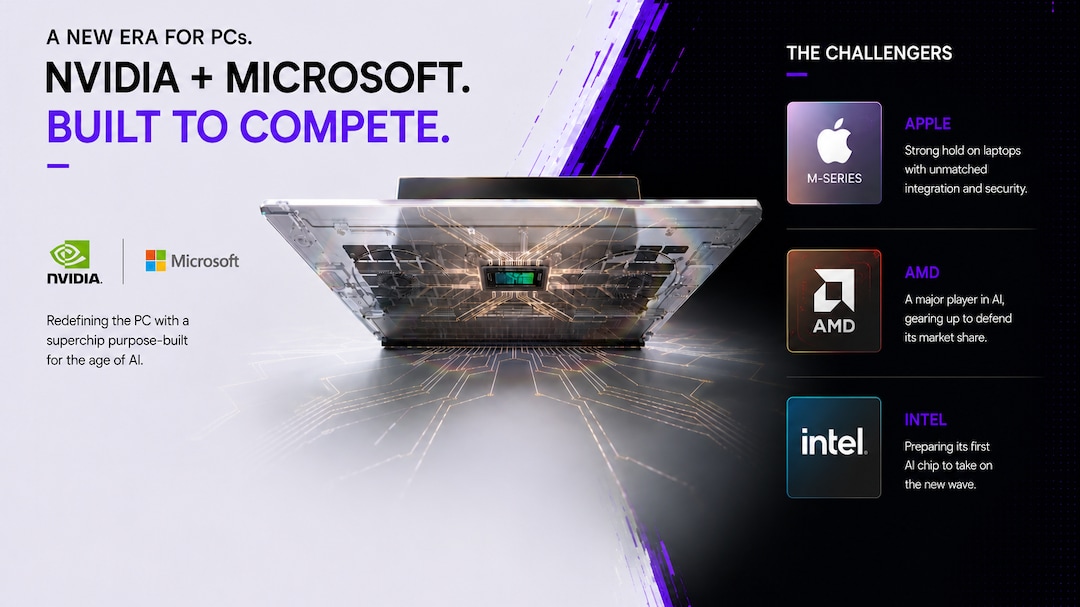
Nvidia will now enter the competition through its superchip offering, potentially eating away market share from AMD and Intel, which was binned by Apple some six or seven years back when the company decided to build its own CPUs.
AMD and Intel are both expected to hit back, with AMD being a large AI-driven company whereas Intel is reportedly planning to launch its first AI chip later this year, in a direct response to Nvidia, Microsoft partnership.
Will it impact Dell, HP, Lenovo etc?
No. The partnership between Nvidia and Microsoft dictates that Nvidia will build the chip hardware while Microsoft will power the OS. The end product and the designing of a laptop or a PC will still be made by technology solutions and manufacturing companies such as Dell, HP and Lenovo, among others.
In fact, the onus will be on these very companies to decide on whether or not they are ready to adopt the next-gen Nvidia superchip-run Windows laptops.
Addressing the keynote, Jensen Huang has made it clear that Nvidia’s new superchip is being backed by ‘the entire PC industry’, implying partnership with the likes of Dell, HP and the likes.
The new series of Nvidia-powered Windows laptops will be available this fall.
ALSO READ: Nvidia Announces Vera — World’s First CPU Not Designed For Humans
Essential Business Intelligence,
Continuous LIVE TV,
Sharp Market Insights,
Practical Personal Finance Advice and
Latest Stories — On NDTV Profit.



