


If you have Rs 10 lakh invested in gold, spread across jewellery, coins, bars, sovereign gold bonds or digital gold. Such an allocation is far from uncommon for many Indian families. Gold has long been a part of household finances, bought for weddings, presented as gifts during festivals and handed down from one generation to the next. It is also widely regarded as a dependable store of value.
That familiarity can make it easy to overlook a key aspect of portfolio planning. If a substantial portion of your wealth is tied up in gold, what share of your total assets does it represent? More importantly, what does that level of concentration mean for the overall resilience of your finances?
The value of the gold holding is only one part of the equation. What matters just as much is how large a share of your overall wealth is invested in the asset.
Also Read | Layoffs Are Rising In Tech, But These Skills Are Helping People Unlock Better Pay
ALSO READ: Real Economy Promise Will Soon Reassert Itself In Stock Markets: RBI Deputy Governor
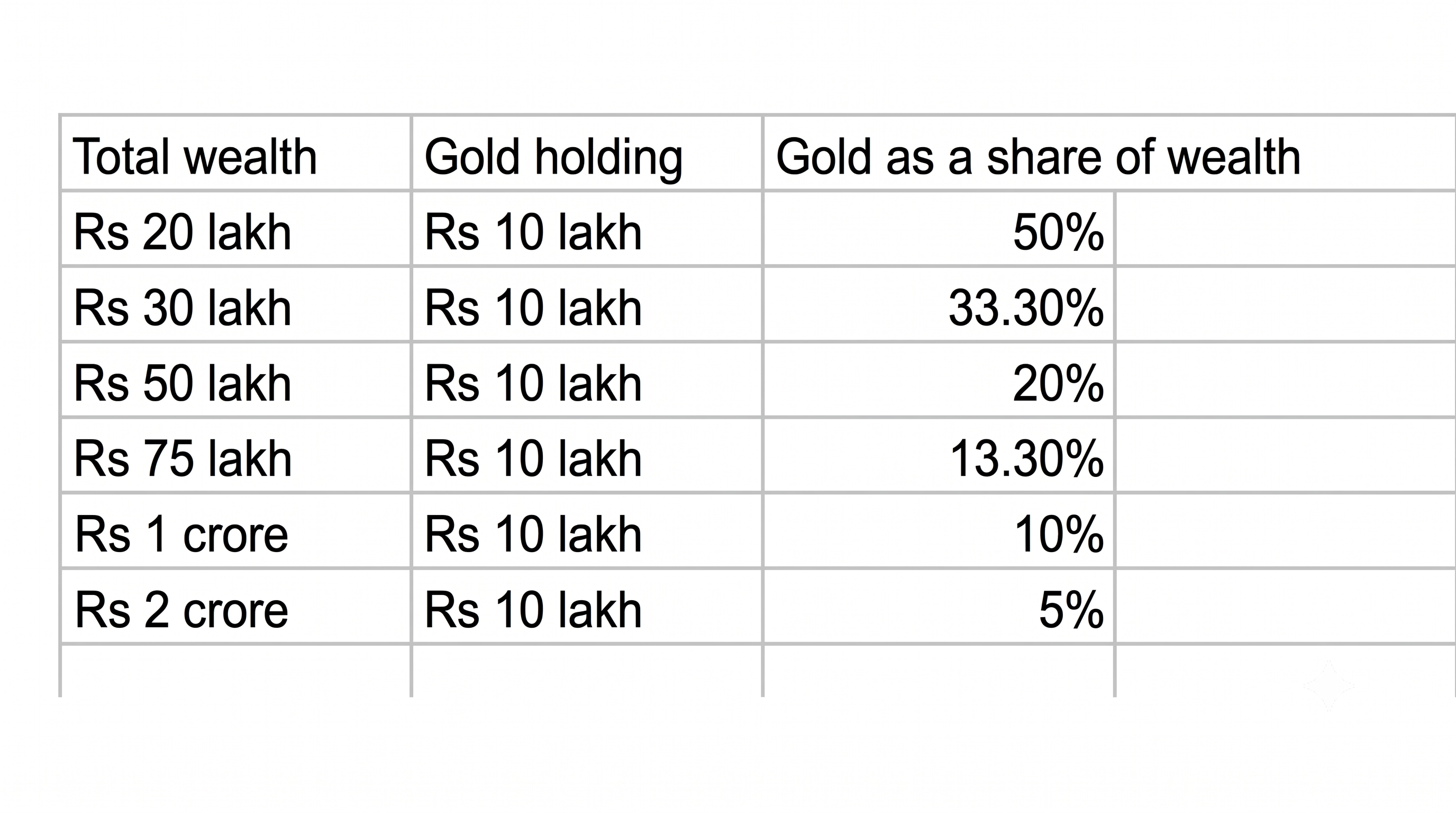
Consider two households. One has Rs 10 lakh in gold and total assets worth Rs 20 lakh, making gold 50% of its portfolio. Another has the same Rs 10 lakh in gold but total wealth of Rs 1 crore. In that case, gold accounts for just 10%.
The difference is significant. A portfolio with a large exposure to one asset can respond very differently to changes in that asset’s price, affecting the overall level of risk and the way the portfolio performs.
Gold exposure
A useful way to assess concentration is to calculate gold exposure as a percentage of net worth.
The basic formula is:
Gold exposure (%) = Current value of gold holdings ÷ Total net worth × 100
Suppose your gold is currently worth Rs 10 lakh and your total net worth is Rs 40 lakh.
Your gold exposure would be:
Rs 10 lakh ÷ Rs 40 lakh × 100 = 25%
Saying that you own Rs 10 lakh worth of gold does not, by itself, reveal much about your financial position. Calculating gold’s share of your overall wealth offers a more meaningful measure of exposure.
Liabilities also need to be factored into the equation. A person may hold Rs 10 lakh in gold while carrying a sizeable home loan, personal loan or other debt. In such a case, total assets can paint a rosier picture than net worth, which takes outstanding liabilities into account.
Gold exposure can be easy to overlook in Indian households because it is rarely built up through a single large investment. Instead, holdings often accumulate over several years.
ALSO READ: SEBI Chief Says Regulator May Explore Margin Cuts For Longer-Term Derivatives
Jewellery may be bought for weddings, festivals and family occasions, while gold coins could be added during periods of strong demand. Some pieces may also enter the household through inheritance. Individually, these purchases may seem relatively modest.
Taken together, they can add up to a sizeable holding. A family may consider its equity mutual funds, fixed deposits and provident fund to be its primary investments, while viewing jewellery as something separate. From a wealth-allocation perspective, that approach can understate the household’s actual exposure to gold.
That makes the purpose behind the holding an important starting point. Rather than asking whether Rs 10 lakh is a large or small allocation, investors should first consider why the gold is being held.
The reasons can vary widely. Some people use gold to diversify long-term wealth or provide a hedge against certain economic risks. Others accumulate it for weddings, future family expenses, inheritance or because of longstanding traditions. For some, it is simply a matter of personal preference.
These motivations can lead to very different approaches. An investor treating gold primarily as a financial asset may view the holding through the lens of portfolio allocation.
The debate around gold is less about whether the asset is inherently positive or negative and more about how much of a family’s wealth is tied to it.
For an investor with a broad mix of assets, Rs 10 lakh in gold may represent only one part of the overall portfolio. For a household with limited wealth outside gold, the identical holding can account for a much larger share of net worth and create greater exposure to movements in a single asset.
Essential Business Intelligence,
Sharp Market Insights,
Practical Personal Finance Advice, Daily Fuel, Gold and Silver Prices and Latest Stories — On NDTV Profit.


