


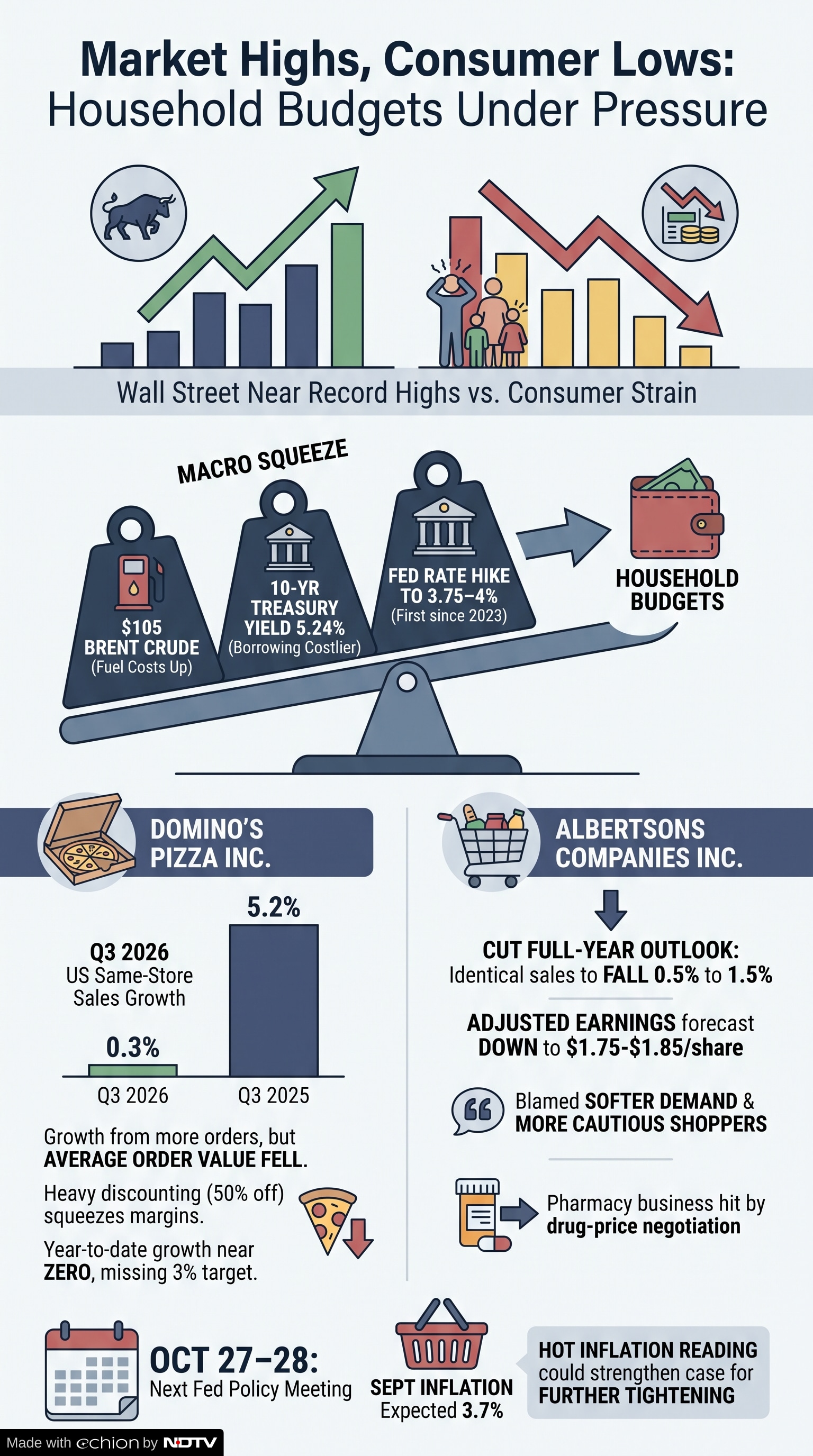
Wall Street is near record highs, but two companies that sell everyday essentials to Americans are pointing to strain on household budgets. Domino’s Pizza Inc. reported US same-store sales growth of just 0.3% for the third quarter of 2026, according to its quarterly filing on Monday. In the same quarter last year, the figure was 5.2%.
Growth came from more orders, but the average order value fell, suggesting customers are still buying but spending less each time. International same-store sales, excluding currency effects, rose only 0.2%.
A Year Of Stalling Sales
Also Read | Layoffs Are Rising In Tech, But These Skills Are Helping People Unlock Better Pay
The weak print continues a pattern. Domino’s US same-store sales rose 0.9% in the first quarter, well short of analyst estimates, and just 0.1% in the second quarter. Early in the year, the company had guided for about 3% US same-store sales growth for 2026. After three quarters of near-zero growth, that target looks hard to reach.
The pizza chain has also leaned on heavy discounting. It ran 50% off menu-priced pizzas from October 5 to 11, a move that brings in orders but squeezes margins.
Albertsons Up Next
Grocery chain Albertsons Companies Inc. reports second-quarter results before the US market opens, and expectations are low.
In July, Albertsons cut its full-year outlook. It now expects identical sales to fall 0.5% to 1.5% and adjusted earnings of $1.75 to $1.85 per share, down from $2.22 to $2.32 earlier. The company blamed softer grocery demand and more cautious shoppers. The stock fell about 21% the day after that report and has not recovered. Options are pricing a move of about 4% on results day.
Part of the sales drag, about 1.5 percentage points, comes from Medicare drug-price negotiation hitting its pharmacy business, not only from weaker consumer spending.
The Macro Squeeze
The weakness comes as American households face several pressures at once. Brent crude is hovering around $105 a barrel amid the US-Iran conflict, pushing up fuel costs and leaving less room in household budgets for eating out and groceries. Borrowing has also become more expensive, with the 10-year US Treasury yield near 5.24%, close to its highest level since the mid-2000s.
The Federal Reserve added to that pressure in September, raising rates to 3.75–4% in its first hike since 2023. Its next policy meeting is on October 27–28, and September consumer price inflation, due on Wednesday, is expected to come in at 3.7%. A hot reading would strengthen the case for further tightening and add to the squeeze on consumers.
Yet the stock market has largely looked past these pressures. The S&P 500, which has risen 13.8% in the year so far, ended flat on Monday at 7,807.24. The index is 37.28 points away from its all-time high.
What It Means For India
For Indian markets, the most direct effect is through foreign investor flows. A weaker US consumer combined with sticky inflation could keep the Fed hawkish and US yields high, a backdrop that has typically weighed on foreign portfolio investment into Indian equities and on the rupee.
There is also a sector read-across. Domino’s results will be closely watched by investors in Indian quick-service restaurant stocks, including Jubilant FoodWorks, which runs Domino’s in India. Further out, sustained weakness among US retailers and consumer companies could slow their discretionary technology spending, a risk for Indian IT firms with retail-heavy client portfolios.
ALSO READ: Jubilant Foodworks Q2 Business Update: Revenue Grows In Double Digits, Domino’s India Adds 88 Stores
Essential Business Intelligence,
Sharp Market Insights,
Practical Personal Finance Advice, Daily Fuel, Gold and Silver Prices and Latest Stories — On NDTV Profit.


