


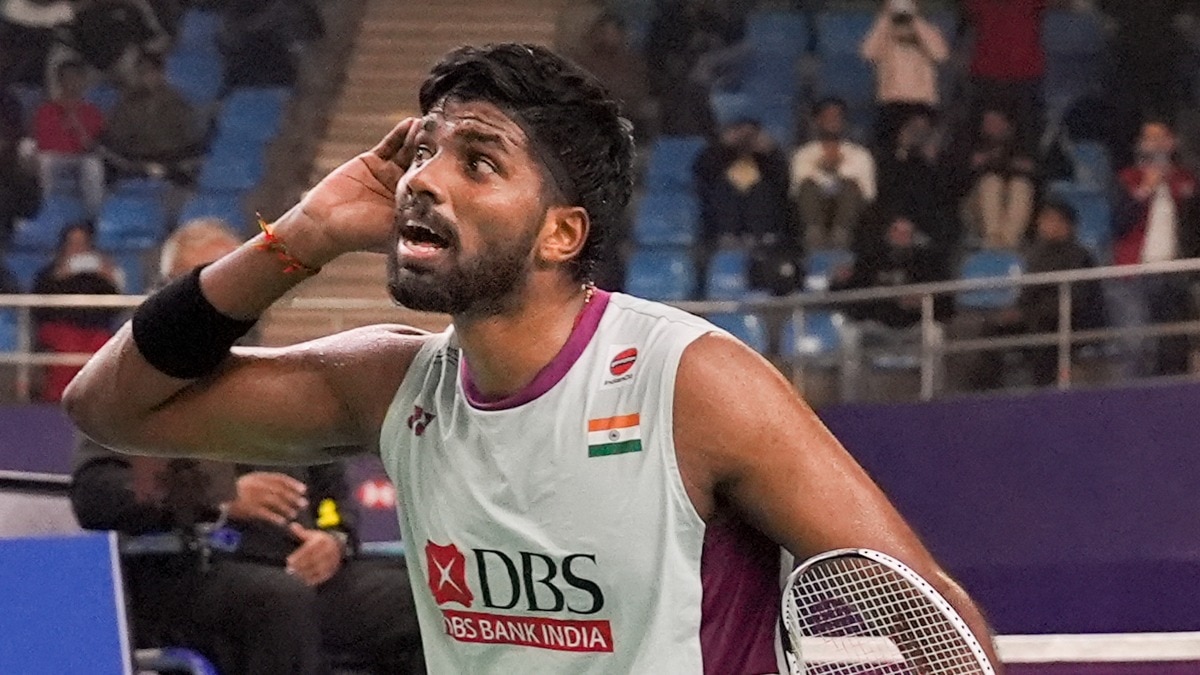
“I do not get support from my government (Andhra Pradesh), I do not get support from anywhere. I am all alone in this. I went a little crack on that day and I spoke out. I am not normally like this.”
Somewhere between the spectrum of grief and irritation, India’s badminton star Satwiksairaj Rankireddy vented his frustrations in an interview with India Today, a day after returning from India’s Thomas Cup campaign. India beat Chinese Taipei to win the bronze medal in the tournament, before getting knocked out by France in the semi-finals. This was India’s second medal finish in three editions of the tournament, the first one being a historic gold in 2022, a campaign that Satwik and his doubles partner Chirag Shetty were a huge part of.
A call that was scheduled to be for 15 minutes, turned into a 45-minute long chat where Satwik constantly spoke about how little the ecosystem offers to sportspersons in India, who travel across the world in the pursuit of excellence and to make their country proud.
After returning to India, Satwiksairaj Rankireddy sparked a massive social media storm when he put up an Instagram story. The said story reflected the sorry state of affairs that is sports in India, where not a single member of the badminton association or the government went to the airport to receive the bronze medal-winning contingent, which had just returned from Denmark.
“Back home now. As usual, no one knows what happened over the past two weeks, and it seems like no one really cares,” Satwik wrote on his story.
THE INVISIBLE CHAMPIONS
An aggrieved Satwik, who is part of the most successful doubles pair in the history of Indian badminton alongside Chirag, asked India Today if it was too much to ask for a little care from the citizens of the country, the officials and the sporting ecosystem. For a pair that has scaled the summit of the BWF rankings, the anonymity of an immigration queue becomes a jarring reminder of where they stand in the Indian sporting hierarchy
“When we travel through the airport, nobody knows that we are the badminton team. No one in immigration, no one at the counter, no one in the flight,” he says.
In fact, the neglect starts much before they entered the court in Horsens to represent India in the Thomas Cup. Satwik reveals a detail that seems unfathomable for a national team: they had to design and print their own kits.
“We designed the Thomas Cup jersey on our own. We printed our own shirts. HS Prannoy came up with the idea that we will wear shirts written Thomas Cup on it which will have one star. We designed two T-shirts – white and black. We bought it, we sent it for printing, and whatever few T-shirts we were able to sell, we donated the money to charity.”
There they were, one of the best teams in the world, standing in an airport wearing jerseys they had designed and printed themselves.
“Not even one person at the airport asked me or anyone in the team: where are you going, are you the badminton team, or playing something? There was absolutely nothing. And that lack of recognition makes your heart sink.”
“What I ask is so simple, cheer for us at team events, show that care. We don’t want any money. We want just a small bouquet, just a comment ‘hey, I saw you playing last night, congratulations.’ I wanted that. And I was very frustrated that night, and it came out. Tomorrow when you lose, they will immediately comment. ‘Arey look, they keep losing in the first round’,” Satwik said.
Satwik’s story, which captured the country’s apathy towards badminton – perhaps now one of India’s biggest sporting ecosystems outside cricket – ended up creating quite a buzz. Popular social media account hit out at the badminton team, asking what exactly they had done to deserve adulation from fans.
“Our badminton team is great. But they still choke a lot. Stardom is not built when you are at the 3rd or 4th place. It’s tough to achieve but gone are the days of celebrating 4th place of Milkha Singh at the Olympics. Win an Olympics medal, see the adulation,” the account said.
THOMAS CUP MOMENT THAT NEVER ARRIVED
The frustration is compounded by these “experts” of the digital age. A country that wants to have a fitness revolution, and host the 2036 Olympics, still to this day does not care about much beyond cricket. Once every four years, the gyanis raise their heads for a month to count India’s Olympic medals. Social media suddenly turn into a sporting think tank and everybody starts analysing why India cannot become a true sporting nation.
The following month, the conversation disappears. What comes out of that? Nothing. Zero positive discourse. The athletes, however, remain exactly where they were.
“Thomas Cup 2022 win was supposed to be our 1983 World Cup moment,” Satwik says slowly. A deep sigh follows.
India’s 1983 World Cup victory changed cricket forever. Money entered cricket. Stardom followed. Infrastructure followed. Generations of children started dreaming differently. But four years after India’s Thomas Cup triumph, Satwik still finds himself explaining who he is at restaurants in Hyderabad.
It is a stark contrast: globally celebrated on court, yet invisible in the very streets he calls home.
“I felt so bad. Because I have not seen the growth of the sport after the 2022 Thomas Cup gold. We got the bronze this time and there is no change at all in attitude. If the landscape does not change now, then our juniors will be treated the same way – like a nobody,” Satwik said.
In a fleeting world of 6-second attention spans, Satwik believes that it is okay to forget or not care about particular players. But when a bunch of people are representing a country in a global tournament, people perhaps should care. The punch to the gut in an already morose interview comes very late in the conversation. By this time, so much sadness has accumulated between the chats that it is almost begging for comic relief.
“In Hyderabad, my only stress relief is that I go for dinner with my friends. When I ask for a table, I am told, ‘sir, no seat is available’. I tell them who I am, what I have done and they do not budge. But the next moment, some Instagram fame person will come, and they will be ‘ma’am, please go, Table is free for you’.”
“MAYBE I SHOULD JUST DO INSTAGRAM”
There is bitterness in Satwik’s voice while narrating the story, but there is resignation too. Almost as if he already knows who wins in the modern attention economy. Satwik ponders sometimes, should he just drop badminton and go full time into content creation instead? Because what is the point? There is not a lot of money, and definitely not fame. So may as well use the reach and get Instagram famous instead, wonders the 25-year-old.
“Sometimes I think I will leave badminton and just do Instagram. I do not see the point in this sometimes. I have nice reach as well, I will dance, sing etc and earn money. There was no support and recognition earlier, there is none of it now, and it might not be there for the future generation also,” Satwik says.
Satwik stops short of mentioning it directly, but the Badminton Association of India, the state governments and the Union ministry perhaps have a bigger role to play in this. Since their return, none of the Thomas Cup winners have been called up by their respective state leaders for recognition or award, not publicly at least. Satwik tells India Today that he knows some of his teammates will be awarded by their respective states, but he will not be getting anything from Andhra Pradesh.
Back in 2024, Satwik’s partner Chirag Shetty snapped at the Maharashtra government for announcing Rs 11 crore reward for four Indian cricket team members who won the T20 World Cup. “Government should treat any other sport equally,” Chirag had said.
THE FEAR OF BEING FORGOTTEN
A sportsperson’s lifespan is brutally short. Satwik is now 25. He will play five, maybe six more years of peak badminton if he remains injury free. The shuttler says that considering he does not get recognition now, not a single person will remember who he is once he retires from the sport.
It is a troubling notion for a 25-year-old to go through, who is perhaps just figuring out his life beyond his sport. But his fight now lies in the present, to find that recognition that he and the other badminton players feel that they deserve.
“If we were even received by BAI officials, or kids from an academy, we would have been so happy. If someone would have even stood at the airport welcoming us, we would have been so happy. These things can be done over a simple phone call also. A medal for the country should be treated as a special thing. I don’t think the country, the officials respected the medal. That would have been enough,” Satwik concluded.
Satwiksairaj Rankireddy isn’t asking for the moon. He is asking for the basic dignity of being recognized in a restaurant in the city he represents.
The real tragedy here isn’t just about a lack of bouquets or missed airport receptions. It is the indictment of a system that demands Olympic glory every four years while remaining fundamentally indifferent to the champions it already has. Satwiksairaj Rankireddy is a Khel Ratna awardee, a world-beater, and a once-in-a-generation icon – yet he is being forced to navigate a landscape that treats his excellence as an anomaly rather than a national treasure.
As India builds its pitch for the 2036 Olympics, the disillusionment of its greatest doubles player serves as a grim warning. We can build stadiums and host global events, but if a man who has conquered the world feels invisible in his own streets, the “sporting revolution” we speak of is a hollow one.
– Ends



