


The fine Normandy port of Granville is one of the best locations in Europe from which to witness the glorious inevitability of sunset.
With a clear horizon in May, dozens of spectators climb to the terrace that runs high above the rocky shore. I am glad to have witnessed the event on Wednesday, despite the non-cooperation of SNCF – French Railways.
I am on a trip through Brittany and Normandy, from the Breton capital Rennes to the chic Norman resort of Deauville. Possibly like you, I believe the best way to travel through France – and any other big country – is by train. You glide past ever-changing landscapes, thread through sun-bleached villages and invariably seem to wind up in a handsome 19th-century city station.
Yet the fact that I reached Granville in time to see the day dwindle was only because a kindly French businesswoman named Marie picked me up in the town of Avranches, 15 miles away.
Yes, I know that any fool can find French train times online. But I assumed my search had gone awry when it served up the first train of the day from Avranches to Granville at two minutes to noon. On what is a short route with surely a fair amount of demand, that seemed nonsensical – as did the last train seeming to leave at 7.05pm.
That is not a real schedule, I said to myself.
A close equivalent in terms of “small, slightly inland town to medium-sized resort” in the UK would be the link from Rye to Hastings in East Sussex. Departures are regularly timed at the same minutes past each hour from 6am to 11pm.
That 17-hour spread is a timetable. Its French counterpart barely made seven hours. Thank goodness for hitchhiking, and merciful Marie.
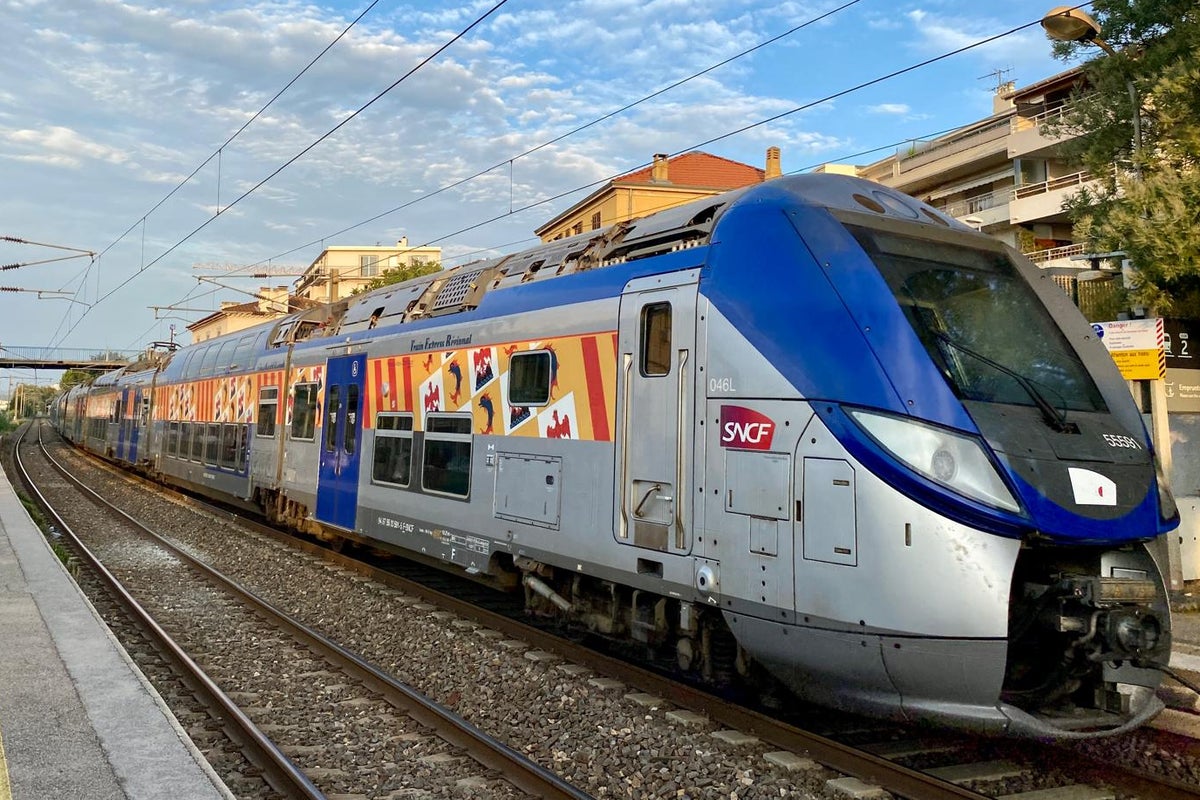
A constant refrain among people disdainful of British trains is that French trains are so much better than ours. Certainly, the high-speed network is an order of magnitude better than our intercity tribute to the Victorian age. The Ile de France around Paris is a superb example of how high-density suburban trains can enhance a city. And whoever runs the Zou! network between Marseille and Nice and into the mountains of Provence deserves a rise for delivering regular, reliable and spectacular services.
But there is much to criticise elsewhere. The notion of a clock face timetable with regular departures does not seem to have occurred to the average French railway scheduler.
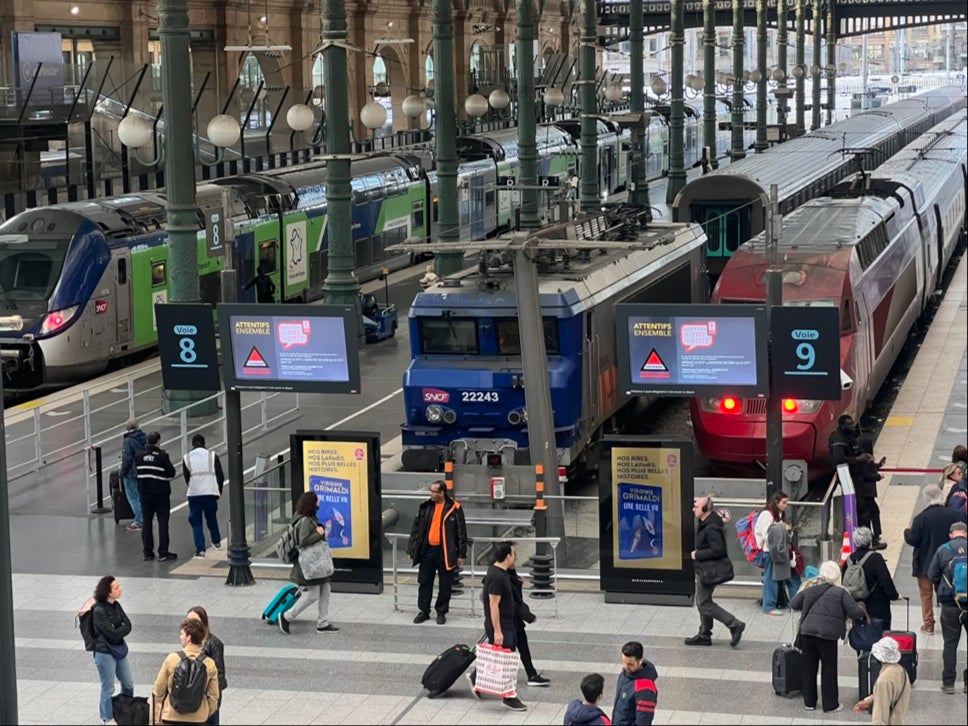
In most parts of the country, the average line has an array of timings seemingly chosen by lottery. They run on an arbitrary set of days with incredibly complicated footnotes that vary according to whether it is a school day (how is the poor tourist to know?), market day or one of the public holidays of which France has an apparently unlimited supply, particularly in May.
At a country station in the deep southwest, I misread Lundi Vendredi as Monday to Friday, and assumed that the train which would get me to Toulouse ran during the working week. You guessed it: on Tuesday, Wednesday and Thursday nothing was moving. That required another bout of hitchhiking.
Then there is the bus that thinks it is a train. Nobody likes rail replacement buses, except presumably the operators who are paid to take the place of trains. Yet in France there is a bizarre system by which even points linked perfectly comfortably by rail are often operated by a bus.
As an example, I give you Rennes, the capital of Brittany, to Caen, the most important Normandy city. Twice a day (subject of course to some variation), the journey is covered by a train. And twice a day it is a bus.
Before you enjoy any of this excitement, you must buy a ticket – which is far from a joy on French Railways. Do you believe UK ticket vending machines were designed to baffle? Well, the French cousin of Franz Kafka was clearly brought in to advise on how to make a device so counter-intuitive that the aim is surely that no one should ever be able to buy a ticket.
Much of the performance involves rotating a round metal disc and – at what you hope is the appropriate point – stabbing the button in the middle of it. It is purely guesswork, because you can barely see anything due to the decision to install the machines at an orientation which means the sun shines upon them for much of the day.
Add to that the “SNCF shrug” when all tickets to Paris are sold for the day – no, you will not be allowed on even though you are prepared to stand – and you have a national railway with even more idiosyncrasies than ours.
Wish me luck on the 6.05am to Bayeux on Thursday morning …



