


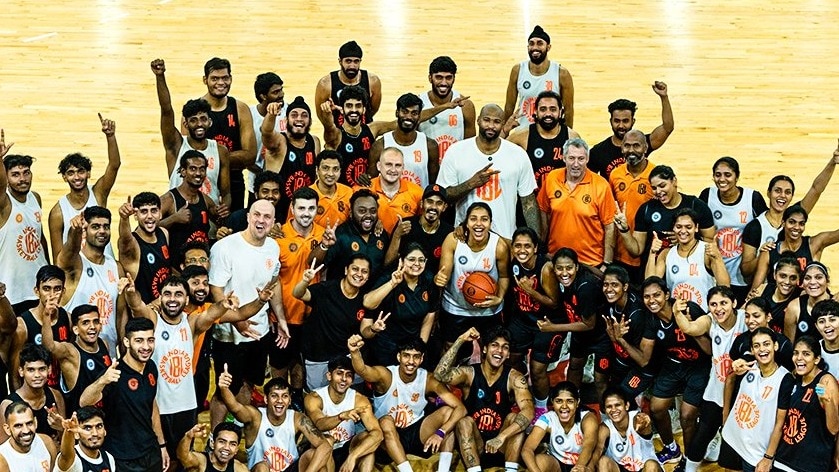
Every new sports league in India eventually gets hit with the same question. “Can it become the next IPL?” The people behind the India Basketball League (IBL) do not even want to entertain that idea. And honestly, that might be the smartest thing about the project so far.
India’s first-ever professional basketball league, launched in 2025 and expected to begin competition by early 2027, is not trying to copy cricket’s biggest machine. No forced “mini IPL” packaging. No obsession with becoming cricket with sneakers.
Instead, the IBL wants basketball in India to finally feel like basketball.
Fast. Loud. Urban. Global. And most importantly, sustainable.
Speaking exclusively to India Today, league commissioner Jeremy Loeliger made it very clear that trying to directly compete with the IPL would simply be “foolish.”
“If we tried to become another IPL, we would fail,” Loeliger said.
That line probably tells you everything about how the league wants to position itself. Because for years, Indian sports leagues outside cricket have often walked into the same trap. Some tried borrowing IPL-style auctions. Others copied formats, branding structures or presentation styles hoping the cricket audience would automatically transfer across.
Most struggled to build a long-term identity. The IBL seems determined not to make that mistake.
BASKETBALL DOES NOT WANT TO BECOME CRICKET
Loeliger’s biggest argument is actually pretty simple. Basketball already naturally fits the kind of audience modern sports leagues are trying to attract.
Fast pace. Constant scoring. Music during breaks. Short attention spans. Indoor arenas. Fans sitting almost on top of the court. Social media-friendly moments every few minutes. Basically, the exact reasons why T20 cricket exploded globally.
“Basketball is already the kind of fast-paced, high-energy sport that T20 cricket was designed to replicate,” Loeliger said while speaking to India Today. And unlike cricket, basketball already comes with a naturally global ecosystem attached to it.
That matters in modern India.
Young fans today do not just watch one sport anymore. They move between NBA clips, football reels, UFC knockouts, F1 highlights and IPL games all on the same phone screen. The IBL knows that audience already exists.
The challenge is giving Indian basketball players an actual pathway after school.
Because the irony is basketball has always quietly existed inside Indian school culture. Courts are everywhere. Inter-school competitions are common. Plenty of kids grow up playing the sport seriously. The problem always came after that. There was nowhere to really go professionally. Now, the league believes there finally can be.
THE BIGGEST WIN MAY NOT EVEN BE THE LEAGUE ITSELF
The interesting part about the IBL project is that it is not just launching a tournament and hoping things somehow work out later. ACG Sports and the Basketball Federation of India are trying to build an actual structure around it.
A fully residential high-performance centre has already been launched. Coaches from the United States and Australia are expected to be part of the ecosystem. Training will not just focus on basketball either, but also nutrition, mental wellness and academic balance.
The long-term goal is obvious: make basketball feel like a real career option in India. And Loeliger seems realistic enough to understand that success may not immediately look like packed arenas or billion-rupee valuations.
Instead, he repeatedly came back to one word: sustainability.
“We want players who grew up within the system to feel they can make a real career from basketball,” he said.
That idea changes everything for young players. Because Indian basketball has often produced talent without producing opportunity.
The IBL wants to become that bridge.
WHY THE IBL WANTS ITS OWN IDENTITY
One of the clearest signs of that approach is how the league plans to structure player recruitment.
No auctions.
Instead, the IBL wants a draft system similar to global basketball leagues, where teams select players in order rather than simply outspending everyone else. Again, the thinking is less about glamour and more about balance.
“Trying to replicate the IPL exactly would be a mistake because we are not cricket,” Loeliger explained. The league also plans to initially operate in a caravan model before eventually shifting into a full home-and-away structure once infrastructure improves across cities.
That infrastructure challenge is real. India still lacks enough world-class indoor basketball venues to suddenly run a massive decentralised league overnight. But the league seems more interested in building slowly than pretending the ecosystem is already ready.
And maybe that patience is the biggest positive sign here. Because Indian sports fans have seen enough leagues launch with noise, celebrity owners and flashy announcements before quietly disappearing a few years later.
The IBL does not seem obsessed with becoming the biggest thing in Indian sport immediately. It just wants Indian basketball to finally have its own space.
Its own sound. Its own culture.
And for thousands of young players who grew up hearing sneakers squeak on school courts without ever really seeing a future in the sport, that might matter far more than becoming “the next IPL.”
– Ends



