


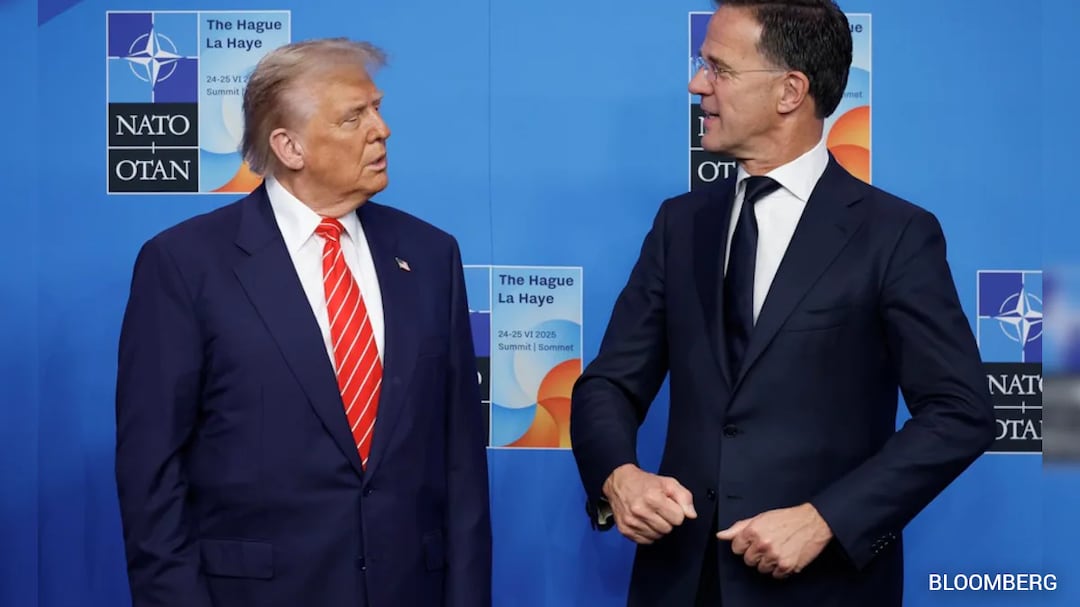
US allies in Europe anticipate that President Donald Trump will withdraw more forces from the continent after he announced he would pull 5,000 troops out of Germany, people familiar with the matter said.
Top diplomats from NATO allies forecast that Trump will announce more drawdowns, possibly including from Italy, and scrap a plan dating back to Joe Biden’s presidency to station long-range missiles in Germany, said the people, who asked not to be identified discussing private deliberations.
Other scenarios include the US ending participation in some military exercises and diverting forces from countries it’s unhappy with to others that are seen as more supportive of the president, the people said. That’s an idea that dates back to Trump’s first term, when he considered sending more troops to Poland.
The people said their predictions about the withdrawals were based on Trump’s public comments and conversations that alliance officials have had with US counterparts over their future plans for NATO. The Pentagon declined to comment.
Trump spoke by phone with Italian newspaper Corriere della Sera on Saturday and said the US is “still considering” whether to withdraw troops from Italian bases. He declined to comment on the movement of troops from Germany. He also said the US has always been there for Italy whereas “Italy wasn’t there when we needed it.”
Last month, Italy denied the US use of one of its air bases for operations in Iran, insisting that the government was following accords and procedures in place for decades, which don’t allow for combat operations, and said that any such requests would need to be put to the Italian Parliament for debate.
“If one of the main reasons why the US is in NATO is the ability to have forces deployed in Europe that we could project to other contingencies, and now that’s no longer the case at least when it comes to some NATO members, that’s a problem — and it has to be examined,” US Secretary of State Marco Rubio told reporters on Friday during a trip to Italy. Italian Foreign Minister Antonio Tajani said he had reiterated to Rubio that “an American presence in Europe is important to us.”
The moves would serve as a further signal of Trump’s unhappiness with some NATO allies such as Germany and Spain over what he’s seen as insufficient help for the US and Israeli war against Iran. Asked in late April whether he would consider removing troops from Italy or Spain, Trump responded, “Well, why shouldn’t I?”
“Italy has not been of any help to us,” he said. “And Spain has been horrible, absolutely horrible.”
The alliance hasn’t yet been told which unit will be pulled out of Germany but officials believe the US is looking at options to promptly implement the withdrawal, one of the people said. Spain, which has drawn particular ire from Trump, also was the only country to be granted an exemption from NATO’s new 5% defense spending target, leading to speculation that the US could draw down its presence at its Rota or Moron bases.
The president’s comments and anxiety among NATO diplomats have added to the longstanding unease between Trump and European nations — tension that has only gotten worse in his second term. That worry is balanced against the fact that Trump has long intimated he might withdraw from NATO — and never followed through.
That may in part be a recognition among Trump and his advisers that a permanent rupture or wide-scale withdrawal would hurt US interests as much as it might satisfy Trump’s demand for revenge against countries seen as keeping their distance.
“We would suffer as much as or more than the European countries we would identify as targets for punishment if we were to try to significantly reduce our forces or footprint,” said Gordon Davis, a retired Army major general and former senior NATO official. Davis is now a senior fellow at the Center for European Policy Analysis.
The US has about 85,000 military personnel currently stationed on the continent — a number which fluctuates over time as units return home or the US bolsters its presence for military exercises. Bases dotted across Europe serve as a springboard for rapid deployment to the Middle East, Africa and Central Asia. The US presence in Eastern Europe provides reassurance and boosts deterrence against Russia.
Despite Trump’s anger, NATO officials and senior diplomats said they still believe that guardrails imposed by Congress as well as US strategic dependency on Europe will constrain the president’s ability to make massive changes.
When Trump announced his plan last week to remove 5,000 troops from Germany, some lawmakers questioned whether the move went against the intent of a law Congress passed last year to require its approval on cutting the US troop presence in Europe below 76,000.
Read more: Trump’s Germany Drawdown Questioned by Allies in US and NATO
A recent meeting between Undersecretary of Defense Elbridge Colby and ambassadors from about a dozen NATO countries was productive and focused on working together to achieve what’s known as “NATO 3.0,” the US push for Europe to assume primary responsibility for its own defense, according to three people familiar with the conversation, who asked not to be identified.
While many are rebuilding their defenses, it will take another five to 10 years or longer for Europe to be able to provide for its own security, said Julianne Smith, who served as US permanent representative to NATO under Biden.
“It simply cannot replace what the US is providing in terms of deterrence,” she said, pointing to strategic mobility, intelligence and surveillance as well as air-to-air refueling.
Some NATO allies are likely to be supportive of an eastward shift of US resources, given Germany is no longer the epicenter of confrontation with Russia as it was in the Cold War. Poland, the biggest NATO defense spender as a percentage of its economic output, is pushing for an increased US presence.
The US is also expanding Souda Bay and Camp Kościuszko bases in Greece and Poland, fueling speculation that the US may relocate troops there.
While there is a case for moving troops eastward, the cost involved in such a relocation is unlikely to make it worthwhile, said Smith, who is now President of Clarion Strategies.
“Rushing to remove troops from Europe will create vulnerabilities and signal to Moscow that now is the time to test that,” she warned.
(This story has not been edited by NDTV staff and is auto-generated from a syndicated feed.)
Essential Business Intelligence,
Continuous LIVE TV,
Sharp Market Insights,
Practical Personal Finance Advice and
Latest Stories — On NDTV Profit.



