


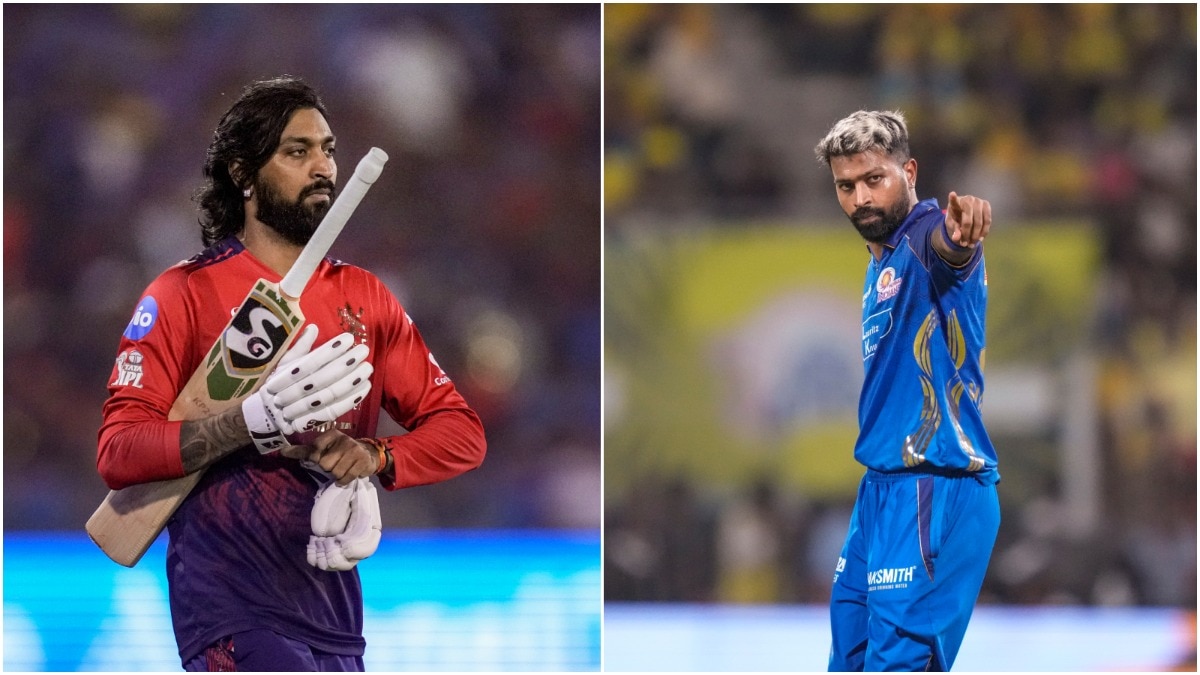
The engine room. Krunal Pandya spoke about Mumbai Indians’ engine room. Kieron Pollard paired with two boys from Baroda – a legendary all-rounder flanked by a fast-bowling all-rounder and a spin-bowling all-rounder. It felt, more than anything else, like family. If you got past Rohit Sharma, there was Suryakumar Yadav. If you got past Suryakumar, there was the engine room, driving Mumbai Indians home, more often than not. RCB vs MI: HIGHLIGHTS | SCORECARD
When Pollard and the Pandya brothers formed the backbone of the middle order, Mumbai Indians won three titles: 2016, 2019 and 2020.
“I had my best six years in MI. I remember Pandya brothers and Kieron Pollard were the engine room. We won a lot of games with bat, ball and fielding. I still remember in 2021, when we were playing our last game, the three of us held each other’s hands and felt like, okay, this is the last time we’ll be able to play together. It was obviously an emotional moment,” Krunal Pandya said on Saturday, after a match-winning performance for Royal Challengers Bengaluru – this time, and with no small irony, against his former team.
Mumbai Indians have not been the same since the engine room was dismantled. Hardik Pandya left for Gujarat Titans. Krunal was not retained. Age caught up with Pollard. Together, they would have papered over each other’s cracks; apart, those cracks have only widened.
- Between 2016 and 2021 (the engine room era): MI won 42 of 70 matches. Win/loss ratio: 1.75.
- Between 2022 and 2026 (post engine room): MI have won 29 of 70. Win/loss ratio: 0.69.
Cut to 2026, and Mumbai Indians are out of the playoffs race for the third time since 2022. This season, they may finish with the wooden spoon, having won just three of their first eleven matches. The five-time champions, the gold standard of this tournament for a decade, are threatening to become also-rans.
Yes, the engine room was gone – but the problems have compounded manifold since. Poor auctions. Squads that glistened on paper and crumbled in the heat of competition. The playoffs, perpetually tantalisingly close, perpetually out of reach.
Fingers are slowly, but surely, pointing at Hardik Pandya – their captain. Rumours of him unfollowing the franchise on Instagram buzzed on Sunday night, minutes after they lost to RCB in Raipur and their playoff chances, already hanging by mathematics alone, went up in smoke. One could not help but notice the symbolism: a captain, seemingly, cutting the last cord.
It was always going to come to this comparison, sooner or later. Two brothers. Two paths. One franchise that had to choose, and, with the benefit of hindsight, may well have chosen wrong.
The connection is hard to ignore.
Since Mumbai Indians made history by trading Hardik Pandya back from Gujarat Titans – where he had led them to the title in 2022 – things have simply not gone to plan. Was it necessary to bring Hardik back into the mix when they had Cameron Green, who was eventually traded out?
They handed the reins to Hardik, asking Rohit Sharma, their most decorated captain, to take a back seat. In return, the Baroda all-rounder has struggled: as a captain, as a batter, as a bowler – the multidimensional brilliance that once defined him flickering, dimming, rarely catching fire when it has mattered most.
In three seasons as captain, Hardik has led MI to the playoffs only once. For the second time in three years, they are set to finish in the bottom two. And, most damningly, the title drought of the five-time champions has now stretched to six years.
Hardik as MI captain – Played: 37. Won: 15. Lost: 22.
There is no single villain, of course. Poor auction strategy, out-of-form stars, and whispers of a fractured dressing room have all been offered as explanations. But the bottom line endures: Hardik has not come close to replicating the alchemy he conjured at Gujarat Titans.
THE OTHER PANDYA
Now look at the other one.
After leaving MI, Krunal had a modest stint at Lucknow Super Giants – solid enough, but hardly the stuff of headlines – around the very same time Hardik was winning a title in his debut season at Gujarat Titans, before leading them to a final the following year. Two brothers, both away from the franchise that had shaped them, but on markedly different trajectories. Hardik was ascending; Krunal was finding his feet. Then came the second wind at RCB, quieter, less heralded, but no less real, and suddenly, the gap between them began to close in ways nobody had quite anticipated.
The numbers, placed side by side, are instructive:
- Hardik for MI since his return: 556 runs in 33 innings at an average of 16.84; 29 wickets in 37 matches.
- Krunal for RCB: 250 runs in 13 innings at an average of 19.23; 27 wickets in 26 matches.
But numbers, as ever, only tell half the story. The other half lives in the spaces between – in what a player means to a team, not merely what he gives it.
At RCB, Krunal has been handed something his previous franchises withheld: licence to attack with the ball. Earlier in his career, he was deployed as a defensive bowler, a pressure-reliever, a plug in the dyke. He excelled in that role – but the responsibility of leading an attack has unlocked something deeper in him, something he calls his mental lab. His bouncer, bowled at over 100 kph, has become the conversation of the tournament. The left-arm spinner has added a weapon and, with it, a new dimension of menace.
At 35, Krunal has kept himself in remarkable physical condition, ensuring his body agrees with what his mind envisions. He spoke about it earlier this season in Delhi – that deliberateness, that almost stubborn insistence on reinvention. It is, when you consider it alongside Hardik’s trajectory, a fascinating divergence: one brother at the peak of his powers, the other searching for a foothold.
THE STREET FIGHTER
With the bat on Sunday, Krunal reminded everyone why he is spoken of in the same breath as the great clutch players in IPL history.
The Raipur surface was a far cry from the batter’s paradises seen elsewhere this season – double-paced, uneven, an altogether more unforgiving arena. RCB’s top order found out quickly. At 39 for 3, with Kohli, Padikkal and Patidar all back in the dugout, a collapse seemed not merely possible but inevitable in a chase of 167. Enter Krunal Pandya.
What followed was a masterclass in self-possession. He eschewed the reckless aggression that had undone his predecessors, choosing instead to apply himself, to grind, to anchor. He made 73 off 46 balls – rotating strike with clinical efficiency, building partnerships from rubble, dragging RCB back into the game one calculated run at a time.
What made the knock truly unforgettable, though, was the physical toll it exacted. As the game reached its crescendo, Krunal was visibly battling crippling cramps that spread from his calves to his back; at one point, he collapsed after a sharp bouncer, the body finally lodging its complaint. He recognised his mobility was gone and decided, in the manner of a man who has spent a career in these moments, to finish it on his own terms.
The 18th over was where the match turned. Barely able to stand, he cleared his front leg and hammered two towering sixes off Allah Ghazanfar, shifting the momentum irrevocably, almost violently. By the time he departed, he had dragged a sinking ship to shore. Others may have more flair. Few, very few, have more heart when the pressure is at its absolute peak.
Hardik, meanwhile, watched from elsewhere. One imagines he watched closely.
It is no coincidence that Krunal loves the big stage. He is the only man in IPL history with two Player of the Match awards in finals – 2017 with MI, 2025 with RCB. The tournament’s great occasions seem to find him, or perhaps it is the other way around.
“This game has to go as a tick for Krunal Pandya. He wanted it desperately – you could see it in his eyes. In tough games, street fighters come through. He certainly had that today,” said Mark Boucher on JioHotstar.
R Ashwin calls him the perfect Pressure Manager. There is perhaps no higher compliment in this format.
Krunal has not always stood out at RCB, but he has been the perfect cog in a well-oiled machine, part of a new engine room, quietly humming. He is not the loudest presence in that dressing room. He does not need to be.
THE IMPACTFUL PANDYA
And the noise, as they say, is not going unheard. While Hardik Pandya remains a crucial part of India’s white-ball set-up, a status he has somehow maintained despite his prolonged slump at MI, Krunal is once again knocking on the selectors’ door, louder now, more insistently.
“When I started playing cricket, my biggest dream was to play for India. That hasn’t changed. My hundred per cent goal is to play for the country. Next year, a World Cup is coming. Fingers crossed – I want to keep doing well and hope I get that opportunity,” he said after his match-winning knock in Raipur.
“That would be pretty special and amazing for me and my family. I just want to keep doing what’s in my hands: keep playing well, keep doing well.”
Just a man, at 35, still reaching.
Mumbai Indians brought back a Pandya. They brought back the famous one, the decorated one, the one whose name arrived with fanfare and a trade that made headlines across the country. And perhaps that was always the plan – the obvious move, the crowd-pleasing move.
But sport has a way of complicating the obvious. While Hardik has captained MI to mediocrity, Krunal has quietly, stubbornly, beautifully rebuilt himself into one of the most indispensable players in the league.
Two brothers. Two paths. One question that Mumbai Indians may spend years trying to answer. Did they bring back the wrong Pandya?
IPL 2026 | IPL Schedule | IPL Points Table | IPL Player Stats | Purple Cap | Orange Cap | IPL Videos | Cricket News | Live Score
– Ends



