


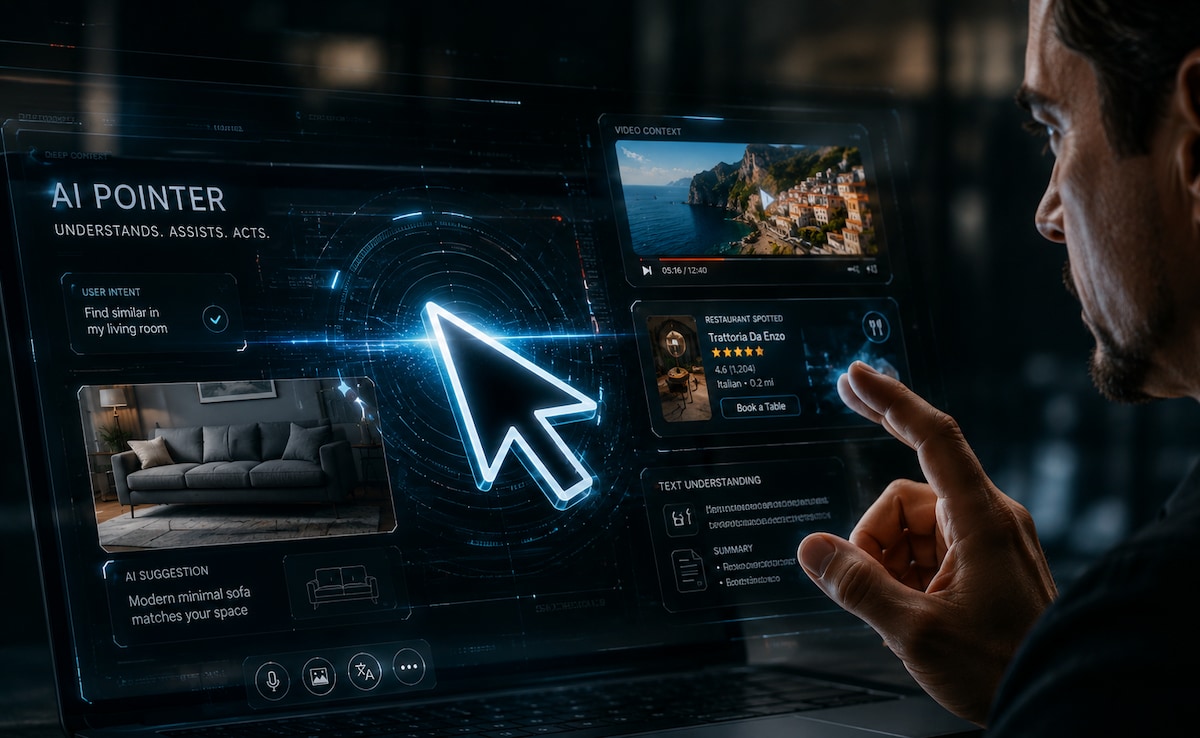
Google is moving the needle on artificial intelligence, quite literally. And in classic Google fashion, it is doing so by reimagining something most people stopped thinking about decades ago: the humble computer cursor.
In a blog post published last night, Google DeepMind unveiled experimental demos of what it calls an “AI-enabled pointer,” a cursor powered by Gemini that does not just track where users are pointing, but also understands what they are pointing at and why it matters.
It feels quite Tony Stark-ish. Remember how the Iron Man movies showed Tony Stark using ambient and intuitive AI all those years ago? His fictional AI assistants, principally J.A.R.V.I.S. and later F.R.I.D.A.Y., operated as always-on, contextual, and conversational partners rather than just command-based tools.
All this is not some distant sci-fi dream anymore. Imagine hovering over a paragraph and simply saying “summarise this.” Or pointing at a couch online and asking AI to place it inside your living room. Or circling a restaurant in a paused travel video and instantly pulling up booking information.
No copying, no pasting, no opening a separate chatbot window. Just point and speak.
For decades, the mouse pointer has largely remained unchanged. It understood coordinates, not context. Google now wants to change that. “Our goal is to address a common frustration: because a typical AI tool lives in its own window, users need to drag their world into it,” DeepMind wrote in its blog. “We want the opposite: intuitive AI that meets users across all the tools they use, without interrupting their flow.” That seemingly small shift could end up becoming one of the biggest interface changes of the AI era.
The Cursor Is Becoming Intelligent
If chatbots represented the first major AI interface revolution, Google appears to be betting that the next phase will be far more ambient and invisible.
Instead of typing elaborate prompts into dedicated AI apps, users may increasingly interact with AI through gestures, voice and context-aware interfaces woven directly into everyday computing.
And according to AI educator and founder of The Cutting Edge Group, Ansh Mehra, this is very much in line with Google’s long history of quietly laying the foundations for the modern internet.
“If you look at Google’s history, you’d realise that almost every important app we use today is built on foundations laid by Google,” Mehra told NDTV.
“Every other browser you use today is built on Google’s Chromium framework. Their 2017 Transformer paper gave birth to OpenAI, Anthropic and Meta Llama, and now they’re about to change the cursor.”
That Transformer paper Mehra refers to – Attention Is All You Need – fundamentally reshaped modern AI and became the technical foundation for today’s large language models, including ChatGPT and Gemini.
Now Google appears to be trying to reshape something even more fundamental: how humans interact with computers altogether.
AI That Understands Intent
One of the most interesting parts of DeepMind’s announcement is that the system is designed not merely to “see” objects on screen, but to understand user intent.
“Normal computers can only track where our cursor is pointing,” Mehra explained. “But now, these new AI-enabled cursors will also understand why we are pointing at something.”
“Our normal cursors track coordinates, but Google’s new cursor tracks intent, which is far more powerful.”
That shift mirrors how humans naturally communicate with each other in the physical world.
We rarely issue perfectly structured instructions in daily life. Instead, we rely heavily on gestures, shared context and shorthand phrases.
Point at a box and say, “keep this there.” Gesture toward a screen and say, “fix this.”
Humans understand instantly. According to Mehra, technology is now beginning to imitate that same instinct.
“I always take examples from the human species because, in the process of architecting artificial intelligence, we are unknowingly imitating evolution,” he said.
“Samajdhaar ke liye ishaara hi bohot hain (if you’re smart enough, you just need a signal, not an explicit instruction).”
“In human societies, we always use phrases like ‘take this’ and ‘keep it there’ and rely on our physical gestures to give instructions. The same instinct is now being carried forward in tech.”
Interestingly, Google itself echoed a similar philosophy in its DeepMind post, saying future AI systems should embrace the power of phrases like “this” and “that”, allowing users to communicate naturally without writing long prompts.
Why This Matters
At first glance, changing how a cursor works may not sound revolutionary. But historically, interface changes have often reshaped the entire computing industry. The graphical user interface (UI) changed personal computing. Touchscreens transformed smartphones. Voice assistants changed how users interact with devices.
AI-native interfaces may now become the next leap. According to AI expert and AiEnsured CTO Dr. Srinivas Padmanabhuni, Google’s experiment is part of a much larger shift toward what the industry increasingly calls “ambient AI” – AI systems that quietly work in the background instead of waiting for users to explicitly command them.
“Ambient AI means integrating context-aware artificial intelligence directly into native applications,” he told NDTV. “Unlike conventional AI that requires prompts, these systems continuously observe interactions, understand context and execute workflows more naturally.”
In simple terms, AI stops behaving like a separate tool and starts behaving more like an intelligent layer woven into everyday computing itself. Padmanabhuni believes Google’s AI-powered pointer represents exactly that transition.
“The mouse pointer is evolving from a simple coordinate tracker into a contextual, intent-based sensor,” he said. That idea may sound futuristic, but Padmanabhuni argues the shift has been building for years.
“Ten years ago, I had said AI is the new UI,” he added. What Google seems to be building now may be one of the clearest examples of that prediction beginning to materialise.
DeepMind says some of these ideas are already being integrated into Chrome and its upcoming ‘Googlebook’ experience, where users will reportedly be able to interact with Gemini directly through pointing gestures.
And given Google’s scale, even experimental interface ideas have a habit of quietly becoming industry standards later. Science fiction films have a strange history of seeing their moments come alive in real life. This is just another living example. The age of prompting AI through chat windows may soon feel like ancient history, much like what life before video calling feels like now.



