


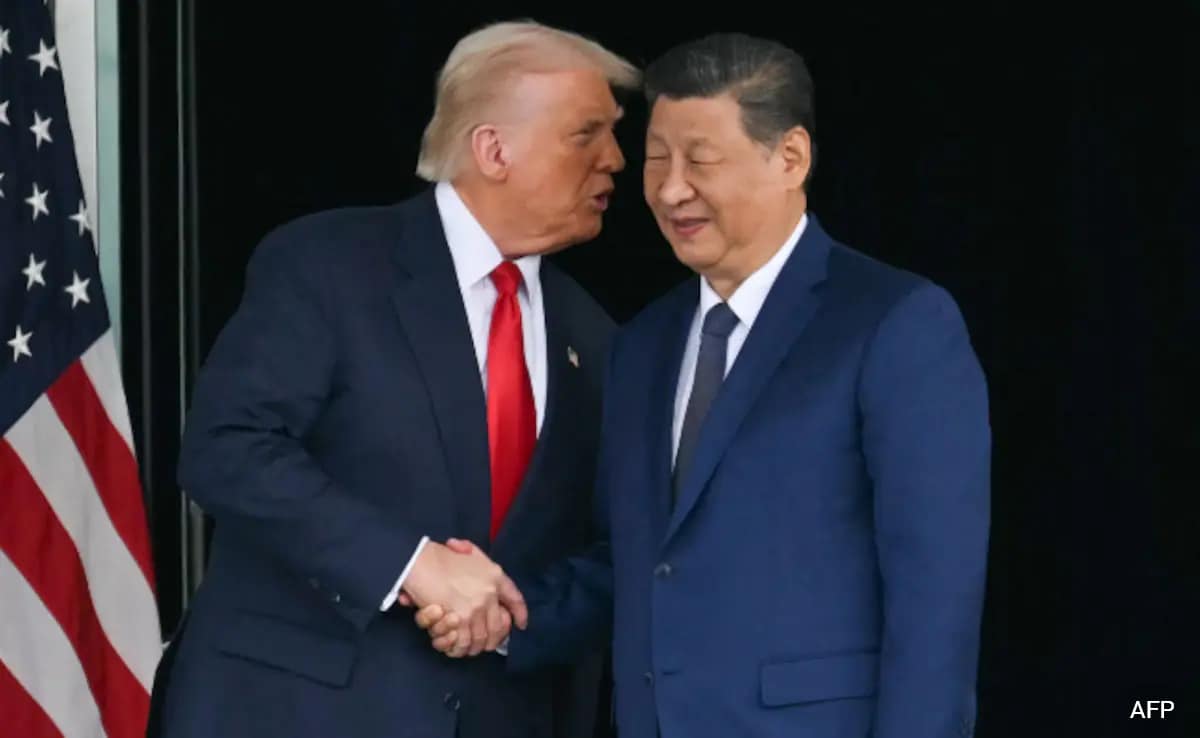
The results of US President Donald Trump’s visit to China will be carefully watched and analysed in many capitals. It is unlikely that it will produce major or durable results, although both sides would have done advance work to ensure that some positive outcomes can be announced.
With his impetuousness and erratic policies, and his disruption of the global system, Trump has seriously eroded trust in the US and damaged its standing in the world. The US is no longer seen as a reliable partner by allies and friends.
Advertisement – Scroll to continue
Who Trump Is
A transactional approach to foreign relations does not build mutual confidence, as deal-making is based on a short-term perspective, not longer term strategic investment. Trump has shown that the deals he has made can be disavowed by him. Besides, in deal-making, he wants to emerge as the unqualified winner, which means he wants one-sided deals.
Trump transgresses US constitutional checks and balances and defies domestic laws to get his way. It is this mindset that is behind his disregard of international law. His kidnapping of the serving head of state of Venezuela, his war on Iran, his blockade of Cuba and open threats to change the regime there show that his foreign policy is based on raw power, discarding even a diplomatic veneer of values or principles.
What Trump Can Do
While, as his wont, Trump is rhetorical about his personal ties with President Xi, lavishes praise on the Chinese leader – which is part of his patronising style and is intended to boost his own persona – the hard-nosed, unsentimental, coldly calculating, self-focused Chinese will hardly be duped by such talk.
More to the point, the US is explicit in viewing China as a technology rival, with focus now on the AI domain. It intends to develop over time domestic production in the area of critical technologies and raw materials that China today virtually monopolises, and progressively reduce its dependence on China.
The US has accused China of many sins, including supporting Russia and Iran militarily. It has threatened China with sanctions, to which the Chinese react sharply. If the US has denied advanced technology to China, especially its most advanced chips, the Chinese have retaliated with limiting US access to dual-use critical minerals, such as graphite items used in EV batteries, and, in principle, not permitting the export of gallium, germanium, antimony and super hard materials that have widespread military applications and are used in semiconductors, infrared technology, fibre optic cables and solar cells.
To this, the US has responded by saying that these controls underscored the importance of de-risking and diversifying critical supply chains away from China. Just before Trump’s visit, the US sanctioned China’s “tea pot refineries” importing Iranian oil, and China has invoked its domestic law to protect its companies from these sanctions.
The US has hurt China’s strategic and economic interests substantially by seeking control of the Panama Canal, depriving China of Venezuelan oil and also, with its blockade of the Strait of Hormuz, preventing it from being the biggest buyer of Iranian oil.
The US believes that China is afraid of its banks being sanctioned – which may be true, given how heavily export-dependent is the Chinese economy. China may temporise a bit, but the underlying tensions in US-China ties are serious and real.
America’s Self-Goals
The general view is that the US has committed many self-goals by alienating its allies and partners in Europe and elsewhere. Its failure to decisively win the war against Iran and protect its allies in West Asia from Iranian retaliation has called into question its role as a security provider. Doubts about the effectiveness of US arms in handling new methods of warfare, and the limits to its capacity to step up manufacturing at home to replenish the stocks depleted by the war in West Asia, have generated a debate on America’s decline as the global hegemon.
China is seen as the biggest gainer from these self-inflicted wounds, the infirmities of US policies and the backlash against Trump’s bullying at the global level. If countries have now to hedge against the unpredictable and capricious US policies under Trump, closer ties with China would seem prudent, as well as with Russia and the BRICS-plus grouping.
The Taiwan issue is extremely sensitive in US-China relations. China would seek stronger assurances from the US on the issue of arms supplies to Taiwan and the aspirations for independence of its leadershp. Taipei would follow with some trepidation the position Trump takes given the manner he has treated his allies. Japan and South Korea would follow closely too what transpires in Beijing because of the political. economic and security ramifications for them of developments in US-China ties.
Europe would equally watch carefully what the Trump’s visit produces. With the unsettling of transatlantic ties, Europe would be tempted to draw towards China, as the world’s second largest economy with a grip on critical raw materials and technologies, by way of a political and economic balancing move. But Europe has its own issues with China and seeks more access to the Chinese market, besides having its own concerns about its over-dependence on China for these critical raw materials and technologies, not to mention the EU seeing China as a systemic rival. The US has been pressing Europe to cooperate in its efforts to deny China access to the most advanced western technologies. It is in this context that Europe would assess the give-and-take in China by the US to determine its own policy options.
Why The Band Of Executives?
Reports are that Trump will be accompanied by a galaxy of chief executives of the biggest US technology and investment companies for his China visit. The messaging here is unclear. Trump wants US corporations to invest at home, bring manufacturing jobs back to the US, do on-shoring and de-risk supply chains, etc. How would that objective be met if he is looking at greater manufacturing and investment partnerships with China?
Trump has always sought to sell more agricultural products to China such as soya beans, corn, sorghum, beef and poultry, cotton, etc. to reduce the trade deficit, but has not succeeded, with China diversifying its suppliers, especially Brazil. In this context, the poor results of the deal Trump signed with China during his first term when the US-China equation was more in the former’s favour than now should give some perspective.
China failed to meet its purchasing commitments under the deal signed in January 2020, buying only 58% of the promised extra US goods. China did not meet its commitment to buy an additional $200 billion worth of US goods and services above 2017 levels by the end of 2021. Escalating tariffs were paused and some progress in intellectual property protection was seen, but no structural reforms in trade, such as China’s industrial subsidies or issues related to state-owned enterprises, followed, and most tariffs on $250 billion on Chinese products were left in place.
India Should Be Watching
India, too, would be watching the outcomes from Trump’s visit with great interest. The question would be how far would Trump go to make concessions to China to make his visit a success, and how much this may affect India’s geo-political interests.
India has invested quite heavily in its ties with the US. Strategically, the Quad and the Indo-Pacific concept have been centrepieces of a maritime strategy to deter China’s expansionism in the western Pacific and the Indian Ocean. It is evident, that unlike during his first term, when Trump raised Quad to summit level, this time, he is showing scant interest in the grouping. A Quad summit to be hosted by India this year seems unlikely. The Quad Foreign Ministers meeting planned in Delhi later in May seems more a way of keeping the grouping afloat and do some tactical signalling after Trump’s visit to China.
Trump has also registered unwanted blows to ties with India, which make no strategic sense. He has compounded this by cosying up to Pakistan, building a role for it in the region and boosting the image of the country’s rabidly anti-India Field Marshal. All this indirectly endorses Pakistan’s continuing close partnership with China, including their defence linkages, which are aimed at India.
A Dud Visit?
Trump’s visit may not meet high expectations for two reasons. One, his Iran war has proved a debacle for him. He had postponed the dates of his visit to China thinking he will have the Iran trophy in his bag when he went. On the contrary, the Strait of Hormuz remains closed and Iran has hardened its negotiating position. China has played its cards carefully on the conflict in West Asia, adopting a cautious position, relying on an enunciation of high-sounding general principles, though seeking an opening of the Strait of Hormuz, and to that extent, not supporting Iran fully. China will not put pressure on Iran on US behalf.
Two, China will factor in the real possibility that in the mid-term elections in November, Trump may lose the House of Representatives and may become a lame-duck president, with constant threats of impeachment. How far should China invest in an agreement with Trump would be a question, apart from his unreliability as an interlocutor. China would also be aware of a wide spread anti-Chinese sentiment in the US Congress and in the administration.
(Kanwal Sibal was Foreign Secretary and Ambassador to Turkey, Egypt, France and Russia, and Deputy Chief Of Mission in Washington.)
Disclaimer: These are the personal opinions of the author



