


New Delhi:
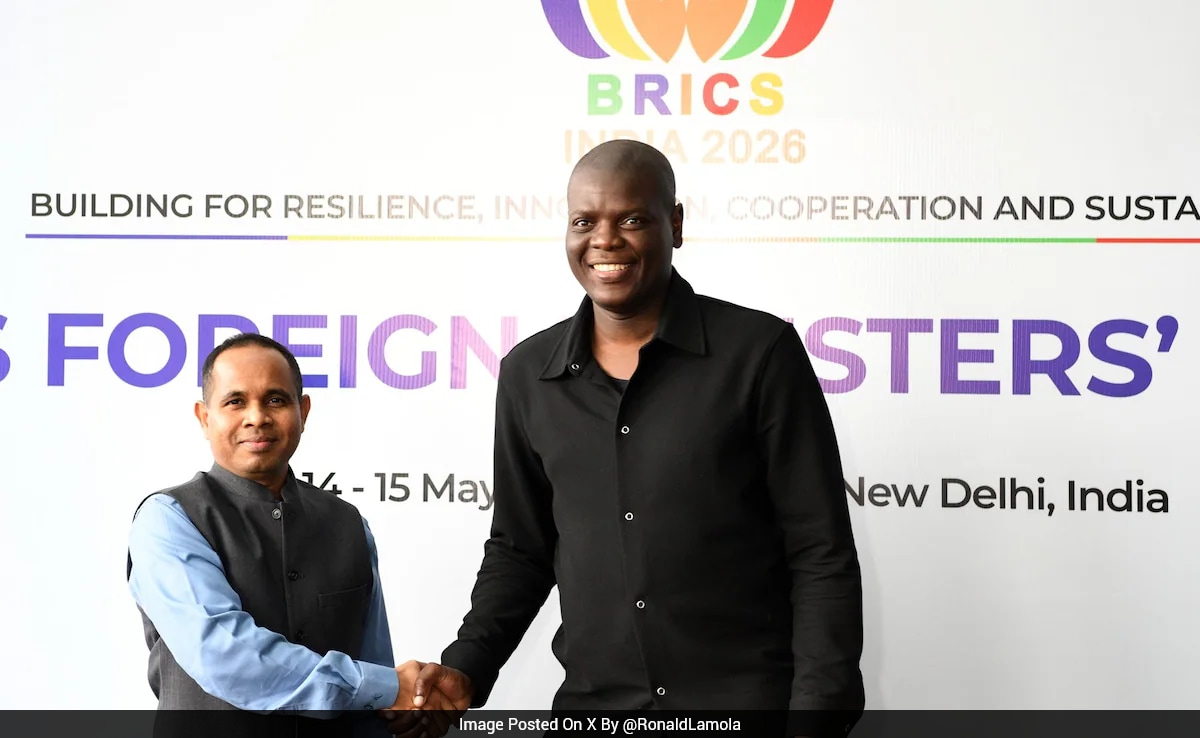
On the eve of the BRICS Foreign Ministers’ meeting in New Delhi, South Africa’s Minister of International Relations and Cooperation, Ronald Lamola, delivered a sharp and confident message to the world – the Global South is rising, BRICS is delivering concrete results, and the days of Western hegemony are numbered.
In an exclusive interview with NDTV’s Senior Executive Editor Aditya Raj Kaul, Lamola dismissed growing criticism that BRICS is little more than political symbolism, pointing to tangible financial support his country has received through the BRICS-backed New Development Bank. “In South Africa, where the challenge is in the logistics sector, we now have a concessional loan from the BRICS Bank to our logistics company Transnet. We’ve also got a loan to deal with our water crisis from the BRICS Development Bank. So for us, this is a key partnership platform to build on development,” he said.
Trade, Not A Common Currency – For Now
With global economic disruptions caused by US President Donald Trump’s aggressive tariff policies rattling alliances and trade relationships worldwide, Lamola said BRICS partners view the turbulence as an opportunity rather than a setback. “We have seen it as an opportunity for diversification,” he said, adding that the bloc was focused on strengthening trade ties, reducing dependence on Western-dominated financial systems, and settling transactions in local currencies. On the much-debated question of a BRICS currency, however, Lamola was measured. “For now, it’s trade,” he confirmed, signalling that a common currency remains a distant prospect.
A landmark development on the trade front came with the announcement that negotiations between the South African Customs Union and India are at an advanced stage, with a free trade agreement expected to be concluded soon. This would place South Africa alongside the United Kingdom, New Zealand, and Oman – nations that have recently sealed trade deals with India.
G20 Snub and Trump’s Threats
Lamola was unequivocal in pushing back against reports that South Africa could be excluded from the upcoming G20 summit in Florida. “South Africa is a founding member of the G20. If that meeting can be called a G20 when South Africa is not there, one can question its legitimacy,” he said pointedly. He drew a sharp contrast between South Africa’s position and that of the United States, noting that Washington voluntarily chose not to attend the G20 summit when it was hosted by South Africa, while Pretoria has made no such choice.
Reforming the World Order
On the question of United Nations Security Council reform, Lamola was unambiguous. Backed by what he called the “Ezulwini Consensus” of the African Union, South Africa supports permanent seats on the UNSC for India, Brazil, and two African nations. “The UN Security Council must be reformed to reflect the new dynamics and demographics of the world post-colonialism,” he said, welcoming the Pact of the Future adopted at the UN General Assembly as a roadmap toward that goal.
Diplomacy Over War
With multiple global conflicts casting a shadow over the BRICS meeting – from Russia-Ukraine to the escalating US-Israel-Iran confrontation – Lamola called firmly for dialogue. “All modern wars have shown that there will be no military victory anymore in any conflict because of the advancements of technology,” he said, urging patience and sustained diplomatic engagement. “It will not be resolved at the click of a button.”
On South Africa’s position within these conflicts, the minister reaffirmed the country’s non-aligned foreign policy. “We will not act at the behest of any superpower,” he said, stressing that South Africa needs investment and partnerships from all major powers – the US, China, Russia, India, and Japan alike.
India and South Africa: A Relationship Rooted in History
Lamola, on his first-ever visit to India, noted that the bilateral relationship runs deep – from Mahatma Gandhi’s early activism in South Africa to Nelson Mandela’s friendship with India. Today, that relationship is increasingly defined by trade, with South African citrus among the agricultural exports growing in the Indian market.
“The rise of the Global South is indeed unstoppable,” Lamola said, as he headed into one of the most consequential BRICS ministerial meetings in recent memory – one that could shape the future of multilateralism itself.



