


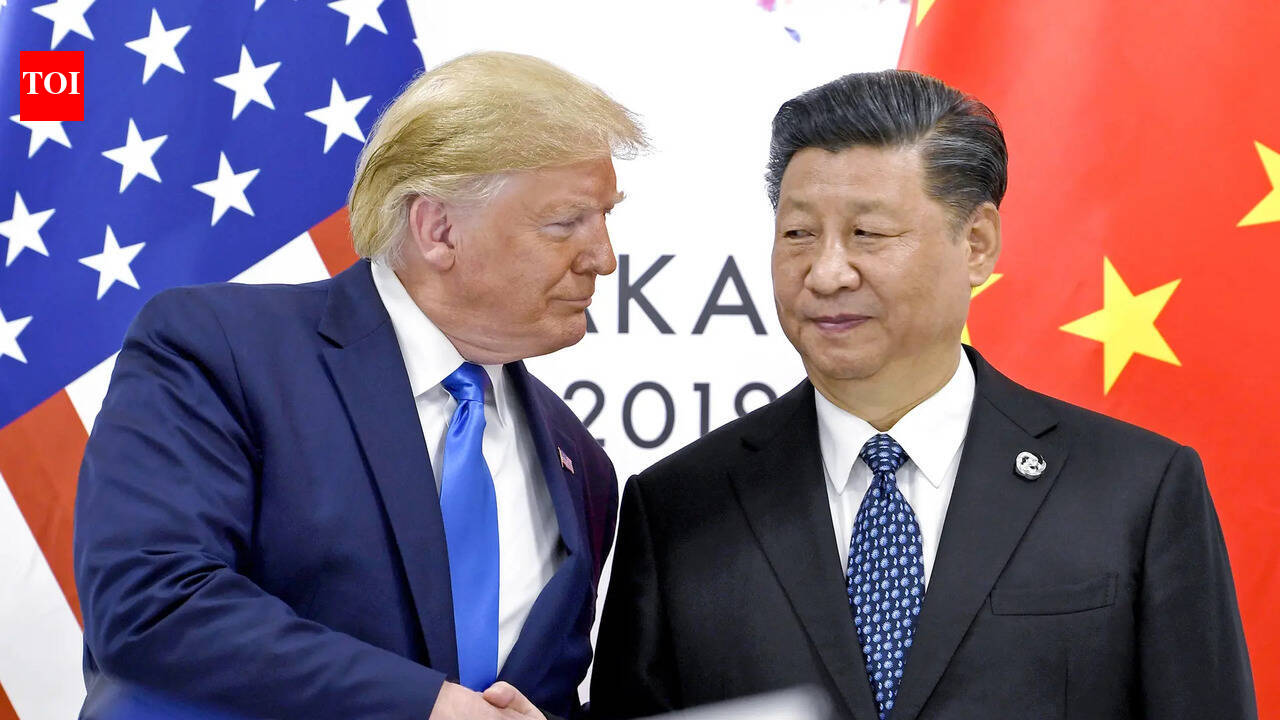
In April, one particular meme had taken over the Chinese internet: Don Tzu. A portmanteau of Donald Trump and Sun Tzu, it imagined the 47th President of the United States as a strategic sage whose wisdom had somehow escaped both grammar and causality. The meme came full of Trumpian aphorisms on “winning”, including gems like “break an enemy blockade by blockading their blockade”, “if you don’t know what you are doing, neither does your enemy”, and “you can’t lose if you don’t have a goal”. Sun Tzu had written The Art of War. Don Tzu appeared to have written The Art of What Is Happening?The meme worked because it captured something real about how Trump uses power. He does not practise strategy in the old sense, with doctrine, discipline, patience and a clearly defined end-state. His genius, if one is being generous, lies in turning confusion into leverage. He makes so much noise that everyone else has to interpret it. He announces victory before the battle, during the battle, after the battle and sometimes instead of the battle. In the Trumpian universe, the declaration is not a description of reality. It is an attempt to replace it.Which brings us to the man across the table. If Trump is Don Tzu, Xi Jinping is the philosopher king. A recent New York Times report on Xi behind closed doors described a ruler with no close domestic rival, willing to lecture weaker leaders, and carrying himself in the mould of ancient Chinese rulers who fused political authority with civilisational instruction. Don Tzu is funny because he turns strategy into nonsense. Xi is unsettling because he turns other people’s nonsense into proof of his own seriousness. Trump moves through politics like a man convinced the room exists because he has entered it. Xi moves through politics like a man convinced the room has existed for 5,000 years and has been patiently waiting for everyone else to learn the correct form of address.
The art of winning without coherence
Trump’s philosophy is often mistaken for the absence of philosophy, but absence can become a system if practised with sufficient confidence. Every problem becomes a deal, every deal becomes a performance, every performance requires a winner, and the winner, ideally before anyone checks the paperwork, is Donald Trump.
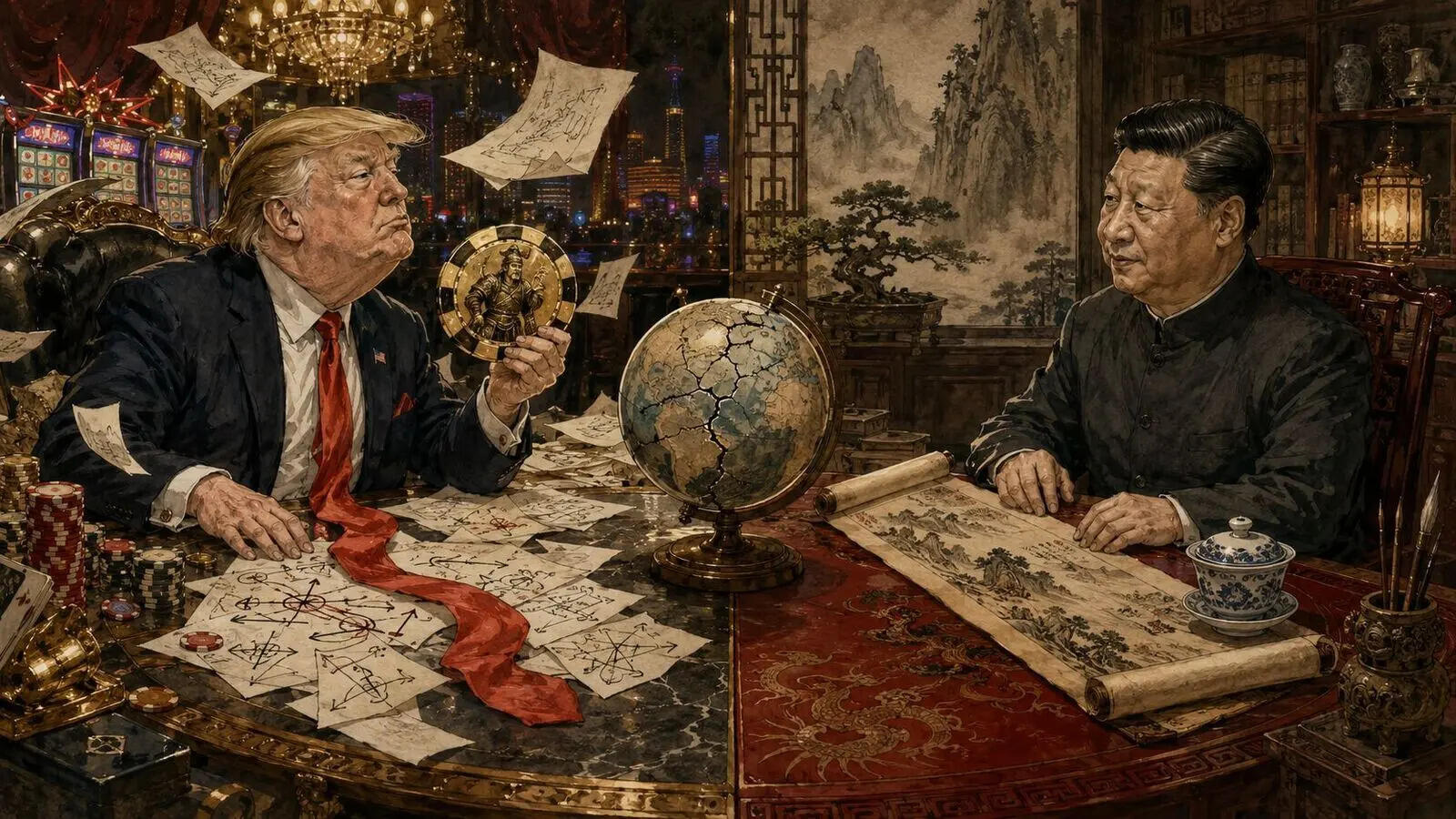
This is why Trump’s foreign policy has always had the air of a casino floor where the house is also the compere, the bouncer and the man selling commemorative steaks near the exit. Alliances are unpaid invoices. Trade deficits are insults. Summits are televised masculinity contests in which someone must later emerge and tell the cameras that the conversation was historic, beautiful and very strong. The form matters more than the substance because the form is the substance.Trump’s incoherence has political utility because it exhausts interpretation. Allies, enemies, markets, bureaucrats, generals and journalists spend enormous energy trying to decode whether his latest statement is policy, provocation, bargaining chip, grievance, brain static or some previously undiscovered fifth state of matter. If you do not know what you are doing, neither does your enemy. If there is no stated objective, there can be no failure. If reality contradicts the statement, reality can be accused of liberal bias.
Xi and the uses of order
Xi appears to have understood Trump early, though not with admiration. In the account of Xi’s final meeting with Barack Obama in Lima in 2016, Trump had just shocked the world by winning the US presidential election, and Xi seemed baffled that American voters could choose someone so unconventional. Obama tried to explain Trump’s rise as the product of American economic frustration, including anger over lost manufacturing jobs and intellectual property theft. Xi was reportedly displeased. He put down his pen, folded his arms and delivered a line that sounded less like diplomatic analysis than a verdict carved onto a palace wall: if an immature leader throws the world into chaos, the world will know who to blame.That moment matters because it shows Xi’s view of Trump, America and democracy converging. Trump was evidence that the American system had lost the ability to filter unseriousness, that democracy could turn resentment into leadership, that the liberal order had produced a man who treated institutions as props and norms as traps. For a leader who has spent years presenting China as stable, disciplined and historically continuous, Trump’s rise was a gift from the gods of comparative politics. Beijing did not need to invent an argument about Western disorder. America had exported the live stream.Xi’s political performance is built around the opposite proposition: that chaos is Western, order is Chinese, and history has finally found its adult supervision. The Chinese Communist Party claims legitimacy not merely from revolution or economic growth, but from its role as custodian of Chinese history. Xi has intensified that claim. He speaks as if China is not simply a modern nation-state, but a civilisation that temporarily had a bad couple of centuries and is now resuming its rightful place in the universe. During Obama’s 2014 visit to Beijing, aides expected discussion of the South China Sea. Instead, Obama and Xi reportedly had a long conversation about whether individualist societies and collectivist Confucian societies could be compatible. That was politics conducted as civilisation studies.
How they treat middle powers
The treatment of middle powers reveals the difference between Trump and Xi with unusual clarity. Trump treats middle powers like supporting actors in the drama of American grievance. Canada, Denmark, NATO allies and trading partners are often engaged not as diplomatic entities with their own constraints and dignity, but as extras in a White House production about American strength. The Greenland episode remains the cleanest example. Trump’s recurring interest in acquiring or controlling the autonomous Danish territory turned an ally’s sovereign question into a dominance ritual, with the island’s people and Denmark forced to keep explaining that they were not a distressed asset on a golf-course balance sheet. Trump’s approach is pressure with a microphone attached. He does not merely want concessions; he wants the spectacle of other countries being made to concede.
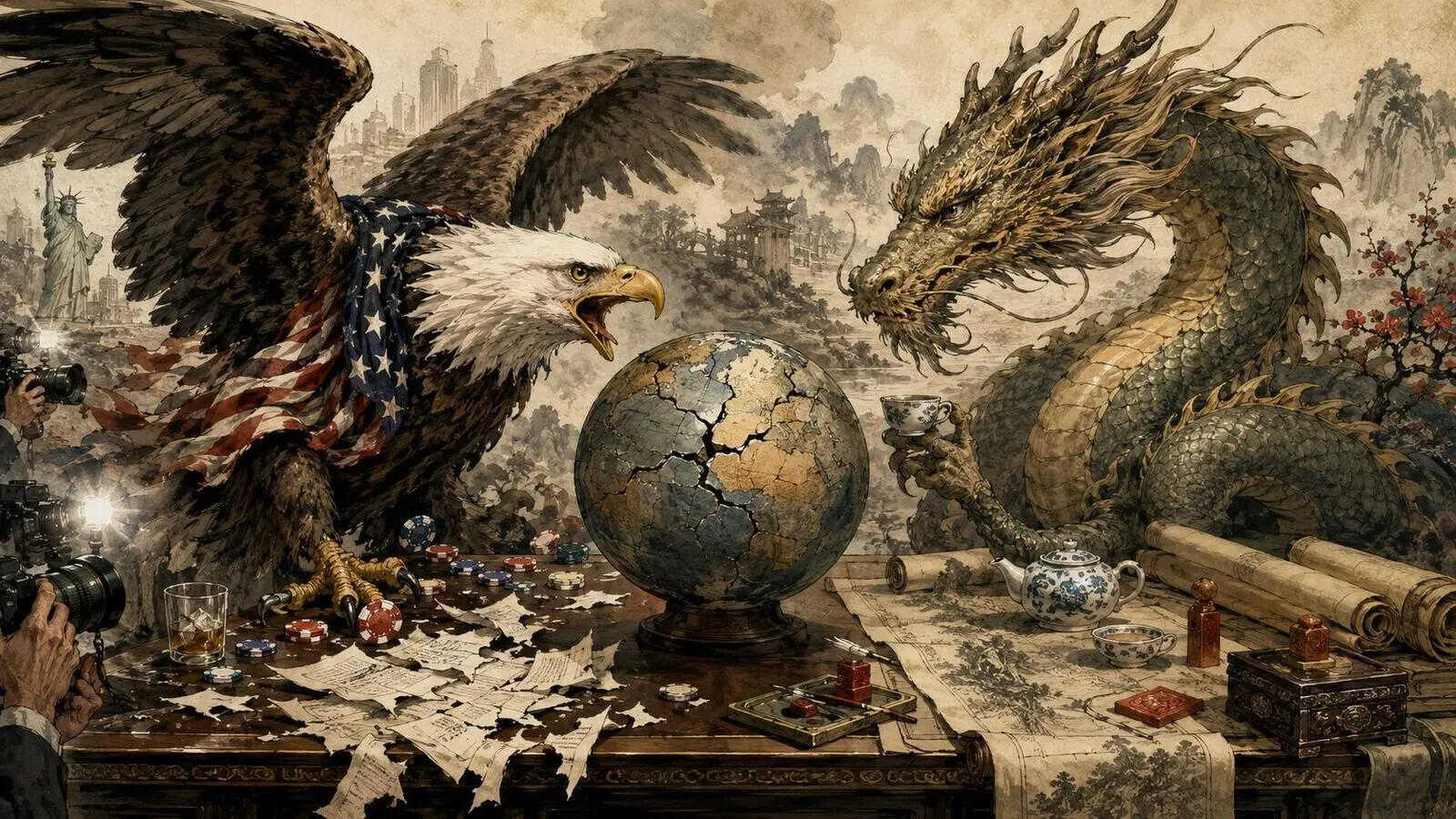
Xi’s treatment of middle powers is different in style, though not necessarily gentler in substance. He does not need the carnival. He prefers the controlled room, the tight smile, the reprimand delivered as protocol. The 2022 exchange with Justin Trudeau remains the clearest example. Xi confronted the Canadian leader at the G20 in Indonesia after details of their earlier conversation appeared in the media. Xi told Trudeau that this was not appropriate and not how the conversation had been conducted. Trudeau tried to explain that Canada believed in open dialogue and agreed-to-disagree diplomacy. Xi cut him off, said they should create the conditions first, shook his hand and walked away.In that short exchange was the grammar of Xi’s power. He was not simply objecting to a leak. He was objecting to a breach of hierarchy. Speak in the correct room. Raise objections in the correct tone. Do not embarrass the sovereign in public. Mark Carney’s account of his own meeting with Xi points in the same direction. Xi, according to Carney, spent the first part of their interaction explaining how he wanted the personal relationship to work. The message, as Carney interpreted it, was simple: no surprises, be direct, raise issues privately and do not lecture me in public.So the distinction is sharp. Trump humiliates middle powers by making pressure public; Xi disciplines them by making protocol sacred. Trump uses them to demonstrate that America can still shove. Xi uses them to demonstrate that China must not be spoken to as if it were just another country.
Grievance and destiny
Their critiques of democracy are similarly revealing. Trump’s critique is emotional. Democracy is legitimate when it loves him, suspicious when it rejects him and sacred again when it returns him to power. Xi’s critique is historical. Joe Biden has recounted Xi telling him that democracies cannot be sustained in the 21st century because consensus is too difficult and autocracies can move faster. For Trump, democracy is a loyalty test. For Xi, it is a museum exhibit: noble perhaps, interesting certainly, but too slow for the century ahead.Their foreign policies flow naturally from these temperaments. Trump wants deals. Xi wants architecture. Trump wants visible concessions: purchases, tariff relief, factories promised, a handshake that can be sold to voters. Xi wants slower and deeper shifts: acceptance of China’s red lines, deference to its status, and recognition that Taiwan is not merely a flashpoint but a sacred question of national completion. Trump’s time horizon is the news cycle, the market reaction and the rally applause. Xi’s time horizon is the party congress, the five-year plan and the historical arc. Trump wants the trophy. Xi wants the map.
The new world disorder
The easy reading is that Trump and Xi are opposites: Trump is chaos, Xi is order; Trump improvises, Xi plans; Trump shouts, Xi lectures; Trump is the casino, Xi is the court. The deeper reading is more unsettling. They are rival answers to the same crisis. Both have risen in an age when the old liberal order no longer commands automatic belief. Both speak to grievance. Both distrust constraint. Both personalise power. Both treat rules as instruments created by others for their own advantage.The difference lies in method. Trump wants order to begin every morning with his mood. Xi wants order to begin every century with China. Trump bends reality by overwhelming it. Xi bends reality by historicising it. Trump turns politics into spectacle so attention becomes authority. Xi turns politics into destiny so authority becomes inevitability.Don Tzu and philosopher king Xi are what happens when the old world loses faith in its own rules. One man says there are no rules, only winning. The other says there are rules, but China wrote them before you were born. Between them sits the rest of the world, waiting to discover whether the future will be shaped by the man who treats geopolitics like a casino, or the man who treats it like a dynasty with broadband.



