


Before Udio existed, before the lawsuits and the licensing deals and the ‘walled gardens’, Andrew Sanchez spent his days studying how civilization scares itself.
His doctorate at the University of Oxford (earned after an undergraduate degree at Harvard) examined how post-WW2 society responded to the fear that automation – the machines! – were coming for human livelihoods.
Sound familiar?
Like most doctoral graduates, Sanchez finished his PhD, put it in a drawer, and assumed he’d never look at it again. Then the question that had consumed his academic life came roaring back… as his day job.
Udio launched in April 2024 with USD $10 million in seed funding from investors such as Andreessen Horowitz, will.i.am, Common, Steve Stoute’s UnitedMasters, and Instagram co-founder Mike Krieger.
The platform was built by a group of former Google DeepMind researchers, and could generate a mastered song from a text prompt in under 40 seconds. It was soon creating an average of 10 songs per second – roughly 864,000 tracks a day.
The music industry’s response was swift. In June 2024, Universal Music Group, Sony Music Entertainment, and Warner Music Group – via the RIAA – sued Udio for copyright infringement, alongside rival platform Suno.
What happened next is what makes Sanchez’s trajectory so interesting. Because, rather than digging into a legal trench war, Udio pivoted toward partnership.
In October 2025, Universal Music Group settled its lawsuit and signed a licensing deal with Udio – the first of its kind between a major music company and a generative AI music platform. Warner Music Group soon followed.
Udio has since also signed licensing agreements with Merlin, Kobalt, and Believe.
There is, though, still one major obstacle stopping Udio from claiming to be ‘fully licensed’: Sony Music Group. Sony remains in active litigation against the platform; a precedent-setting fair-use ruling may yet be the result.
Meanwhile, Udio is busy building a new, “walled garden” version of its platform – where users can make songs in the style of opted-in artists, but cannot extract the music from the platform.
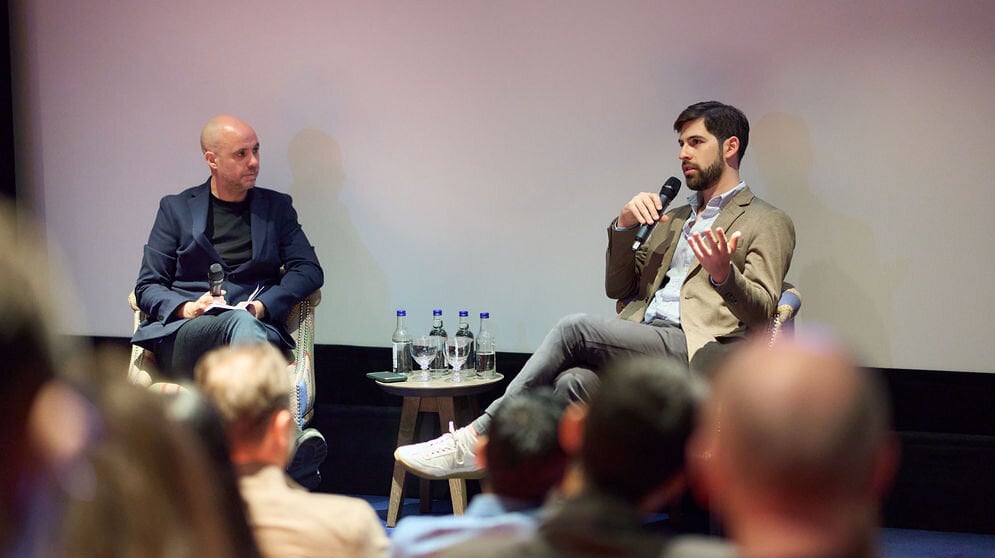
Sanchez, Udio’s CEO, sat down with Music Business Worldwide this morning (May 19) at an invite-only industry breakfast co-hosted by MBW and The Raine Group at the Charlotte Street Hotel, London.
An abridged version of this interview is below.
As you’ll read, Sanchez discussed the ‘walled garden’ debate, his skepticism that anyone can accurately trace an AI model’s output back to its training data, and why he believes quality – not volume – is the only viable future for AI music…
What can you tell us about the new Udio that’s coming later this year?
The idea of making generic music is very low on our users’ priority list. The vast majority – I mean 90+ percent – go on our platform and ask to make a song in the style of a favorite artist or a favorite song.
When you have that hook between the artist and the AI-generated music, it aligns well with the interests of artists. A lot of problems get solved, and it becomes a multiplying factor – a way to expand the reach of their work, a marketing tool.
“If I said, ‘Here’s a machine that can make any music you want in the world – what are you going to do with it?’ I don’t think anybody would say, ‘I want to be able to make generic pop songs.’”
We went into our licensing negotiations with that idea in the back of our heads. So the product we’re building will center on your ability to make music in the style of your favorite song or artist – provided they’ve opted in.
You can say, ‘I want my favorite song, covered by this other artist from a totally different time period or genre.’ You can create a song in the style of an artist with your own lyrics, provided the appropriate guardrails ensure the artist is comfortable with it.
If I said to you, ‘Here’s a machine that can make any music you want in the world – what are you going to do with it?’ I don’t think anybody would say, ‘I want to make generic pop songs.’
You’d be [far more likely] to do what I just described.
Is there an actual business here?
We have a product in the market, and I can see the number of users who churn, and the number who go on to become subscribers.
It’s pretty clear to me that the market we are operating in now is a tiny fraction of what it could be.
You said you don’t think anyone would go in with the intention of creating generic pop – but someone trying to siphon off $2,000 a month from the Spotify royalty pool via streaming fraud might happily make a thousand generic pop songs. What’s your perspective on how the industry solves that problem, and Udio’s place within it?
This intersects with the ‘walled garden’ idea: when you create a song on the [new Udio] platform, you can’t take it off and use it for something else.
Being in favor of [the ‘walled garden’ approach] isn’t something I’m apologizing for.
A highly controlled ecosystem is necessary for most rightsholders and artists to be comfortable with this extraordinary and potentially transformative technology.
“A highly controlled ecosystem is necessary for most rightsholders and artists to be comfortable with this technology.”
At some point – two years, five years down the line – there might be mechanisms for you to get something off the Udio platform, assuming all the various [parties] are comfortable with it.
Having spent probably a unique amount of time talking about this with artists, there is trepidation but also excitement about what can be done. And control is really the fundamental building block – [particularly] control over how songs are distributed.
Warner Music Group, unlike Universal and Sony, has LICENSED SUNO. Suno is not a ‘walled garden’ and has no intention of becoming one. What do you make of that agreement?
To be clear, we have a deal and a great relationship with Warner; we’re super excited to partner with them and our other licensing partners. But for the product that we are primarily focused on, control is absolutely elemental.
There are other aspects of the market that we will pursue at some point – and that may involve some amount of distribution. But any of it would be highly controlled.
“The fundamental challenge from a business perspective isn’t volume – it’s the under-monetization of the music user.”
The core principle [of Udio] is that quality, rather than ‘slop’, is the absolute most important thing. You can imagine a platform [in the future] where there’s some amount of distribution, [and] what comes off the platform is super high quality. It advances DJ use cases, producer use cases. But it’s most certainly not going to be something where you’re just, en masse, making songs of varying quality.
There’s an enormous amount of music already on the streaming platforms. The fundamental challenge from a business perspective isn’t volume – it’s the under-monetization of the music user.
There’s an enormous opportunity to introduce new features and capabilities that create ways for individual users to be [better] monetized.
The thing that will enable that is quality over volume.
The music industry famously struggled with piracy in the early noughties, and one of its band-aids was digital rights management – DRM – on CDs. What gives you the impression you can “control” how AI music is made and distributed, when we’ve seen lessons from the past suggesting that’s impossible?
I don’t actually remember the DRM era for CDs, but I have an understanding of it!
I think great art and great music want to be consumed as widely as possible. There can be a way of control through distribution; for example, an artist could easily have their use of their [AI-replicated] voice removed if they were uncomfortable with it. Those takedown mechanisms exist today. So there is a way to control things.
“I don’t actually remember the DRM era for CDs, but I have an understanding of it!”
What we’re doing now is making the best effort at control, which serves as the gating function for achieving our near- and medium-term goals. Over time, hopefully, technological, legal, or policy innovations will make it easier.
In the United States, for example, there is no federal right of publicity – it’s a state-by-state application. A federal right of publicity would facilitate takedowns and could get us closer to a world with sufficient measures of control beyond a closed ecosystem [aka ‘walled garden’].
There’s a lot of focus on AI attribution engines in music. I can see how one type would work – tech that can tell you ‘this song was created with this model on this platform’. But this idea that there will be tech that can determine ‘10% of this AI-generated recording used Diana Ross’s voice; 3% used an Ed Sheeran chord sequence’ and so on – and that somehow royalties will be divided up on that basis? Personally, I think that’s a fantasy. Am I being overly negative?
You set me up with that one! I’m also skeptical of AI attribution engines, even in a fundamental way.
There’s a general misapprehension about how AI technologies work. [There’s a belief] that they are like sampling machines on a huge scale – as if we’re looking at a [vast] scale of sound recordings and grabbing a little bit here, a little bit there, and stitching things together. That’s not how they work.
They work by analyzing large amounts of data, and the model develops an ‘understanding’ of music through exposure. One of the first things we do is show the model music and say, ‘This is music.’ We don’t even say, ‘This is pop, this is jazz.’ In the same way that a small child begins to distinguish between human voices, music, traffic etc.
So [the AI] develops an understanding, and [then] through repeated exposure to labeled music – ‘this is jazz’ or ‘this is a four-chord sequence’ – it’s able to develop an abstract understanding of music.
“The idea that you could assign a percentage of the output to something used in the training corpus just doesn’t make sense.”
The idea that you could assign a percentage of the output to something [definitive] used in the training corpus just doesn’t make sense. If you started singing a new melody right now, you wouldn’t be able to say, ‘I’ve come up with this because when I was three I was exposed to this song, and when I was 11, I was exposed to this other song.’ It just wouldn’t work that way.
That’s why AI attribution that tries to draw a direct line between the training corpus and the output is going to be a very challenging and perhaps impossible problem.
The only thing to note is that there could be something I call a ‘robot musicologist’ – that listens to a [finished] song and says, ‘That sounds quite like this,’ or identifies an obscure chord sequence.
Sony is still in active litigation against Udio. How optimistic are you that this will be reconciled?
Unfortunately, I’m not going to be able to give you anything interesting here. Active litigation is one of those things that means I can’t speak with any level of specificity.
“Partnership with the music industry is not incidental to what we do, but fundamental.”
The one thing I would say – and I hope the actions of our business over the last year have demonstrated this – is that partnership with the music industry is not incidental to what we do, but fundamental. Both in enabling the type of user experience we want and in ensuring that what artists and rightsholders contribute is reflected.
If proper licenses are a priority for udio, why didn’t you get them in the first place?
All technologies involve innovation, and innovation by definition involves steps in directions that are unknown.
It was important to demonstrate that this technology existed, and that there was a viable market.
“It was important to demonstrate that this technology existed, and that there was a viable market.”
But then, crucially, I said, ‘Look, I want to work with the industry.’
Obviously, there are things one can learn from [in retrospect]. But the ability to form a business that ultimately has rightsholders’, artists’, and users’ interests in mind is crucial to succeeding. And that’s what we’ve built our business around.
Making gen-AI music on Suno or Udio is kind of mind-blowing, but to me, it remains a novelty. Making a song for my mum in the style of Frank Sinatra on her birthday, I can see that. But I’m not sure I fully buy the idea that this becomes a subscription user behavior. Is this the Instagram filter of tomorrow, or is my pessimism justified?
Well, a lot of people would have said the same thing about Instagram filters!
If you go on the [Udio] platform today, you’re only getting maybe 5% of what’s possible. It would be unwise to cap the potential [in your mind] when so little of the technology’s potential power is out there.
Also, music is a unique medium. The output has more staying power than the majority of outputs in image or text.
“It’s pretty clear to me, based on what I know about technology and user behaviors, that there will be a significant market for this.”
If I need a financial analysis from [a large language model], it’s useful – but I’m not going back to consume it repeatedly. Nobody is looking at an image repeatedly the way they consume music. If a song appeals to you, you might come back to it over and over again.
It’s pretty clear to me, based on what I know about technology and user behaviors, that there will be a significant market for this. And the ability to do the really powerful stuff I’m talking about will unlock it.Music Business Worldwide



