


In the early summer of 2003, a 10-year-old boy in Chennai performed a ritual that would feel almost alien in today’s digital age. He did not download an app or forward a link. Instead, he waited for the local newspaper to publish the full fixture list for the ICC Men’s Cricket World Cup in South Africa, walked to a neighbourhood photocopy shop, and printed dozens of copies. Over the next two days, he distributed those schedules to schoolmates, neighbours and their parents. To miss a single match was to risk being excluded from a four-year cultural conversation. The tournament was not merely an event. It was an epoch.
At the time, cricket and football shared the same psychological currency: anticipation. Fans spent years revisiting old triumphs, reliving heartbreaks and watching national teams slowly rebuild. Because the World Cup was rare, it felt sacred. Its arrival altered routines, conversations and expectations.
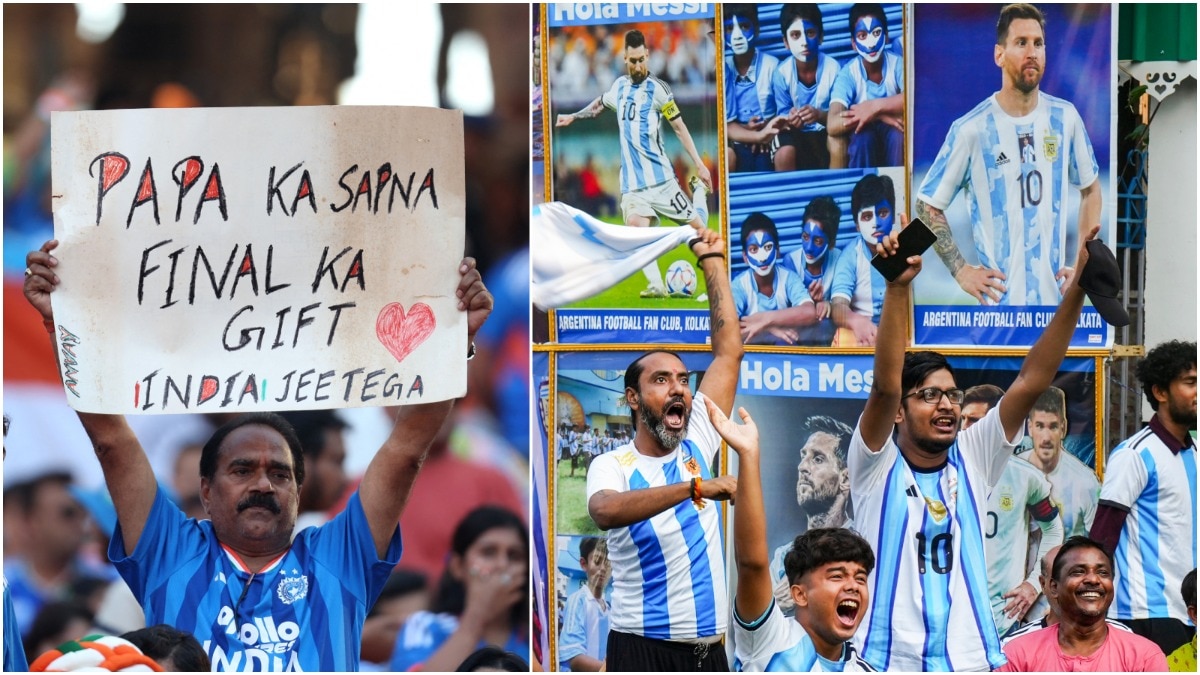
That feeling remains alive in football. Earlier this month, towns across Kerala, alongside traditional football strongholds such as Kolkata and the northeast, once again transformed themselves for the FIFA World Cup. Giant cut-outs of Lionel Messi, Neymar and Cristiano Ronaldo rose above roads and rooftops. Homes were painted in the colours of Argentina and Portugal.
A tournament taking place thousands of kilometres away had once again captured the imagination of a country that had not even qualified, probably that will not qualify in the next decade.
The hunger was visible because fans had spent four years waiting.
On the other hand, cricket operates a very different machine. The television screens rarely go dark and the promotional drums never stop beating. One year brings a Champions Trophy. The next brings a T20 World Cup. Layer onto that the World Test Championship, women’s tournaments and age-group global events, and a striking reality emerges: cricket now stages a major international event almost every year.
On paper, this should be a golden age. Revenues are soaring, streaming records are regularly broken and ICC events continue to attract enormous audiences. Yet beneath the commercial success lies a quieter question. If fans are still watching in record numbers, why do so many feel that something has been lost?
The answer may not lie in consumption. It lies in anticipation.
THE FLOODED MARKET
“The stars we once saw as idols have either retired or moved past their prime,” says Chennai-based cricket fan Palaniappan Subramanian.
“But more than that, having world cups and championships almost every year makes them less awaited. There are simply too many.”
For much of cricket’s modern history, eras were measured through the four-year rhythm of the ODI World Cup. The gap between tournaments allowed stories to mature.
India’s journey between 2003 and 2011 illustrates the point. There was the heartbreak of Johannesburg in 2003, the humiliation of a group-stage exit in 2007 and, finally, redemption under MS Dhoni in Mumbai in 2011. The wait amplified the reward. A failed World Cup campaign could haunt an entire generation because another opportunity sat four years away.
Today, the cycle feels different. A disappointing ICC campaign is quickly followed by another global event. Reflection is shortened. Defeat hurts, but the next chance arrives before the wound has settled.
The trophy is no longer a monument. It is a lease that expires in 11 months.
India’s Champions Trophy triumph in 2025 was inevitably framed as redemption for the heartbreak of the 2023 ODI World Cup final. Yet equating an eight-team tournament with the emotional weight of a home World Cup final illustrates how compressed cricket’s narrative cycles have become.
“I am always excited for the ODI World Cup, but the T20 version does not give me that same feeling,” says Prithvi, an engineer based in the United States. “The term World Cup is being overused. It dilutes the sacred nature of what it means to be the best in the world.”
Critics of modern cricket often point to oversaturation. Administrators respond with numbers. Broadcast deals are worth billions and tournament finals continue to deliver astonishing audiences.
Yet financial success masks a fragile reality. Unlike football, which relies on thriving domestic ecosystems across continents, cricket remains overwhelmingly dependent on the sub-continent, predominantly India. Because one market underpins much of the game’s commercial value, the sport cannot afford long periods without premium inventory. The result is an endless cycle of marquee events designed as much for broadcasters as for supporters.
THE CORPORATE BLUEPRINT
The institutional acknowledgement of this shift is no longer confined to nostalgic fans. It is being openly discussed by some of the most influential figures in the sport.
Ravi Shastri, who spent years at the centre of India’s dressing room, offered a striking assessment in 2022.
“I don’t remember a single T20 International game in the last six or seven years as coach of India, barring the World Cup,” he said.
Shastri’s broader point was even more revealing. Franchise cricket, he argued, should occupy the majority of the calendar, while international cricket should reserve its emotional capital for major tournaments.
“You play franchise cricket around the globe. Then, every two years or four years, you come together and play in the World Cup. That is how you keep it special.”
His comments align with the economic transformation reshaping the sport. The IPL, SA20, the Hundred, the CPL, the Big Bash and the ILT20 have altered the priorities of players and administrators alike. Bilateral cricket is no longer the primary source of prestige or income.
Arun Dhumal, chairman of the IPL, views the trend as inevitable.
“Every player is finding more value in the IPL or any domestic league vis-a-vis bilateral cricket,” he told IndiaToday.in in June.
“If the traction with bilateral cricket is going down, there may be another way of doing it.”
Asked whether cricket was moving towards football’s club-versus-country structure, Dhumal was unequivocal.
“Yes, it is already going there. We have to prepare ourselves for that.”
BROADCASTERS’ BIG NO
The shift reflects a broader reality. Traditional bilateral series are becoming increasingly difficult to sell. Three-match ODI and T20I series often struggle to generate sustained interest, particularly when they carry little wider significance. To compensate, cricket’s administrators have expanded the inventory that broadcasters value most: ICC events.
A World Cup or Champions Trophy guarantees audiences, subscribers and sponsors. It offers certainty in a fragmented media environment. The problem is that every new global tournament chips away at the exclusivity that once made the World Cup unique.Scarcity, after all, is not merely a scheduling tool. It is the foundation of memory.
THE LOST ART OF WAITING
Football is hardly immune from commercial expansion. FIFA’s enlarged Club World Cup and the 48-team men’s World Cup have both attracted criticism. Yet one principle remains intact: the FIFA World Cup still arrives only once every four years.
The same is true of the European Championship and Copa America.
Football understands that anticipation is an asset. Domestic leagues and continental club competitions satisfy the weekly appetite for elite competition. International football can therefore afford to disappear long enough to be missed.
That absence creates longing. Longing creates significance.
Fans remember where they were when Zinedine Zidane headbutted Marco Materazzi, when Andres Iniesta scored in Johannesburg, when Lionel Messi lifted the trophy in Doha. Those memories endure not merely because of what happened, but because of how long supporters waited for those moments to arrive.
Cricket is trying to have it both ways. It wants the immense wealth generated by franchise leagues while simultaneously preserving an international calendar built for a different era. The result is a crowded ecosystem in which global tournaments are increasingly asked to carry the commercial burden of the entire sport.
Cricket still commands audiences. It still produces unforgettable players and unforgettable moments. What it increasingly struggles to produce is yearning.
The great strength of the FIFA World Cup is not simply its scale. It is its willingness to remain absent. Football disappears long enough for people to miss it.
That is what cricket has forgotten. The 10-year-old boy who photocopied World Cup schedules in Chennai was not responding to marketing. He was responding to rarity. Every fixture felt precious because every fixture was precious.
Today, cricket’s world champions change so frequently that even devoted followers occasionally struggle to remember who holds which crown.
The sport still generates enormous revenue. The streaming records will continue to fall. Corporate presentations will continue to celebrate unprecedented growth.
But scarcity is the one commodity sport cannot manufacture once it has been lost.
And without scarcity, even the grandest World Cup risks becoming just another event on the calendar.
– Ends



