


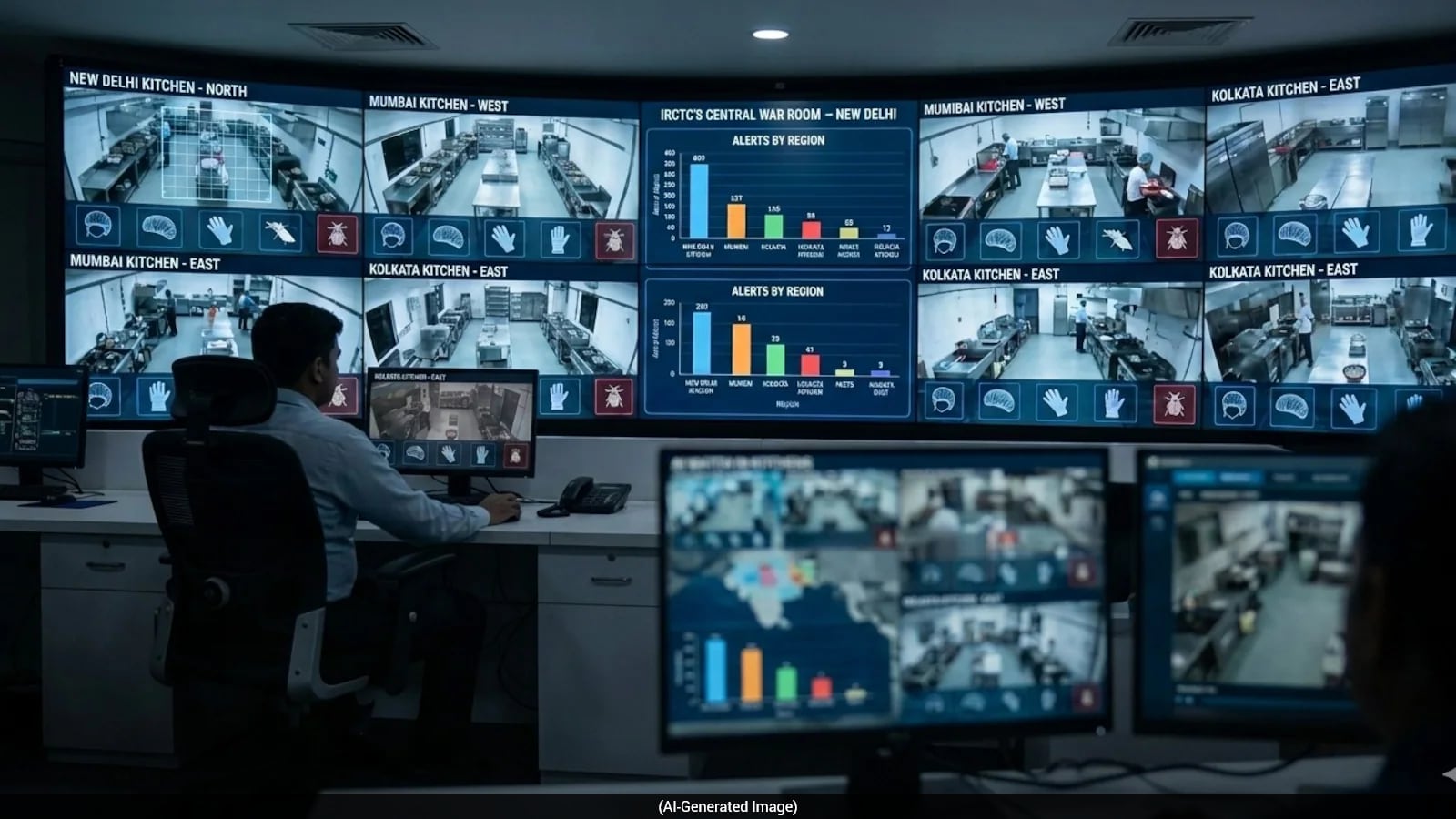
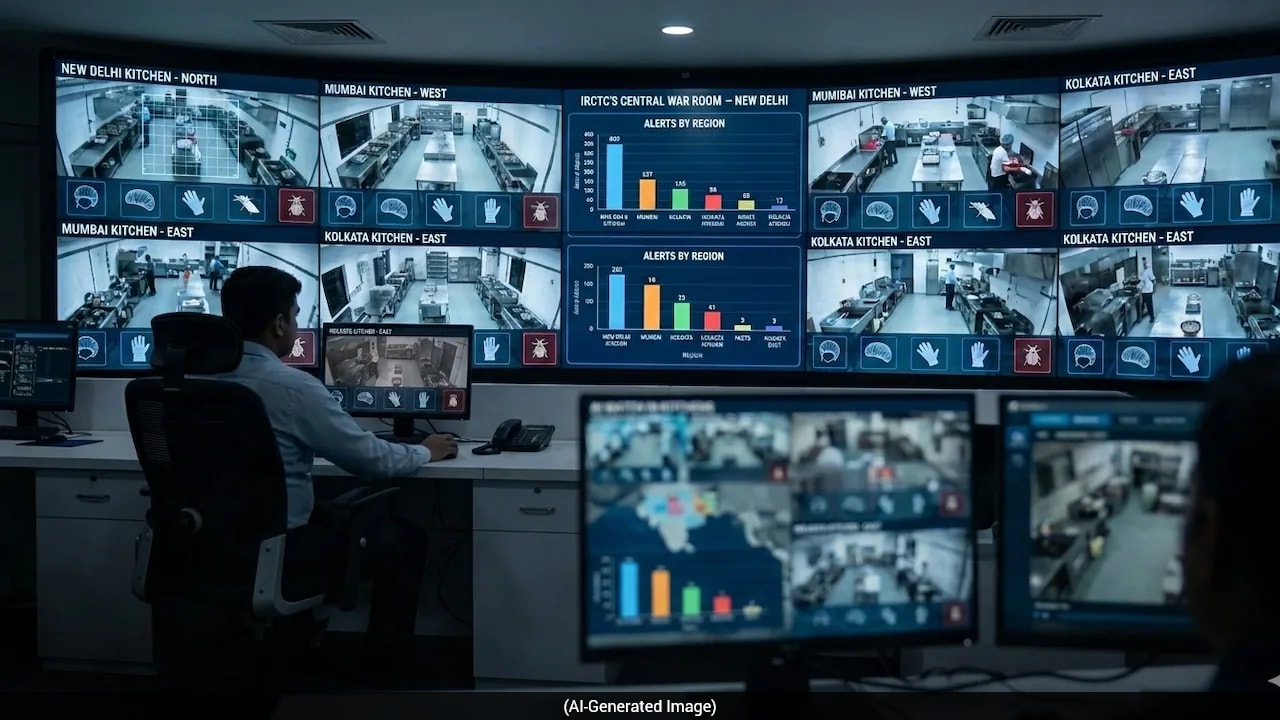
In a bid to maintain the hygiene and quality of food served at railway stations and on trains, the Indian Railway Catering and Tourism Corporation (IRCTC) has significantly strengthened its monitoring system. IRCTC has implemented an Artificial Intelligence (AI) based monitoring system in its base kitchens, enabling round-the-clock surveillance of the food preparation process across the country.
Monitoring Of More Than 800 Kitchens
Over 800 IRCTC kitchens across the country have been linked to 2,394 AI-based cameras, which are monitored from a central war room located in New Delhi. This AI-powered system keeps a strict watch on the cleanliness of food served on trains. It identifies a total of nine types of anomalies that could make food unhygienic. This includes checking whether kitchen staff are wearing hairnets and transparent gloves, monitoring cleaning and mopping activities, and detecting the presence of rodents, flies, and cockroaches.
How Does This System Work?
IRCTC introduced this system about two and a half years ago and is now continuously expanding its scope. Under this expansion, more cooks and a wider variety of anomalies are being included. A senior IRCTC official explained that the cameras installed in the kitchens are integrated with AI technology, which immediately detects dirt or unhygienic activities and sends an alert.
The system is highly sensitive and can detect insects as small as 7 to 8 millimetres. As soon as an issue is spotted on camera, an immediate message is sent to the respective kitchen manager. If corrective action is not taken in time, the matter is escalated. Generally, action is taken against the responsible individual within two hours.
The official added that the most common hygiene violation in the kitchen is staff failing to wear hairnets. Under this monitoring system, an average of about 350 alerts are generated daily. In the past month alone, a total of 13,550 alerts were received. Of these, the highest number of 4,123 tickets were registered in the Northern Region, followed by 3,205 in the Eastern Region, 2,687 in the Western Region, 2,226 in the South Central Region, and 1,309 in the Southern Region.
Cameras Watch Even Minor Negligence
The senior official noted that the most challenging period for kitchens is during seasonal changes. During these transitions, food quality can be adversely affected, which is also when the highest number of complaints are typically received. He mentioned that while the system generates around 350 tickets every day, false alerts occur in about 10 per cent of the cases.
Sometimes, the AI flags errors that do not exist in reality. For example, if a cook is wearing a hairnet but it has slipped slightly upwards, the AI system treats it as a rule violation because it has been programmed specifically to detect exact compliance.
18 Lakh Meals Being Served Daily
According to IRCTC, it is now delivering approximately 60 Crores meals annually to passengers across the Indian Railways network. By March 2026, 16 lakh meals were being delivered to passengers daily, a figure that has now risen to 18 lakh per day.
Currently, catering services are operational in around 1,453 trains. This includes premium trains such as the Vande Bharat Express, Rajdhani Express, Shatabdi Express, Duronto Express, Tejas Express, and Gatimaan Express. Apart from these, catering is also provided on standard Mail or Express trains as well as through train-side vending services.
The senior official stated that the objective is to ensure real-time compliance, quality control, and immediate corrective action so that passengers receive better and safer catering services. The corporation hopes that this high-tech war room will play a crucial role in increasing transparency, accountability, and passenger satisfaction across railway services.
It is worth noting that the Ministry of Railways recently imposed a fine of Rs 10 Lakh on IRCTC for serving poor quality curd on the Patna to Tatanagar Vande Bharat train. Additionally, a hefty fine of Rs 50 Lakh was slapped on the private company responsible for supplying food on that train. IRCTC took a strict stance on the matter and demanded a formal explanation from the contractor.
According to data presented by the Ministry of Railways in the Rajya Sabha in July 2025, more than 19,000 food-related complaints were received from passengers over the last five years. Fines were heavily imposed in 3,137 of those cases. The data also revealed that while the total number of complaints decreased from 7,026 in the 2023-24 period to 6,645 in 2024-25, the figure remains significantly higher than the mere 253 complaints registered back in the 2021 financial year.



