


What comes to your mind when you think of bees?These buzzy insects may remind you of a painful childhood sting or the sweet honey they produce. But did you know that apart from honey, with its remarkable antibacterial properties, bees also give us beeswax used in candles, cosmetics, and pharmaceuticals, and propolis, often called “bee glue,” which has strong antimicrobial and anti-inflammatory benefits?But their importance goes far beyond what they produce.Beyond these familiar products, bees have a far more critical role to play.They are among nature’s most efficient and tirelessly laboring pollinators, quietly holding together ecosystems, agriculture, and ultimately, human survival.“In India, people know only two things about bees,” says Pune-based beekeeper and conservationist Amit Godse. “One is that they produce honey, and the second is their sharp sting.”That simple perception, he argues, hides a far more important ecological truth that bees are foundational pollinators, silently sustaining global food systems and biodiversity.Fondly known as Pune’s “Bee Man,” Godse has spent over a decade observing what he describes as a slow but steady ecological decline across the Indian landscape. Speaking to TOI, he emphasizes that while public awareness has improved slightly over the years, it still remains remarkably shallow. “People still don’t connect bees with agriculture or food security,” he says.This limited public understanding coincides with a time when bee populations are under growing biological, chemical, and environmental stress.
Why bees matter more than we realise
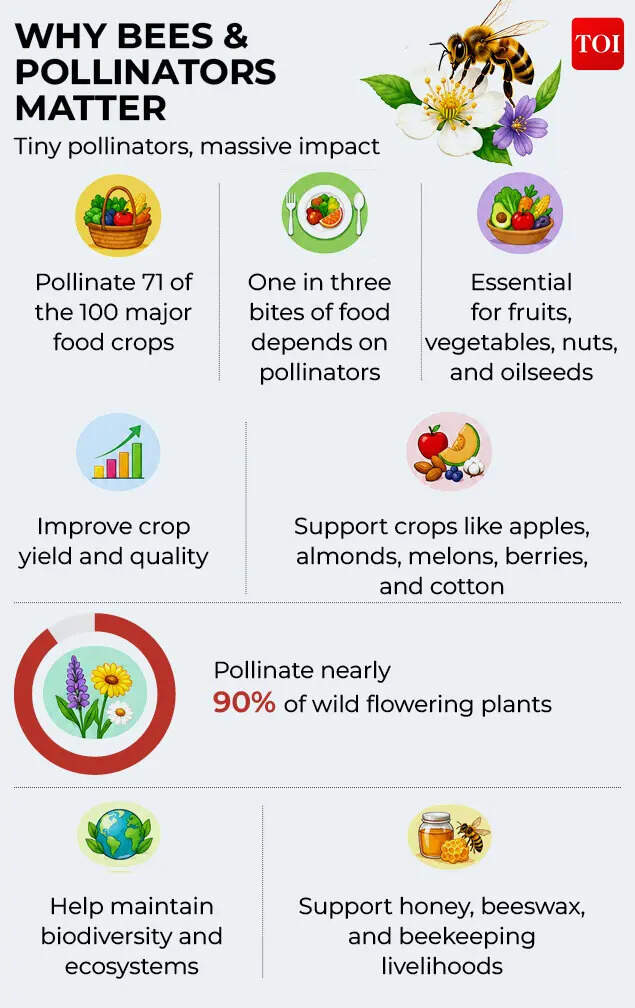
To understand the sheer scale of what is at stake, TOI spoke to Dr. K T Vijayakumar, a leading scientist at the University of Agricultural Sciences (UAS), Bengaluru. He explains that bees are among the most vital contributors to Earth’s baseline ecosystems and the global food supply.About one-third of all human food depends directly or indirectly on animal pollination, and bees do the heavy lifting. They are responsible for pollinating over 70 of the world’s top 100 food crops. When bees visit flowers to collect nectar and pollen for food, they act as the primary, unintentional drivers of plant reproduction.
–
Daily staples and high-value crops including apples, almonds, cucumbers, berries, pumpkins, and even essential beverages like coffee rely heavily on their constant labor. This natural partnership does not just trigger fruiting, it also significantly improves both the final crop yield and the physical quality of the produce.Without this invisible service, Dr Vijayakumar warns, wild plant diversity would rapidly weaken, triggering a devastating chain reaction across the entire food web. Entire ecosystems would become less healthy, less resilient, and deeply unstable.The impact is equally profound on a macroeconomic scale. Insect pollination adds billions of dollars in value to global agriculture each year by boosting the efficiency and value of agricultural outputs without human capital or cost.
Major threats facing bees today
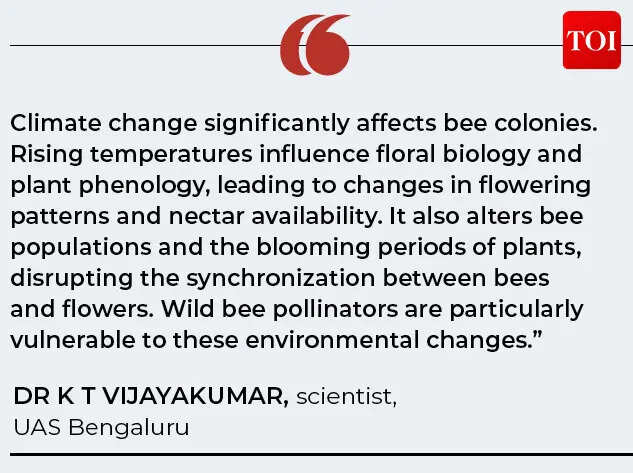
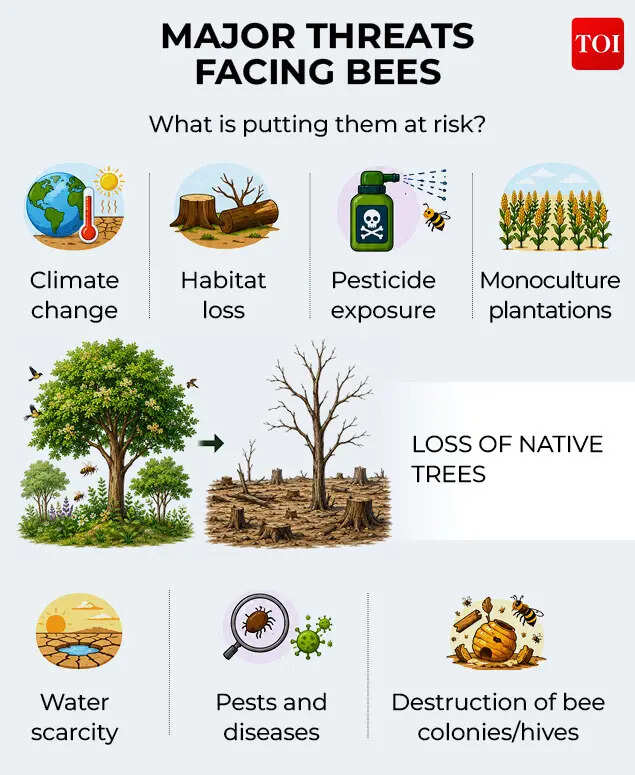
To map out exactly why these vital creatures are struggling to survive, scientists and conservationists point to an interconnected web of modern environmental, biological, and human-made pressures:Climate change and shifting phenology: Dr. Vijayakumar says climate change is significantly affecting bee colonies by disrupting long-standing synchronisation between bees and plants. Rising temperatures are altering plant phenology, shifting flowering times, shortening bloom periods, and reducing nectar availability. Bees, unable to adjust their life cycles quickly, often emerge after peak flowering has passed, leading to poor pollination and food stress.
–
The rise of agricultural monocultures: Amit Godse notes that diverse cropping systems are increasingly being replaced by monocultures. Crops like mustard offer abundant forage for a short period but leave long gaps with no floral resources. Bees require continuous pollen sources and suffer nutritional stress when this is absent, weakening their immunity.Systemic agrochemical poisoning: Neonicotinoids and similar pesticides are a major cause of colony decline. Absorbed into nectar and pollen, they damage bees’ nervous systems, affecting memory, navigation, and flight. Many worker bees fail to return to the hive, contributing to colony collapse.Emerging biological diseases and pests: Bee colonies are also under pressure from diseases and pests, including foulbrood, wax moths, mites, wasps, and the expanding small hive beetle in India. These threats damage colonies, contaminate stores, and can force hive abandonment.Habitat fragmentation and loss of native trees: Urban expansion and deforestation are reducing natural nesting habitats for wild bees. Old canopy trees are disappearing, while replacement plantations like eucalyptus and acacia offer poor nesting and limited forage for native species.The urban “death trap” phenomenon: In cities, discarded sweet liquid waste in plastic and paper cups attracts bees. Once inside, they become trapped and die in large numbers, turning urban spaces into accidental hazards for pollinators.Human fear and defensive eradication: Limited awareness leads to hostility toward bees. Instead of safe relocation, colonies found in homes or public spaces are often destroyed using chemicals or fire, causing avoidable mass deaths.
–
The overlooked bee species
When the average citizen visualizes a bee, they almost always picture a managed hive of European honeybees (Apis mellifera) or the native Indian honeybee (Apis cerana indica). However, scientists emphasize that there are over 20,000 bee species globally, comprising a vast, hidden tapestry of wild and solitary pollinators that look and behave nothing like domestic hive bees. These include: Bumblebees: Large, robust, and heavily furred, these bees are capable of a unique physical mechanism called “buzz pollination.” By vibrating their flight muscles at a specific frequency, they can dislodge firmly trapped pollen from deep-throated wild flowers and greenhouse crops like tomatoes.Carpenter Bees: Carpenter bees belong to the genus Xylocopa in the subfamily Xylocopinae, which includes around 500 species across 31 subgenera. The common name comes from their nesting behavior, as most species burrow into hard plant materials such as dead wood or bamboo to construct individual nests.Stingless bees (tribe Meliponini) are ancient, highly social insects widely kept in tropical and subtropical regions for specialized pollination and their prized, medicinal pot-honey. Solitary Bees: Accounting for the vast majority of all wild plant reproduction, these bees do not form communal colonies, live in hives, or answer to a queen. Every single female is a fertile queen who constructs an independent nest in sandy soil or hollow stems, quietly maintaining the plant diversity of their local micro-climates.Dr. Vijayakumar notes that these wild, unmanaged pollinators are by far the most vulnerable to human disruption. Unlike commercial honeybees, which receive human intervention, supplementary feeding, and shelter from beekeepers during lean seasons, wild bees depend entirely on undisturbed natural habitats.
What is Colony Collapse Disorder ?
In recent decades, localized population drops have escalated into a structural, systemic failure known as Colony Collapse Disorder (CCD). First reported in the United States in 2006, CCD is a devastating phenomenon marked by the sudden, clean disappearance of an entire hive’s worker bee population. Mysteriously, they leave behind an intact queen, the immature brood, and plentiful food reserves, effectively rendering the hive a ghost town incapable of functioning.A 2025 study titled Buzzing into silence: A geographical analysis of Colony Collapse Disorder published in the International Journal of Ecology and Environmental Sciences by researchers Vijaylaxmi and Dr. H. N. Koli, emphasizes that CCD is not merely a freak biological anomaly. Instead, it is a complex socio-ecological crisis heavily shaped by regional agricultural policies, rapid land-use changes, and extreme chemical dependencies.According to the global synthesis of environmental data presented in their research, the primary drivers pushing bee colonies into silence are divided by distinct impact levels: neonicotinoid pesticides lead the crisis at an estimated 35%, followed by varroa mites at 20%, habitat loss and monocultures at 15%, climate variability at 15%, and the remaining share comprised of localized pathogens and urban pollution.
“Bees were everywhere, now they are disappearing”
This ecological decline is not an abstract statistical model; it is an observable reality on the ground. “Twenty years ago when I traveled to farms, you used to see bees everywhere,” Amit Godse recalls. “Today, the pollination is so down. It is difficult to find a bee on the farm, and it is disappearing even in the forest areas. Bees are not safe anywhere now, whether you go to a farm, a forest, or a city.”The empirical findings from Vijaylaxmi and Dr. Koli’s 2025 study confirm this worrying decline in India’s pollinator infrastructure. Over a 13-year trailing period, India’s total number of estimated active bee colonies has plummeted by nearly 40 per cent.In 2010, the nation possessed 1.50 million active colonies. This fell to 1.30 million in 2015, representing a 13.3% drop. The annual decline rate peaked significantly around 2020 with a massive 19.2% single-period loss, a window characterized by extreme regional climate anomalies and heavily intensified chemical inputs. By 2023, the number dwindled further to 0.92 million colonies, reflecting a persistent downward trajectory.
Uneven decline across India: Agrochemical density vs. resilience
The 2025 geographical analysis shows a clear link between pesticide intensity and colony loss, with high-input agricultural regions suffering significantly higher bee declines than diversified systems.Punjab (1.33 kg/ha pesticide use) reports about 25% hive loss, driven by intensive wheat and cotton cultivation. Maharashtra (1.18 kg/ha) records around 21% loss in horticulture and cash-crop zones. Rajasthan (0.72 kg/ha) shows a comparatively lower 15% loss across mustard and bajra regions.In contrast, states with lower chemical use and more diverse cropping patterns demonstrate greater resilience. Overall, higher pesticide intensity and monocultures consistently correspond to higher bee losses.
Urban vs rural: A shifting ecological paradox
This widespread urban hostility has created a bizarre and ironic ecological paradox. Godse reveals that there is a complex divide between urban and rural settings, and bee populations are increasingly being observed nesting in cities as compared to certain heavily degraded farmlands or rural forest areas.Rural ecosystems across India have undergone profound, negative ecological transformations. “Earlier, water was available throughout the year in forests and rivers,” Godse explains. “Now streams are drying up, groundwater levels are falling, and flowering plant diversity is disappearing.”Paradoxically, urban areas, despite their concrete density, often feature a continuous patchwork of home gardens, public parks, and ornamental flowering trees that offer a steady, year-round supply of nectar and water. However, this accidental urban sanctuary remains highly dangerous for bees due to human fear, resulting in frequent colony destruction driven by a systemic lack of public awareness.The field observations logged from the urban “death trap” studies, where up to 48 bees die every 10 minutes at high-traffic sugary waste disposal sites, prove that cities are a double-edged sword for the insects.
Path forward: What farmers and citizens must do
The crisis facing India’s pollinators is severe, but experts agree it is entirely reversible through deliberate behavioral, technological, and systemic adjustments. Vijaylaxmi and Dr. Koli advocate for a shift away from uniform national policies toward region-specific, targeted agricultural strategies.
–
For the agricultural sector:
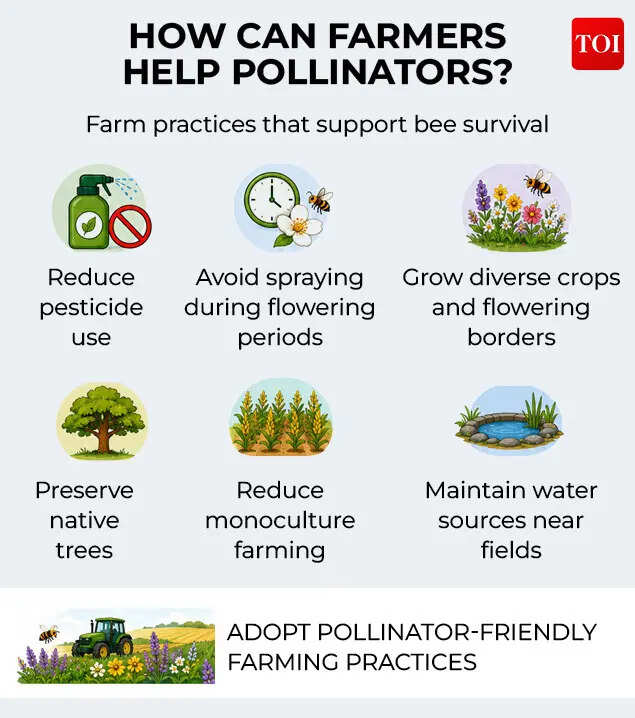
- Implement Integrated Pest Management (IPM): Transition away from chemical-heavy reliance, adopt biological pest controls, and reduce dependence on bee-toxic neonicotinoid variants, mirroring successful international stabilization frameworks.
- Establish dedicated floral corridors: Farmers must reject absolute monocultures by planting different, nutrition-diverse crops and maintaining wild floral boundaries to ensure bees have a continuous, year-round supply of forage between main harvests.
- Practice smart spraying timing: Training smallholders to avoid applying any necessary chemical treatments during peak daylight foraging hours will minimize active chemical contact with visiting colonies.
For urban citizens:
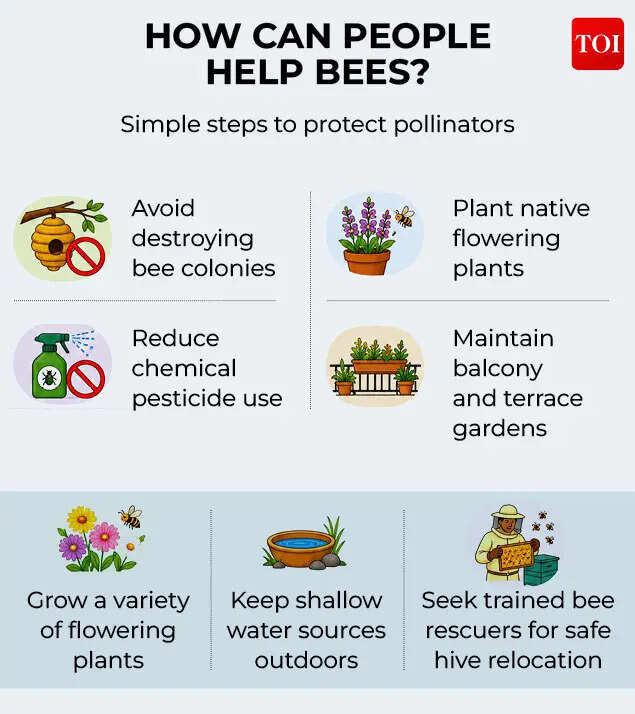
- Halt destructive eradication: Communities must completely ban the practice of using pest control chemicals or fire to remove urban bee colonies, opting instead to contact trained conservation groups to safely relocate hives discovered in residential zones.
- Manage sugary waste: Ordinary citizens can actively help by rinsing and crushing disposable sweet beverage cups before disposal, removing the “death trap” effect from roadside stalls.
- Cultivate native flora: Transform balconies, terraces, and community public parks into safe foraging havens by planting a diverse array of native flowering plants.
–
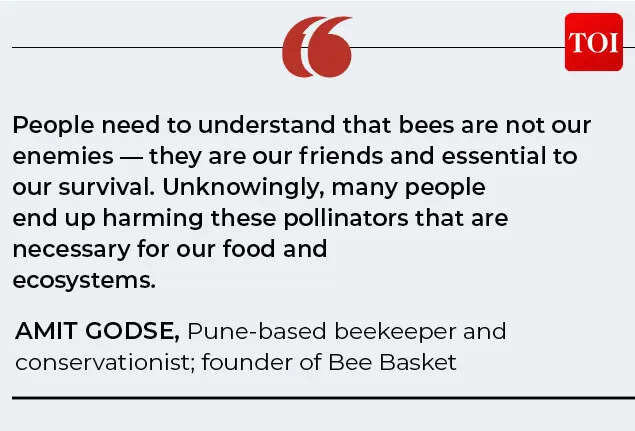
As World Bee Day draws global attention to the plight of pollinators, the message from India’s scientific and conservation communities is clear, simple, and incredibly urgent.As Amit Godse succinctly puts it, “Bees are our friends, not enemies.”
–
Bees are not aggressive pests or “enemies” to be feared, nor are they simply insects that produce honey. These hard-working architects are key pollinators that support food production, agricultural productivity, and ecosystem stability. Their survival is essential for global food security and food chain dynamics, as well as for maintaining crop yields, biodiversity, and overall ecological balance. Greater public awareness and reduced human-induced threats are crucial to their conservation.



