


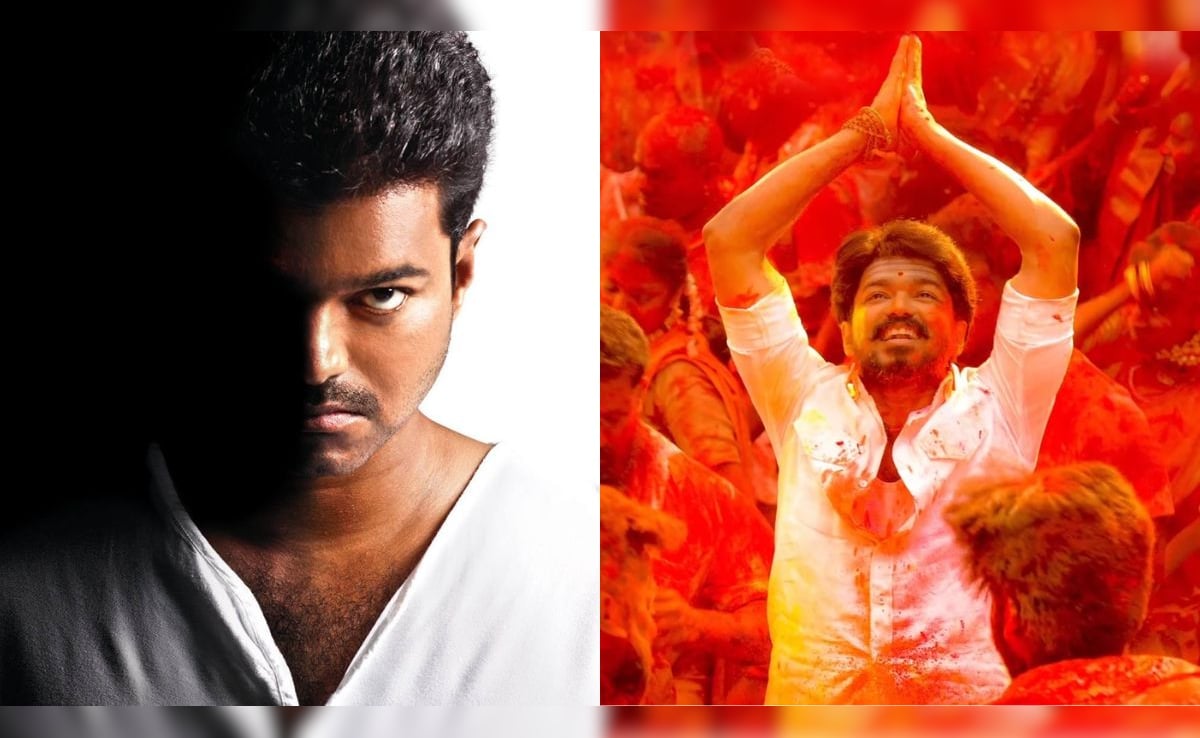
Long before actor Thalapathy Vijay formally entered politics with the launch of the Tamilaga Vettri Kazhagam (TVK) in 2024, his cinema had already been laying the groundwork. Over two decades, Vijay’s films steadily evolved from romantic entertainers to social and political dramas that tackled corruption, governance, public welfare, and citizens’ rights. For many, his political foray was not a sudden shift but the logical extension of ideas he had repeatedly dramatised on screen.
According to reports, Vijay’s swan song, Jana Nayagan, is said to be a Tamil remake of the 2023 Telugu film Bhagavanth Kesari. The film stars Thalapathy Vijay and is directed by H Vinoth. It reportedly centres on strong political messaging, positioning it as a politically driven project rather than a conventional commercial release
His filmography is not primarily political, but from the 2010s onwards, several of his films began carrying clear political or socio-political messaging, often around corruption, governance, corporate exploitation, and citizen rights.
Thamizhan – 2002
One of the earliest indicators of Vijay’s political inclination was Thamizhan, where he portrayed a young lawyer fighting systemic corruption within the judiciary and bureaucracy. Though not overtly partisan, the film focused on citizen responsibility, legal awareness, and moral governance. Released in the early 2000s, it positioned Vijay as an idealistic reformist, an image that would return frequently in his later work.
Thuppakki – 2012
Directed by A R Murugadoss, this film focuses on a military officer uncovering terrorist sleeper cells in India. While not electoral politics, it carries a strong nationalist and anti-terror narrative, shedding light on concerns about internal security. It subtly positions the hero as someone correcting systemic lapses.
Thalaivaa – 2013
With Thalaivaa, Vijay stepped into a narrative centred on leadership and public responsibility. The film followed an ordinary man forced into a position of power, echoing classic Tamil cinema’s fascination with reluctant leaders. Its tagline, “Time to Lead,” triggered political controversy and delayed its release in Tamil Nadu, underlining how sensitive its themes were perceived to be at the time.
Kaththi – 2014
Perhaps the most widely cited example of Vijay’s political cinema is Kaththi. Directed by A R Murugadoss, the film addressed farmer suicides, land acquisition, corporate exploitation, and water rights. Vijay’s character delivers lengthy speeches on agrarian distress and corporate accountability, which resonated strongly with audiences and activist groups. The film’s impact was such that it is often referenced in discussions on cinema-inspired political awareness in Tamil Nadu.
Mersal – 2017
In Mersal, Vijay’s politics became even more explicit. The film criticised medical corruption and inequality in healthcare and included controversial dialogue referencing GST and public policy, which sparked political controversy. The controversy cemented Vijay’s image as a star unafraid to question authority. This film significantly blurred the line between cinema and real political debate.
Sarkar – 2018
If one film came closest to predicting Vijay’s real-life trajectory, it was Sarkar (2018). The story follows an NRI businessman who returns to India to vote, discovers electoral fraud, and eventually contests elections himself. The film focused on voter rights, electoral corruption, and political mobilisation, striking a chord with young audiences. Years later, as Vijay’s party surged in the Tamil Nadu elections, parallels between Sarkar and reality became a recurring media talking point.
Bigil – 2019
Bigil focuses on women’s football and the societal barriers faced by female athletes. While not traditional politics, it addresses gender inequality and empowerment. Though less directly political, this film reinforced Vijay’s consistent focus on institutional reform and social responsibility.
Master – 2021
Master highlighted the failures of the juvenile justice system and the need for rehabilitation over punishment. It explores how young offenders are manipulated by powerful criminals and critiques systemic failure within reform institutions.
Leo – 2023
Leo is less overtly political but still engages with law enforcement and systemic crime structures. It forms part of a broader trend of Vijay playing morally complex, system-challenging characters.
Evolution Of Vijay’s Political Messaging
Early career – Mostly romance and family films
Post-2010 – Rise of socially conscious action films
Late 2010s – Clear political commentary (Mersal, Sarkar, Kaththi)
Studies of his filmography show that explicitly political films form a smaller portion of his overall work, but they became crucial in shaping his “leader” image over time. Vijay’s films are rarely pure political cinema, but many are commercial entertainers layered with strong socio-political messaging.
Over time, these roles have positioned him as a protector of the common man, built a mass-leader image, and helped bridge his transition from actor to real-life politician.



