


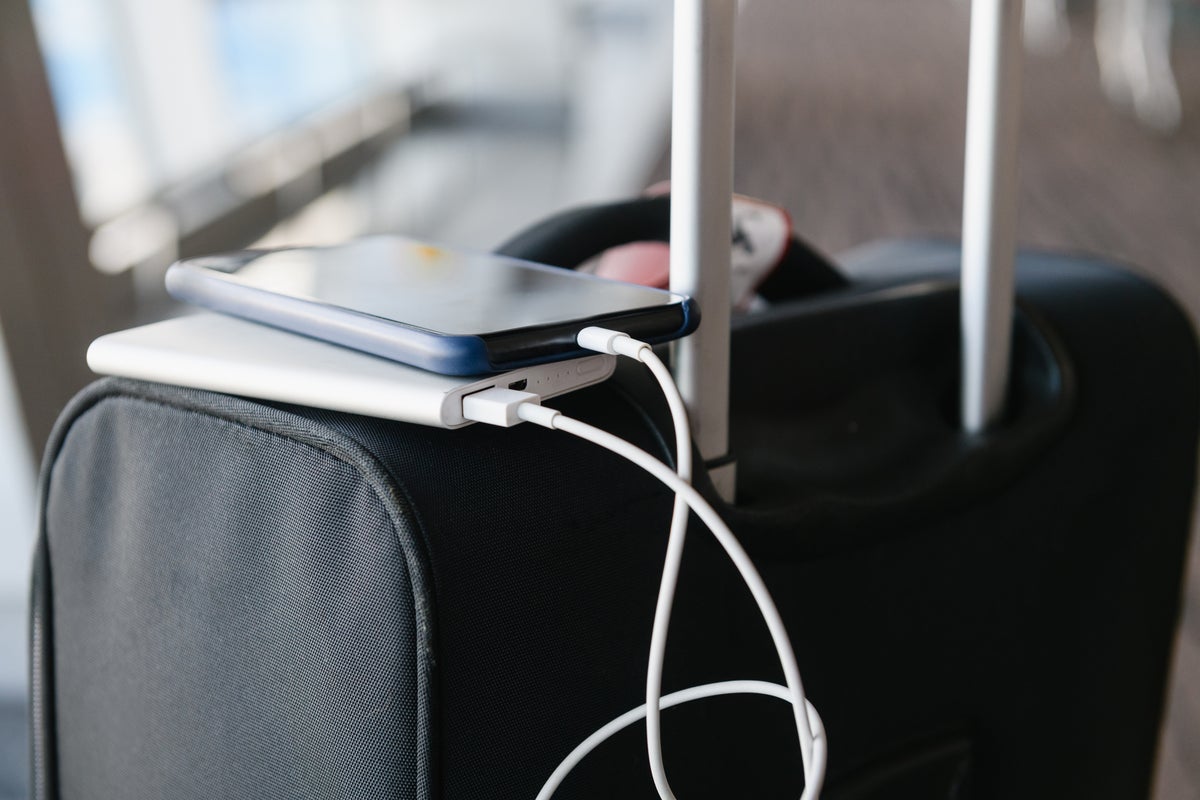
With travel documents becoming increasingly digitised, knowing your phone has the charge to carry you from check-in through to customs is key for travellers.
Although portable chargers may be vital to ensure a smooth journey, lithium-ion batteries commonly found inside power banks pose a fire risk to aircraft and confined cabin spaces if damaged.
On 19 May, an easyJet flight from Hurghada in Egypt to Luton diverted to Rome when a passenger revealed they had a power bank in their baggage in the hold – and that it was charging a mobile phone. “The captain then took the decision to divert as a precaution in line with safety regulations,” an airline spokesperson said. Because of restrictions on crew hours, the plane was delayed overnight in Italy.
Earlier, on 27 March, the UK Civil Aviation Authority (CAA) issued updated restrictions based on International Civil Aviation Organization (ICAO) instructions – limiting the number of power banks to two per person,. and insisting they must be carried in carry‑on baggage.
Several carriers have already introduced a ban on chargers in overhead storage, to allow crew members to respond faster to lithium batteries overheating or catching fire.
As airlines move to contain fire risks in the cabin, we address the question: can you fly with a portable charger? And what are the rules?
Read more: Southwest makes another policy change for passengers
Can I take my portable charger on a flight?
Yes. Portable chargers and power banks are usually allowed on flights, but there are restrictions on where they can be packed.
Most airlines allow portable chargers packed in your carry-on luggage, but not in checked luggage or any bags that will go in the hold.
Generally, power banks with a capacity of 100Wh or less are permitted in the cabin without requiring airline approval. But the power banks must not be connected to a power supply or a device.
Some airliines also insist must also be stowed “on a passenger’s person”, in the seat pocket or in under-seat carry-on baggage.
What do the UK authorities say?
The UK Civil Aviation Authority (CAA) says portable chargers:
- “Must not be recharged on board the aircraft.
- “Should not be used to charge other portable electronic devices on board the aircraft.”
It adds: “No more than two individually protected spare batteries per person may be carried.”
Each lithium-ion cell or battery must also be “individually protected so as to prevent short circuits”.
Any spare batteries are not permitted to fly in checked baggage, warns the CAA.
Glenn Bradley, head of flight operations at the CAA, said: “Lithium batteries power everything from vapes and mobile phones to cameras and power banks. If they become faulty or damaged, they can cause an intense fire that is difficult to extinguish, both in the cabin or the hold of an aircraft.
“Correct handling reduces risk. Lithium batteries should be carried in your carry-on baggage. Power banks and spare batteries should also be in a cabin bag and should be completely turned off and not in standby mode.”
Foreign Office (FCDO) travel advice recommends checking “the restrictions on certain types of batteries with your airline if you’re not sure what you can carry”.
What are the portable charger rules in other countries?
Alongside airlines in Australia and Switzerland, carriers in the US, China, Taiwan, Thailand, South Korea and Singapore have also implemented new power bank regulations following safety concerns.
Japan is currently considering a blanket ban on the use of power banks on board domestic flights from April, following fire safety concerns in the cabin.
Travellers in Japan are limited to a maximum of two portable chargers per person, not exceeding 160Wh, in carry-on luggage.
From 1 October, passengers on flights with Emirates were banned from using phone power banks due to concerns over fires, explosions and toxic gases.
Rules state that passengers are allowed to carry one power bank onboard, as long as it has capacity rating information available and is only stored in the seat pocket or a bag under the seat in front, not in the overhead storage.
As of December, Virgin Australia, Qantas and Jetstar are also no longer allowed to use power banks on board due to the safety risks of “damaged or defective lithium battery-powered devices”.
The charging of power banks onboard, including the use of in-seat power ports, is also prohibited.
On 7 April, the Hong Kong Civil Aviation Department banned passengers from using power banks on flights after a fire on a Hong Kong Airlines flight from Hangzhou in China on 20 March.
Passengers can still take power banks in carry-on luggage, but they must keep the devices under seats or in seat pockets and not in overhead compartments.
Taiwan’s EVA Airways similarly bans the use and charging of power banks and spare lithium batteries on flights. Passengers can carry them in their hand luggage if they are “properly stored to prevent compression or damage”.
In March, Singapore Airlines shared a post on X stating: “Effective 1st April 2025, Singapore Airlines customers will not be allowed to charge portable power banks via the onboard USB ports, or use power banks to charge their personal devices, throughout the duration of the flight.”
From 1 March, South Korea similarly implemented stricter rules on carrying portable batteries on flights following a fire on an Air Busan plane on 28 January 2025.
The revised rules state that a passenger can carry a maximum of five portable batteries, each with a capacity of up to 100 watt-hours. Batteries exceeding 160 watt-hours in capacity are strictly prohibited.
Read more: Why Asian airlines are tightening rules on using power banks on flights



