


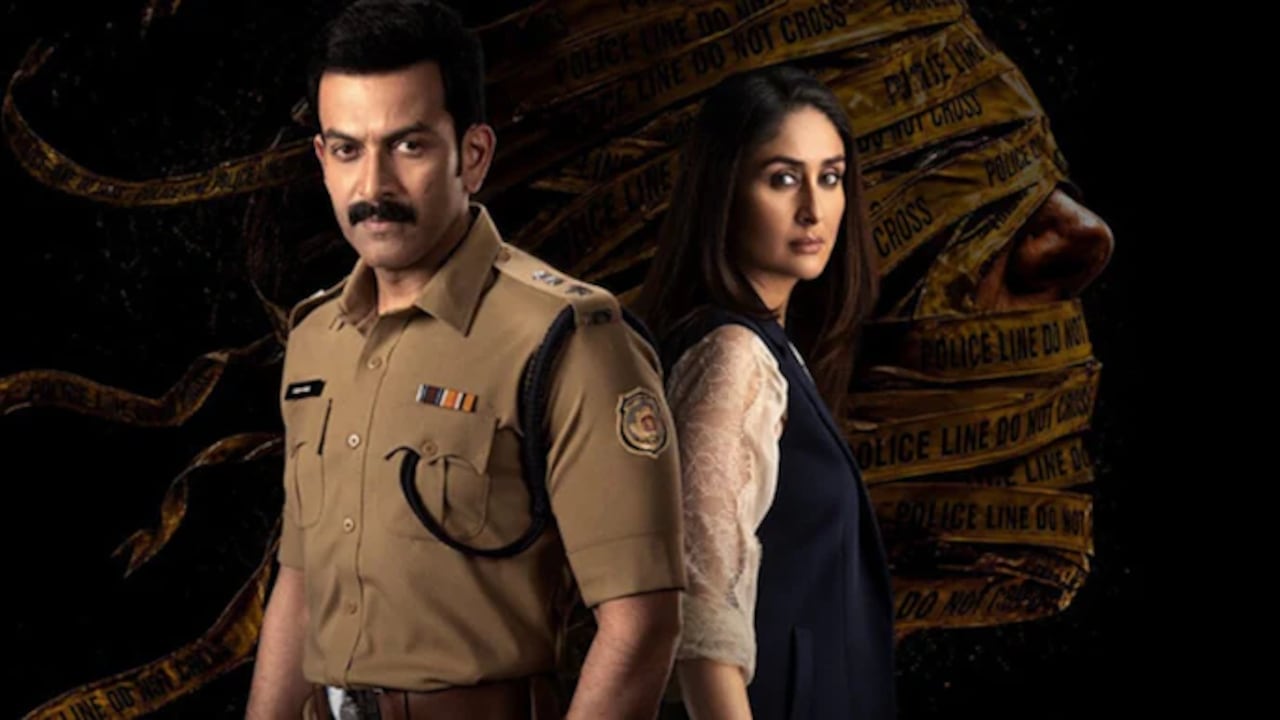
A police drama that upends generic conventions, Daayra spins around a core composed of the tropes of a thriller blended with the dynamics of a procedural focussed squarely on the essentials.
Director Meghna Gulzar, returning to the domain of crime, inquisition and punishment that Talvar explored, adopts an aptly workaday storytelling style enlivened by dazzling editing.
Crime-busters in Mumbai movies are usually men (and sometimes women) who are fast-talking, quick-on-the-draw individuals. The two Daayra cops are a world apart.
They are as committed to the uniform as any law enforcer one has seen in Hindi cinema. One believes in instant results, the other is slow and steady. The contrast underpins the debate at the heart of the tale.
Neither DCP Ajooni Kohli (Kareena Kapoor Khan) nor DCP Raman Kumar (Prithviraj Sukumaran) is given to gratuitous heroics or blustery bravado.
To that extent, the dissimilar duo shares some traits with the policemen that Govind Nihalini created in Droh Kaal (1994) and Dev (2004), men who sought to strike a balance between thought and action, between certitudes and confusions.
Raman tends to be on a short fuse. Although mindful of the pitfalls, he crosses the line when he is pushed to the wall. That indiscretion and his attempts to pass it off as a routine act of self-defence constitute the crux of the story.
That is where the other DCP comes in, articulating a worldview that is far removed from Raman’s.
The two lead actors bear the weight of the film with admirable ease. With both in fine fettle, Daayra sustains its intensity and momentum as it ploughs back and forth between several lines of action: a gangrape, the police response to it and the subsequent internal inquiry into an encountered alleged to be fake.
Two behind-the-camera stars shine just as bright. Without what the director, who is also co-editor and co-writer, and lead editor Charu Shree Roy (Killa, Chhichhore, Sitaare Zameen Par) bring to the table, Daayra wouldn’t be the film it is.
Together, they shape its captivating narrative rhythm. While they ensure that pace never flags, Kareena and Prithviraj, rooted in the film’s relatable ambience, convey the inherent ambiguities and imponderables of a cop’s life and work.
Daayra, produced by Junglee Pictures and Pen Studios, plays out like a dual police procedural in which vagueness of purpose goes up against certainty of approach.
The craft at its core, buttressed by cinematographer Saurabh Goswami’s evocative lighting and nifty camera angles, captures in all its complexity the dichotomy of police ethics and excess amid the media clamour for instant justice.
The conflicting perspectives, created with the aid of frenetic parallel cutting all through the film, define the film’s primary purpose – separating truth hiding in plain sight from face-saving falsehood out to evade scrutiny.
The screenplay by Sima Agarwal, Yash Keswani (the writers of Netflix’s Accused) and Meghna Gulzar dives into the urgent duel between whatn is apparent and what is not and emerges from the depths with statements from both sides of the divide.
The constant cross-cutting between separate but related events not only underlines the similarities between them – one heinous crime mirrors another – but also vitalises the film.
Daayra, “a work of fiction based on a narrative of events available to the public at large”, is set in an indeterminate city where the law of the land is prone to wildly contradictory interpretations.
It revolves around two violent acts – one by a quartet of social malcontents, the other by a team of policemen charged with the task of bringing the criminals to book – and, equally, around a pair of separate investigations.
Three post-interval chase sequences, heightened by hyperactive camerawork, are mounted in quick succession in a manner that sets the film apart from routine police thrillers.
In the first, a policewoman overpowers a young man after being punched in the face in the first sequence. The next has a senior cop (Jitendra Joshi, who stands out in many scenes) grapples with slowing reflexes and is reduced to huffing and puffing. In the third, DCP Raman Kumar nabs his man undemonstratively.
It’s all in a day’s work for this bunch of lawmen. They aren’t in the game for brownie points. Raman, when questioned at a press conference, asserts that “the law has done its duty”.
But that isn’t how Ajooni Kohli sees it. She the only daughter of an upright judge (Kanwaljit Singh in a special appearance). She has reason to be sceptical in the light of personal experiences but still believes that the law should take its own course.
Raman Kumar, who has the tacit support of the police commissioner, lacks the patience to let weeks turn to months and months to years in the pursuit of justice.
The events involving the two cops take place across three distinct times separated by only a few days in a microcosmic setting where dispensation of justice is influenced by those who wear the uniform and those that wield the power to deliver or deny justice.
As the first two events play out and the follow-up unfolds, the film seeks to put in perspective the vulnerability of women in public spaces and the apathy of law enforcement agencies with direct allusions to the Delhi Nirbhaya gangrape case.
With the action in Daayra set in 2019, the film also recalls the horror of the Hyderabad sexual assault and murder case of that year (as also its aftermath) without expressly mentioning it.
A 24-year-old girl, a law firm intern, returning from work is raped and strangled to death. The investigation is led by DCP Raman Kumar, who is determined not to let the culprits take advantage of legal loopholes.
Against the backdrop of widespread public euphoria and a bunch of PILs filed by human rights activists, DCP Ajooni Kohli launches an investigation.
It is her investigation that the film opens with before it begins to glide in and out of prior situations that aren’t chronologically or linearly arranged.
Each sleight within the film’s narrative frame tightens the screws in the battle between the rule of law and the propensity for instant tit-for-tat justice. What plays out psychologically and subliminally is no less important than what transpires on the physical plane.
Daayra sees Meghna Gulzar, her editor and the two lead actors at the top of their games. There is a great deal to savour and absorb here. That is much more than one usually says about Bollywood police dramas.


